

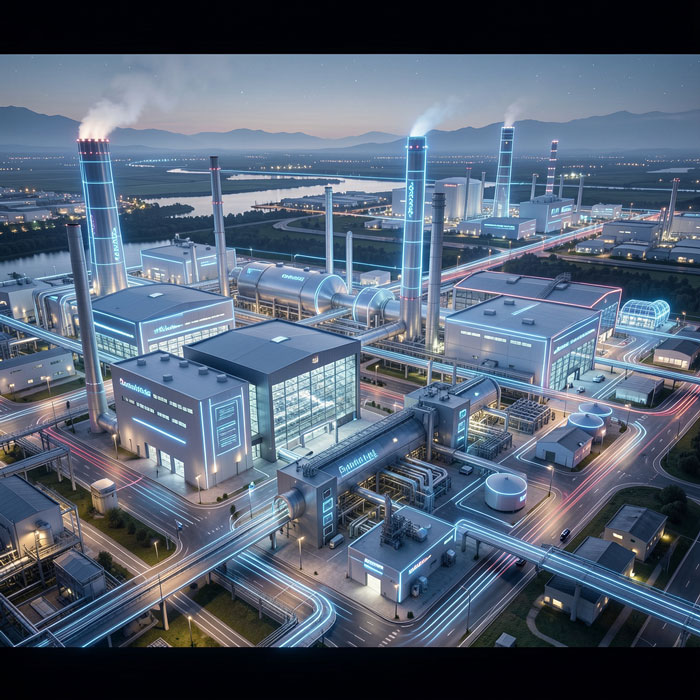
Factories of the Future
Smart manufacturing will evolve toward fully connected ecosystems supported by digital twins, robotics, blockchain-enabled transparency, and AI-driven design optimization, says Kapil Pathare.
The Indian textile industry stands at a pivotal point in its evolution. Traditionally known for its scale, craftsmanship, and labour strength, the sector is now transitioning towards smarter, technology-enabled manufacturing models. This shift is not merely about automation — it is about building agile, efficient, and sustainable ecosystems that can compete globally while responding to rapidly changing consumer expectations.
Increasingly, industry leaders are realising that true growth does not begin with expansion into new markets or product categories; it begins on the factory floor. Sustainable competitiveness comes from strengthening core manufacturing capabilities before scaling outward.
Smart manufacturing integrates digital technologies such as automation, data analytics, IoT, and artificial intelligence into production processes. For apparel manufacturers like us, this transformation is especially relevant as we operate in a highly competitive innerwear and athleisure market where speed, consistency, and quality are critical.
Technological trends
Automation and advanced machinery have significantly improved production consistency and reduced dependency on manual interventions. Modern knitting, dyeing, and garmenting machines offer precision control, minimising defects and improving throughput. Automated cutting and stitching solutions help maintain uniformity while optimising fabric utilisation.
IoT-enabled manufacturing systems now allow real-time monitoring of machine performance, energy consumption, and production efficiency. This visibility helps anticipate maintenance needs, reduce downtime, and optimise workflows. AI-driven analytics further supports demand forecasting, inventory optimisation, and faster defect detection.
Another critical dimension is sustainability. Water-efficient dyeing processes, energy-efficient machinery, and waste-reduction systems are becoming essential as environmental responsibility becomes central to brand positioning.
However, technology alone does not guarantee manufacturing excellence. Machines deliver speed, but disciplined processes deliver consistency. Competitive advantage emerges when technology strengthens production fundamentals rather than replacing them.
Manufacturing as brand identity
In categories such as innerwear and athleisure, manufacturing quality directly reflects brand trust. Consumers may connect with marketing or design initially, but loyalty is built through consistent comfort, fit, and durability.
A single inconsistency in sizing or fabric performance is rarely seen as a factory error — it is perceived as a brand failure. This perspective fundamentally changes how promoters view manufacturing. It is no longer a support function; it becomes the very identity of the brand.
Impact on productivity, efficiency, and workforce
Smart manufacturing delivers measurable productivity gains by reducing production cycle times and ensuring consistent quality output. Predictive maintenance reduces breakdowns, digital production planning improves supply chain responsiveness, and resource optimisation strengthens sustainability outcomes.
Workforce transformation is equally significant. Rather than replacing human talent, smart manufacturing reshapes skill requirements. Technicians increasingly operate advanced machinery, interpret data, and manage automated systems.
India’s textile workforce carries deep generational knowledge. Investing in training, safety, and skill development ensures that manufacturing transformation remains sustainable while preserving craftsmanship and operational stability.
Scaling manufacturing as a leadership responsibility
India’s textile sector is witnessing strong capacity expansion, but scaling manufacturing requires deeper discipline than simply adding machines. Scalability means building systems capable of replicating quality regardless of production volume or geography.
Infrastructure expansion, automation, and modern machinery must be viewed as long-term capability investments rather than short-term ROI decisions. Larger production should strengthen reliability, not dilute product experience.
Challenges and opportunities in adoption
Despite clear benefits, adoption of smart manufacturing in India faces structural challenges. Capital investment cycles remain demanding, skill gaps persist, and integrating new technologies with legacy infrastructure requires careful planning.
Maintaining uniform production standards across multiple locations, managing supply chain volatility, and building governance frameworks require strong promoter leadership. Encouragingly, this shift is moving the industry from volume-driven manufacturing toward reliability-driven manufacturing.
India’s global opportunity lies in reliability
India possesses scale, a skilled workforce, raw material access, and entrepreneurial drive. The next differentiator will be manufacturing reliability.
Global markets increasingly value partners who deliver consistent quality, predictable timelines, and scalable production systems. Manufacturing discipline will define the future positioning of India within global textile supply chains.
The future outlook
Smart manufacturing will evolve toward fully connected ecosystems supported by digital twins, robotics, blockchain-enabled transparency, and AI-driven design optimisation. Sustainability will continue to gain prominence, with circular manufacturing practices becoming increasingly mainstream.
For Indian textile manufacturers, success will depend on balancing efficiency with responsibility — producing high-quality garments while minimising environmental impact and maintaining ethical production standards.
Building a legacy that lasts
At VIP Clothing Ltd., our long-term focus remains rooted in strengthening manufacturing fundamentals through scalable infrastructure, process standardisation, and workforce capability development. Manufacturing should never be treated as a cost centre; it is the foundation upon which brands and consumer relationships are built.
The way forward
The textile industry is undergoing one of its most significant transformations. While innovation and expansion will continue, enduring success will belong to companies that respect manufacturing fundamentals — consistency, discipline, and scalability as core business philosophies.
Markets evolve, technologies change, and consumer preferences shift. But factories built on strong foundations continue to create value across generations. Smart manufacturing succeeds when technology supports people, strengthens processes, and preserves the legacy of quality that defines Indian textiles.
About the author:
Kapil Pathare is the Deputy Managing Director of VIP Clothing Ltd., bringing over two decades of leadership experience in India’s apparel and textile sector. Having joined the Group at 21 and serving on the Board since 2002, he has played a pivotal role in strengthening manufacturing excellence, operational efficiency, and customer-focused growth. An MBA from Mumbai University and an accomplished author of three leadership books, he also serves on the boards of several diversified business enterprises.
