


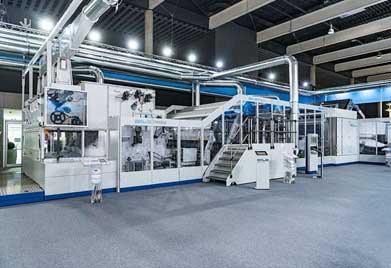
The company will be present in hall H12.0, booth No. H12B23.
India ITME 2022 is an important exhibition for the textile industry and thus offers a central forum for dialogue within the textile production sector with the relevant supply chain comprising textile machine building, fibre production, ancillaries and accessories.
For DiloGroup this event is a good opportunity to inform customers and interested parties about new developments aimed at improving production technologies with a focus on needlefelts.
It becomes more evident that the textile industry comes into the focus of regulatory authorities who push respecting sustainability principles and who initiate a new body of laws. Hence all industrial sectors are requested to achieve savings in material and energy. The textile machine building, of course, plays an important role by seizing this initiative and offering solutions for fibre pulp recycling and reduction of energy, water and ancillaries. DiloGroup has made big efforts to meet these challenges together with a circle of partner companies. In this regard focal points of the development work are:
- Intense Needling
Needling per se is a mechanical production method with a high energy efficiency. For this reason, the development efforts of DiloGroup aim at producing nonwovens by “intense needling†instead of water entangling, even for light nonwovens made of fine fibres for the medical and hygiene sector with an area weight of 30 – 100 g/m². This would result in a reduction of the environmentally relevant production costs; per annum to about 1/3 to 1/5 of current.
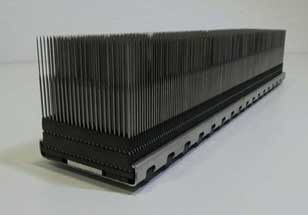
Despite the prospective advantages of the mechanical intense needling method over the hydrodynamical, water entanglement is at the moment the most important production method for low area weights and highest production capacity and is also offered by the DiloGroup as general contractor in cooperation with partner companies.
2.Fibre pulp recycling
Fibrous material in nonwovens and particularly used clothes can be successfully recycled, if staple length can be conserved in the tearing process. In the classical tearing process, staple lengths are dramatically reduced and therefore these fibres can only be used as base material for inferior uses in thermal or acoustic insulation or in protective textiles, transportation or protective covers etc.
When recycling textile waste in the context of the collection of used clothes, the so called “filament-saving†tearing using special tearing machines and methods must be used to produce fibres with longer staple lengths which can be fed to a nonwoven installation. Hence product characteristics can be better specified and controlled.
3.Additive nonwoven production
The additive production method of the “3D-Lofter†is especially suited for automotive parts with differently distributed masses; but there may also be potential for increasing uses in the sector of apparel and shoe production.
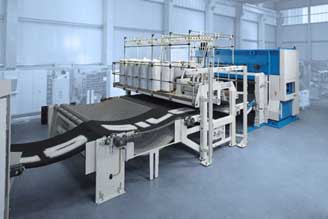
4.“IsoFeedâ€-card feeding
In the field of card feeding, the “IsoFeed†method offers great potential for a more homogeneous card feeding at the same time reducing the variation in cross-machine fibre mass distribution and thus the fibre consumption while conserving the end product quality.
DiloGroup would like to discuss the above mentioned developments of needling technology as well as modules of Industry 4.0 applications for further digitalisation during the Techtextil exhibition. The company will inform about the numerous universal and special applications of the complete nonwovens technology.