


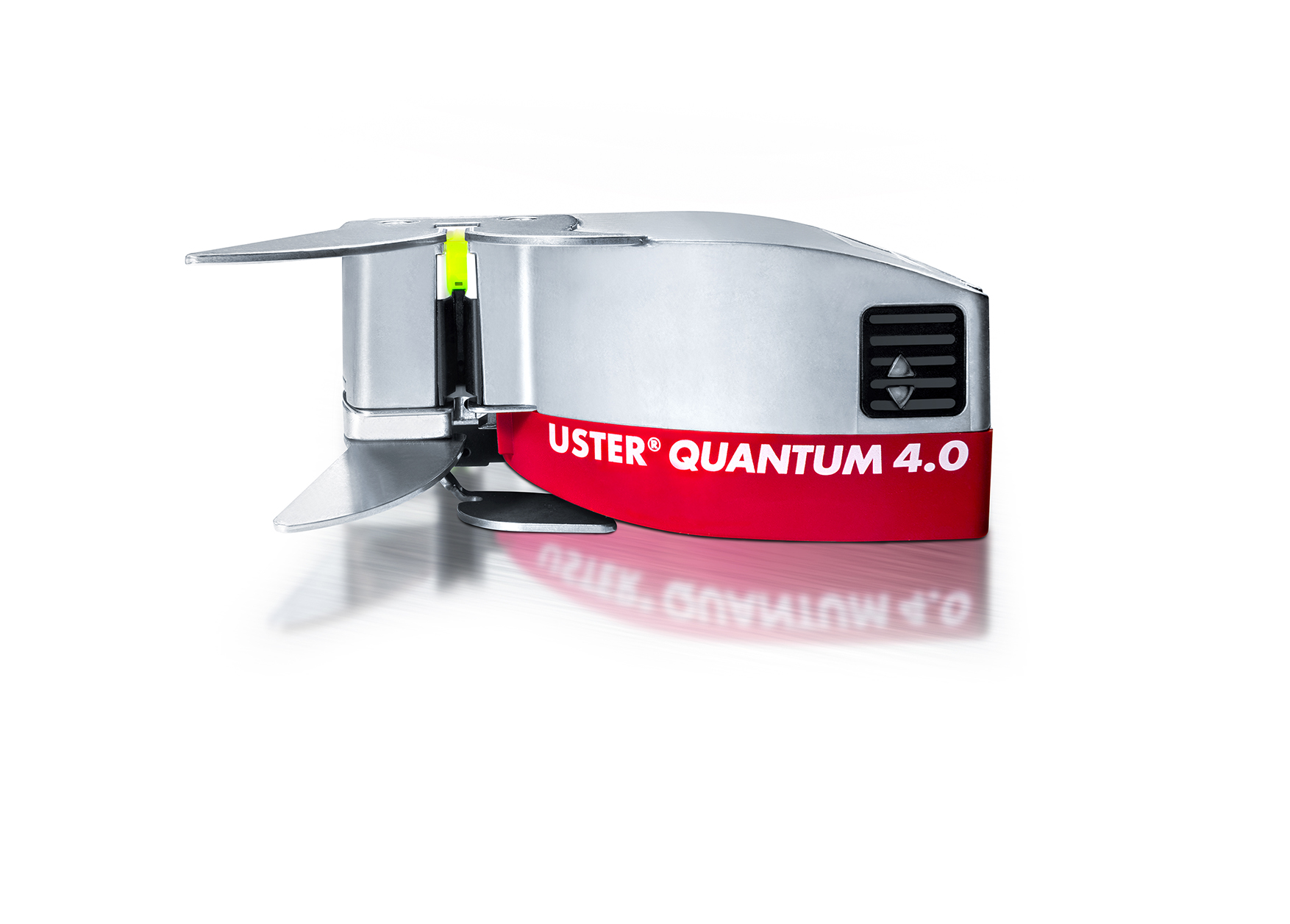
Smart Duo yarn clearing applies innovative technology for practical results.
Making a choice between the two main technologies for yarn clearing is now a thing of the past. That’s because Uster’s latest Quantum 4.0 clearers offer both capacitive and optical sensors in a concept called Smart Duo. This innovation recognises that each sensor option has its own special functionality – so using both together brings significant advantages in quality and profitability for spinners.
Cross clearing
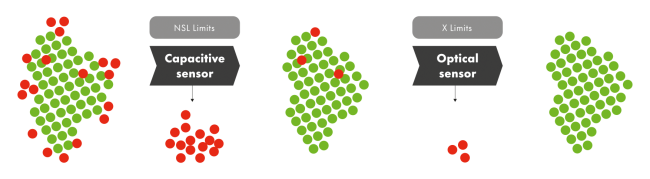
The Smart Duo approach uses ‘cross clearing’, in which both capacitive and optical sensors are applied. The capacitive signal reacts on very compact yarn faults. It offers guaranteed detection of dense thick places in the yarn, containing more fibres, as a significant mass increase. The optical sensor records a minor diameter increase in such cases. Instead it is better at detecting voluminous, visually large occurrences in the yarn, where the capacitive sensor would record only a minor increase in mass.
For maximum benefit in detecting compact and fluffy events, both signals are added in series. The cross-clearing function uses the backup of a second clearing limit after the basic clearing parameters. For example, a thick place which might not be identified as a fault under the capacitive clearing limits would be rechecked under the extra optical clearing settings. This allows the clearer to detect thick and fluffy events that are not detected by the capacitive sensor alone. Cross clearing events, designated X, are also useful to indicate spinning conditions for housekeeping and maintenance purposes, such as fiber accumulation on roving creels or in the drafting zone.
No compromises for better fabric quality
In a practical example, the benefit of cross clearing was proven by a spinner in India producing 100 per cent combed cotton yarn (Ne 30) for knitted fabrics. The goal was to improve fabric quality by reducing the remaining thick places, while maintaining the same level of clearer cuts. To ensure an independent assessment of the fabric samples, an Indian textile institute was engaged for the inspection and comparison.
For the tests, the cross clearing setting was kept at ‘medium’ and the NSL setting was opened slightly to compensate for the additional X-cuts. Finally, both articles were cleared with 92.6 cuts/100 km for the NSL T including the X-cuts and 92.5 cuts/100 km for the NSL T without cross clearing activated. The cross clearing function demonstrated improved fabric quality without the need for additional cuts. The Uster Smart Duo was able to ensure better quality without increased production costs.
Density detection
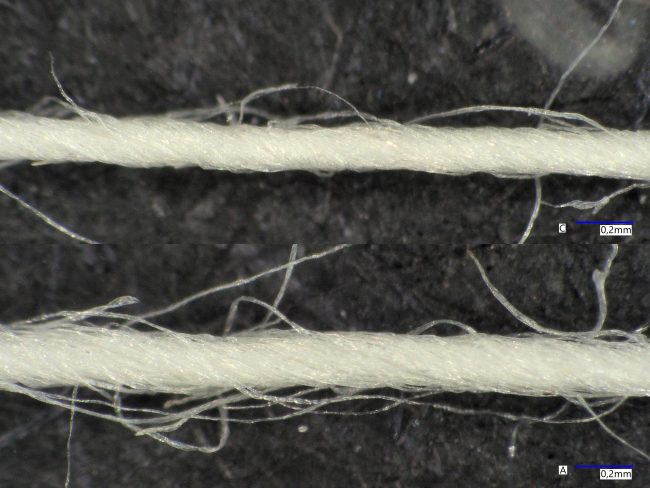
Density measurement is unique in the market, as a highlight feature introduced by the Smart Duo function of the Quantum 4.0 clearer. Density involves two separate measurements: the density channel (D) is active after the splice over a defined reference length; in addition to this temporary density measurement, a continuous density (CD) measurement takes place.
Different densities can be caused by different twist levels in the yarn. Other factors could be a mixture of compact and non-compact yarn or irregularities in compacting levels, while different yarn types and materials also have different densities. The density measurement function also prevents yarn issues caused by malfunctioning of the compacting device.
Saving a tonne of yarn
In another practical example, a customer in China discovered that one of its ring spinning machines was producing high twist yarn. Some high twist yarns were mixed with regular yarns on the winding machine, with the result that 1.21 tonne of yarn was contaminated and rendered unusable.
It is impossible to differentiate between yarns of different twist levels by eyesight at the ring frame stage. And until the launch of Uster Quantum 4.0 there was no way to separate yarn with different twists at the winding stage. Thanks to the density detection function, the spinner saved 1.08 tonne of yarn that would otherwise have been waste. By installing the new generation of Uster yarn clearers the mill was able to rewind the yarn to separate the high twist element.
Innovated for the major challenges
Quantum 4.0 is the efficient yarn quality assurance system with Smart Clearing Technology for both standard and special applications. The accepted standards of Yarn Body, Dense area and Smart limits are further enhanced by the new Smart Duo technology. Numerous easy-to-use functions cover basic clearing, Smart Duo clearing – including cross clearing and density detection – as well as contamination clearing and special applications. Uster’s latest yarn clearing innovations provide maximum flexibility, security and prevention for today’s market challenges in spinning mills.