Close Menu
Indian Textile Journal
  • Home
  • Textile Machinery
    • Allied Equipment and Accessories
    • Automation
    • Dyeing, Processing & Finishing
    • Knitting
    • Printing
    • Spinning
    • Weaving
  • Tech Textiles
  • Sustainability
  • Resources
    • Trade Fair
    • Events
    • Videos
  • Interview & Opinion
  • Subscribe Now
  • Advertise
  • Digital
  • Apparels & Garments
  • Fibres & Raw Materials
  • Home Textiles
  • Industry Update
Facebook X (Twitter) YouTube LinkedIn
Indian Textile Journal
Epson
  • Home
  • Textile Machinery
    • Allied Equipment and Accessories
    • Automation
    • Dyeing, Processing & Finishing
    • Knitting
    • Printing
    • Spinning
    • Weaving
  • Tech Textiles
  • Sustainability
  • Resources
    • Trade Fair
    • Events
    • Videos
  • Interview & Opinion
  • Subscribe Now
  • Advertise
  • Digital
  • Apparels & Garments
  • Fibres & Raw Materials
  • Home Textiles
  • Industry Update
Indian Textile Journal
Home » Bangladesh garment industry faces cotton shortage amid flood delays
Apparels & Garments

Bangladesh garment industry faces cotton shortage amid flood delays

By September 2, 20242 Mins Read
Share Facebook Twitter LinkedIn WhatsApp Copy Link

Last year, Bangladesh was ranked as the third-largest clothing exporter in the world, following China and the European Union, exporting $38.4 billion worth of clothes in 2023.

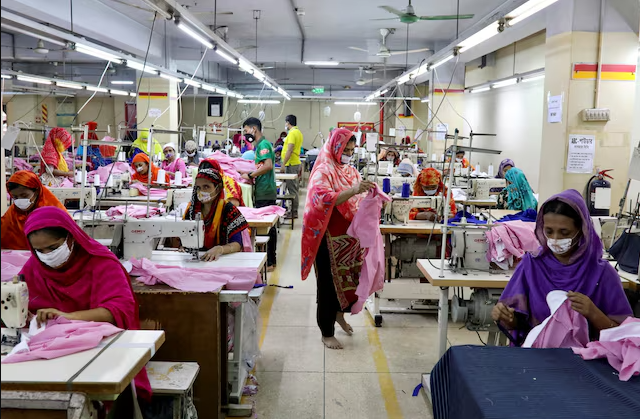
Garment factories in Bangladesh, one of the world’s largest clothing production centres, are facing challenges in completing orders on time due to flooding that has disrupted their cotton supplies, further worsening a backlog already impacted by recent political turmoil.

As a major global cotton importer, Bangladesh relies heavily on cotton for its large textile and garment industry. However, severe flooding has significantly hindered the transportation of cotton to factories from Chittagong port over the past week, according to industry officials and analysts. This disruption, combined with the recent unrest and protests that resulted in factory closures earlier in the month, has led to a 50 per cent decline in garment production, according to Mohammad Hatem, president of the Bangladesh Knitwear Manufacturers and Exporters Association. He mentioned that the industry is under considerable pressure to meet deadlines and cautioned that without a quick resolution, the supply chain could deteriorate further.

Last year, Bangladesh was ranked as the third-largest clothing exporter in the world, following China and the European Union, exporting $38.4 billion worth of clothes in 2023, according to the World Trade Organisation. Rubana Huq, who runs a clothing factory in Dhaka, is assessing the impact of lost production. She noted that for a medium-sized company like hers, which produces 50,000 shirts daily at a price of $5 each, the production loss amounted to $250,000. Huq, a former president of the Bangladesh Garment Manufacturers and Exporters Association (BGMEA), mentioned that while some garment plants are slowly resuming production, she estimated that full recovery would take at least six months. She also warned that Bangladeshi manufacturers could potentially lose 10-15 per cent of their business to competitors in other countries.

The ready-made garments industry in Bangladesh, which supplies many of the world’s leading fashion brands, contributes more than 80 per cent of the country’s total export earnings.

News source: Reuters

Previous ArticleNew QCO regulations for textile hygiene standards start October 1
Next Article CITI’s MDP-ESG Paves the Path to a Greener Textile Future

Related Posts

CMAI highlights India’s apparel mastery and global ambitions at Bharat Tex 2026

July 23, 2026

CMAI’s 83rd National Garment Fair opens in Mumbai, uniting 25,000 retailers

July 13, 2026

Dollar Protect’s Rainguard collection blends monsoon protection with style

July 13, 2026
Recent Posts
  • Mihir V Shah: Sustainability is no longer optional it is a business imperative
  • Velislava Niederkofler: Manufacturers are increasingly looking for solutions that provide greater flexibility
  • Hans Wroblowski: Monforts helps customers produce better fabrics more efficiently
  • Sanjay Chawla: We support virtually every machine model used in textile production
  • Dr Bettina Temath: Trützschler Group combine the proven quality and technology standards of German engineering
  • Woolmark highlights Australian-Indian textile ties at Bharat Tex 2026
  • Mark Smith: In India, we currently see particularly strong demand in technical textiles
  • Rieter’s COMPACT4 – A New Universal Solution for Compact Spinning
Facebook X (Twitter) YouTube LinkedIn
  • About us
  • Contact us
  • Privacy Policy
  • Terms and Conditions

SISTER PUBLICATIONS

Construction World Equipment India Industrial Product Finder Infrastructure Today

© 2026 Indian Textile Journal. All Rights Reserved.

Type above and press Enter to search. Press Esc to cancel.