


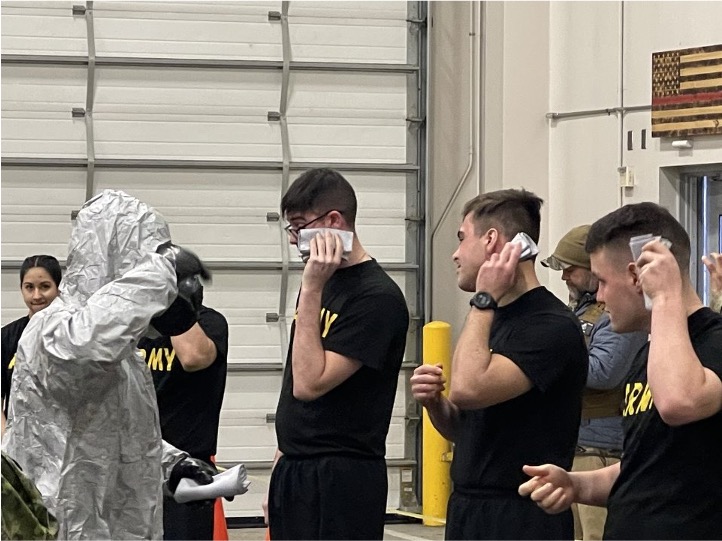
FiberTect wipe and HEPA vacuum performed much better than wet decontamination, explains Dr Seshadri Ramkumar.
Dry nonwoven wipe saves lives in subzero temperatures.
Fairbanks in Alaska reaches -17 oF in January necessitating the need for non-liquid-based decontamination products to save lives.
On November 18, 2026, about 175 people who serve as emergency responders, hazmat and first responders came online in an event organized by Fredericksburg, VA-based First Line Technology [FLT] to know about the advantages of “Dry Decontamination,” process.
In an effort funded by the United States’ Biomedical Advanced Research and Development Authority, protocol for chemical management, “Primary Response Incident Scene Management [PRISM] Guidance for Chemical Incident,” has evolved. PRISM report recommends dry decontamination as a default procedure during the initial stages of decontamination.
“Winter doesn’t stop hazmat emergency call, it changes them,” stated Corey Collings, Director of RDT&E at First Line Technology. While one cannot change the weather, countermeasure techniques and products that function efficiently in subzero temperatures are needed. Due to low vapor pressure, toxins take time to evaporate, stay on the skin for longer duration, and freeze and hence requiring dry products.
First Line Technology has taken the patented FiberTect nonwoven wipe to develop “Dry Decontamination,” process that can be used in temperatures as low as -25 oF to save lives of first responders. Dry decontamination is now the default process during first 5 minutes of decontamination which is crucial to save lives and prevent people from hypothermia in cold climate. FiberTect is domestically manufactured by Hobbs Bonded Fibers and is exclusively licensed to First Line Technology for defense applications.
FiberTect has been found to be effective in laboratory testing at temperatures as low as 5 oF by United States Amry’s Cold Regions Research and Engineering Laboratory. In addition to volatile chemicals, FiberTect wipe can also remove fine particles like Fentanyl. The study found that the removal efficiency ranged between 78% and 95%. The colder was the temperature, the better was FiberTect’s removal efficiency. FiberTect wipe and HEPA vacuum performed much better than wet decontamination.
FLT is proposing dry decontamination protocol that involves: 1) Blotting and 2) Wiping using dry wipe. The effectiveness of the process was proven during Arctic Eagle/Arctic Patriot 22 exercise hosted by Alaska National Guard. Corey Collings also provided the feedback from end users such as uniformed service personnel that dry process takes less duration for training and can be used at all temperatures.
Dry decontamination involving proven FiberTect wipe has become a default cold weather decon process. First Line Technology is recommending having dry wipes as necessary decontamination supplies on first due rigs and first response fire trucks.
Nonwoven wipe has become a lifesaving default wipe technology.
About the author:
Dr Seshadri Ramkumar is a Professor, Nonwovens & Advanced Materials Laboratory in Texas Tech University, Lubbock, TX, USA.