


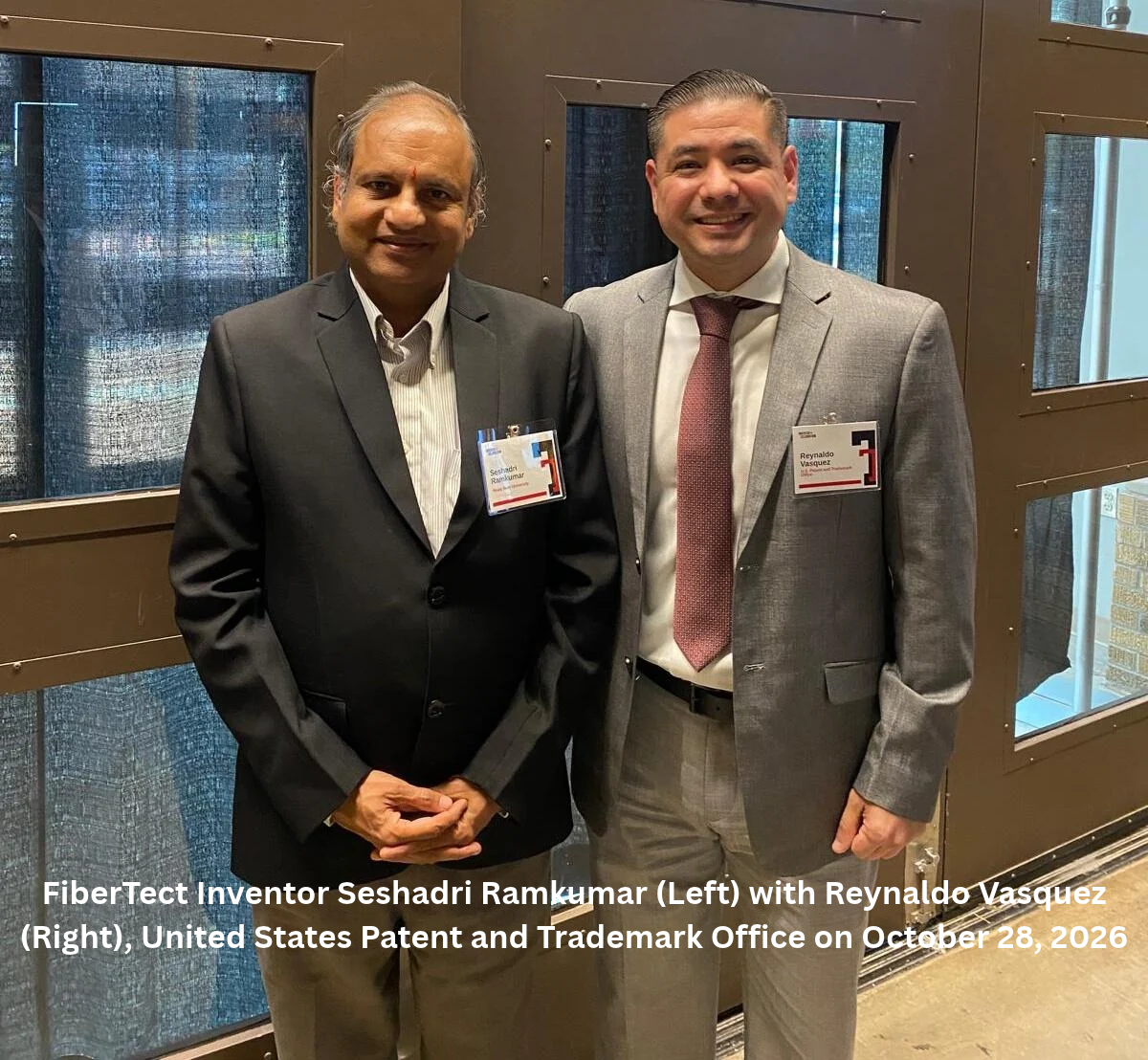
University support for research commercialisation is valuable as it brings resources for researchers and builds industrial partnerships says Dr Seshadri Ramkumar.
Nonwoven wipe, “FiberTect,” becomes a valuable tool to save lives and enhance defense capabilities.
On October 28, 2026, Lubbock-based Texas Tech University System [TTUS] inducted inventors whose work have made an impact into its inaugural “Inventor Hall of Fame.”
Among the recognised inventors, there are researchers who hold memberships in prestigious academies such as the National Academy of Engineering, and the National Academy of Inventors.
Increasingly, university research enterprises are recognising the need for translational research, and start-ups as they create jobs and grow the economy.
Highlight of the event was the keynote by Reynaldo Vasquez, Reginal Outreach Officer, Southwest Regional Office of the United States Patent and Trademark Office [USPTO] which emphasised the importance of turning hard problems into solutions. Vasquez highlighted how universities matter to innovation stating,” in universities, basic research collides head-on with applied problem solving, and labs feed into industry relationships.”
While telling story about Texas Tech’s research commercialisation, Vasquez singled out the success of FiberTect nonwoven wipe that evolved out of Nonwovens & Advanced Materials Laboratory mentioning it as an engineered fabric that finds applications in protection and environmental technologies.
FiberTect wipes are manufactured by Waco-based Hobbs Bonded Fibers and are exclusively marketed by Fredericksburg, VA-based First Line Technology for emergency response and decontamination applications. “FiberTect research drives home a key truth, breakthroughs rarely happen in isolation,” stated Reynaldo Vasquez.
FiberTect is a vital component in dry and hybrid decontamination processes, which are lifesaving protocols championed by First Line Technology. Dry decontamination using nonwoven absorbent-adsorbent wipe is the first line of decontamination which is crucial to saving lives of soldiers, emergency personnel and public. Due to the nature of the wipe, FiberTect can be used in regions which are normally in sub-zero temperature like Alaska. Recently, these wipes were found to trap and clean fine particles such as Fentanyl indicating its broad-based applications.
According to statistics provided by Reynaldo Vasquez, between 2001 and 2025, academic technology transfer introduced 17,252 products into the market. FiberTect was launched in 2005, and it is one of the products that became a success during these years [NBC News, April 2005, https://www.nbcnews.com/id/wbna7391954].
Vasquez made a point which is valuable for researchers that discoveries should not get buried in filing cabinets, rather become useful products.
Texas Tech University System is promoting translational research with a dedicated Office for Research Commercialisation. It is evident from the USPTO data that in the last decade patent applications from TTUS increased fivefold from 17 in FY2016 to 88 in FY2026.
In the case of Lubbock, Texas Tech University System is playing a vital role in boosting the innovation culture. According to data from USPTO’s Reynaldo Vasquez, Lubbock’s inventor growth outpaced that of the State of Texas highlighting the support of the university, city, and community.
University support for research commercialisation is valuable as it brings resources for researchers and builds industrial partnerships. Silicon Valley, Boston, and Lubbock are fitting examples where universities, cities and economic development organisations collaboratively enable growth.
About the author:
Dr Seshadri Ramkumar is a Professor, Nonwovens & Advanced Materials Laboratory in Texas Tech University, Lubbock, TX, USA.