


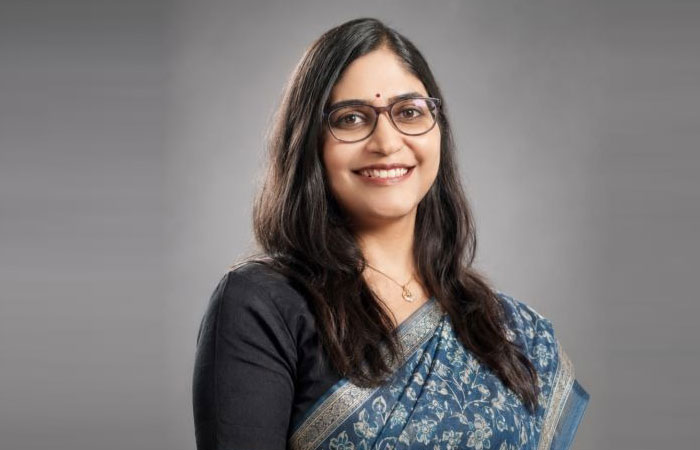
Mafatlal Industries is a diversified enterprise with over 120 years of legacy, with its heritage rooted in textiles. Over the past several years, they have deliberately evolved from a traditional textile manufacturer into a diversified, asset-light solutions enterprise serving institutions. Our portfolio spans over textiles (integrated uniform solutions), digital infrastructure (offering software hardware and services), and consumer durables. integrated uniform solutions remains our core business, with capabilities across design, sourcing, garmenting and distribution, supported by a strong vendor ecosystem. Smita Jhanwar, Chief Financial Officer, Mafatlal Industries, shares with Divya Shetty, the overview of the business and how they are balancing existing businesses with newer avenues.
How has Mafatlal Industries evolved over the years?
Mafatlal Industries is a 100-plus-year-old name traditionally associated with textiles, but today the company is also building businesses around digital infrastructure, robotics labs and consumer durables. How do you define Mafatlal today, and what do you want the company to be known for five years from now?
Mafatlal today is a diversified, product-agnostic enterprise. The categories may differ, but the underlying capability is consistent: we understand institutional requirements, for which we assemble the right solution, and execute it reliably on a scale.
Whether the requirement is of a uniform programme, a digital classroom, a robotics laboratory, a healthcare product, or a hygiene solution, our role is to deliver a dependable institutional outcome rather than merely supply an individual product. That is the common thread across our portfolio.
Over the next five years, we would like Mafatlal to be known for consistency: predictable delivery, disciplined capital allocation, strong cash conversion, and returns that reflect the quality of our growth. For a listed company, durable trust is built when the organisation consistently delivers on its commitments.
The next phase is not about pursuing growth at any cost. It is about improving the quality and predictability of growth. We are focused on three levers.
First, we are improving the business mix as Uniform Solutions scales and contributes a larger share of integrated, value-added solution. Second, we are continuing the transition from supplying fabric to delivering complete solution, including design, garmenting, distribution, and programme management. Third, we are strengthening project execution and software development capabilities for digital infrastructure business.
Alongside this, Digital Infrastructure is our key adjacent growth platform. Through Mafatlal Technologies, we are building capabilities across software development, AI-enabled solution developments, large project implementation and after-sales service. The business is showing encouraging momentum, with Q1FY27 revenue increasing to Rs 420 million from Rs 60.5 million in Q1FY26, up 543.5 per cent YoY, while segment EBIT grew 416 per cent Y-o-Y.
This approach allows us to strengthen the core while selectively scaling newer businesses where we see clear strategic and execution advantages.
How large can the integrated uniform business become, and could uniforms eventually become the defining core of Mafatlal’s textile operations?
Uniform Solutions is already the centre of our textile strategy, and its strategic importance will continue to increase. We are moving from mere supply of fabric to offering an integrated solution covering design, specification alignment, customisation, manufacturing, quality assurance, and distribution.
Institutions are looking for consistency across large and geographically distributed workforces. They need standardised specifications, reliable quality, and on-time delivery across thousands of individuals working. Our institutional experience allows us to address that requirement at scale.
The opportunity spans over education, healthcare, aviation, hospitality, security, heavy manufacturing, public services, and other organised sectors. I would not put a ceiling on the opportunity. It will be built institution by institution, as we deepen existing relationships and broaden the scope of the solutions we provide. Textiles delivered the highest segment result in FY 2025-26, which reinforces the importance of this business to our overall strategy.
Digital Infrastructure is a young business; therefore, its development should be assessed through capability-building as much as through current scale. We are moving from a hardware-led model to an integrated offering that combines AI-enabled software, applications, robotics, implementation, training, and after-sales support.
During FY 2025-26, we enabled more than 840+ classrooms across Tripura and Odisha. The focus is to build the service architecture around these deployments. That includes monitoring, maintenance, teacher enablement, software support, and multi-year service contracts. The value of an education-infrastructure programme is realised through sustained usage and outcomes, not merely through installation.
Opportunity for us lies at the intersection of technology and institutional execution. We understand procurement environment, large-scale deployment, supply-chain coordination, and stakeholder management. Combining those strengths with software and service capabilities which we are building rapidly is how we intend to build a differentiated position.
Our most important learning is that a classroom is not simply a delivery address. It is an operating ecosystem that includes hardware, software, teacher readiness, training, maintenance, monitoring, and ongoing support.
Hardware is the visible component, but the success of the programme depends on whether teachers can use the tools effectively, whether the software remains relevant, and whether service issues are resolved quickly. Each of these factors affects delivery timelines, user adoption, cash conversion, and the long-term value of the deployment.
In FY 2025-26, we enabled 840+ classrooms across Tripura and Odisha. We are using these experiences to develop a repeatable playbook for deployment, training, monitoring, and service delivery. Replication across other states is possible, but we will pursue it selectively, based on the procurement structure, institutional need, implementation complexity, and execution economics of each opportunity.
As of June 2026, Mafatlal had an order book of approximately ₹890 crore. How do you manage tender dependence, execution cycles, receivables, and delays?
A strong order book creates strong revenue and margin visibility. We therefore continuously focus on building order book across public and private institutional requirements. The process also focuses towards working-capital requirements, supply-chain readiness, delivery feasibility, execution milestones, and risk allocation.
Execution is governed through defined milestones, clear ownership, structured reviews, and escalation mechanisms. Working-capital discipline remains a management priority, particularly in businesses involving large institutional deployments and extended delivery cycles.
The discipline that matters most is cash conversion. Growth becomes meaningful only when it translates into cash flow and returns. In FY 2025-26, revenue increased by approximately 38 per cent, while EBITDA stood at Rs 1.24nbillion. That makes the quality of growth, rather than growth alone, the immediate priority.
Our focus is therefore on tighter working-capital management, quick inventory turnaround, disciplined receivables collection, and clear payment terms for every order. These are not back-office measures. They determine whether growth strengthens the balance sheet or places additional demands on it.
My bold bet is on capital efficiency. We intend to continue scaling through the asset-light model, while investing selectively in the capabilities that improve our strength to succeed. Capital will be deployed where it can earn clear returns, and we will remain focused on sustaining ROCE at a healthy level.