


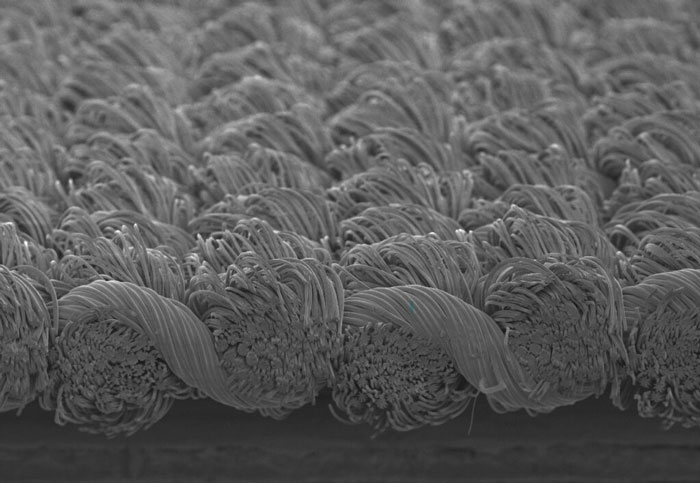
This achievement leverages the firm’s mastery in polymer chemistry and bicomponent spinning, built upon methods refined through its eco-friendly yarn portfolio.
Toray Industries, Inc. has engineered a polyester-nylon composite yarn incorporating a minimum of 93 per cent recycled content by weight, representing a major advancement in utilizing greater proportions of recycled feedstocks for complex textile applications. This achievement leverages the firm’s mastery in polymer chemistry and bicomponent spinning, built upon methods refined through its eco-friendly yarn portfolio.
The 93 per cent recycled ratio applies strictly to the raw filament based on its overall mass. It does not reflect the recycled proportion of the completed fabric or garment, which fluctuates depending on the final textile construction.
Solving bicomponent filament engineering obstacles
Composite filaments are prized for imparting superior performance, refined textures, and unique visual characteristics. Nevertheless, combining disparate polymers within a single filament creates difficulties when producers attempt to maximize recycled volume while preserving uniform standards.
Toray surmounted these hurdles using patented polymer engineering and bicomponent spinning systems, successfully integrating recycled feedstocks into both the polyester and polyamide fractions of the newly created filament.
The enterprise intends to confirm the process’s suitability for commercial-scale manufacturing while pursuing ongoing research to elevate recycled proportions in bicomponent structures. This innovation directly addresses mounting enthusiasm across the apparel sector for recycled inputs, especially as labels endeavor to harmonize sustainability goals with the high-grade aesthetics and functionality expected of luxury garments.
For high-end fashion lines, incorporating recycled elements is insufficient on its own. Textiles must additionally provide the essential finish, tailoring performance, drape, hand-feel, and longevity.
ARTIROSA® CX merges environmental responsibility with premium styling
To convert this filament breakthrough into a commercially viable textile, Toray introduced ARTIROSA® CX, a fabric platform unifying its bicomponent processing mastery with the weaving, knitting, dyeing, and finishing know-how of Japanese textile districts.
The textile exhibits a compact, subtly grained face along with a firm, elegant hand-feel. Its visual profile breaks away from traditional utility-focused aesthetics, delivering an elevated look suited to modern metropolitan fashion.
Substrate choices, weave structures, and finishing techniques can be tailored to impart utility traits, including water resistance, long-lasting water repellency, and wind protection. Exact technical attributes depend on the specific blend ratios, weave architecture, and treatment applications selected.
Toray further noted that the water-repellent chemicals applied to ARTIROSA® CX contain no intentionally added per- and polyfluoroalkyl substances (PFAS). The corporation seeks to pair functional utility with eco-conscious material choices aligned with modern environmental guidelines.
This project demonstrates an strategy where sustainability and design are tackled simultaneously, instead of viewing recycled inputs as an isolated promotional feature.
Focusing on upscale garment segments
Toray intends to position ARTIROSA® CX across diverse product categories, including tailored outerwear for men and women, urban utility gear, and high-grade lifestyle apparel. Subsequent textile development will investigate nylon blends, natural-fiber combinations, and specialized post-treatments to broaden the array of hand-feels and physical capabilities.
The business aims to harness Japanese textile mastery and finishing capabilities to engineer products that satisfy the changing expectations of apparel labels and buyers.
ARTIROSA® CX is slated to debut for the Autumn/Winter 2027 collection, with Toray projecting first-year sales to reach 200,000 meters.
Elevating recycled feeds for premium textiles
This milestone underscores the technical complexity of introducing recycled inputs into demanding garment sectors, where stable quality, sophisticated aesthetics, and utility remain non-negotiable.
By embedding recycled material into both the polyester and nylon constituents, Toray aims to expand the utility of bicomponent filaments past traditional boundaries. Moving forward, the company will concentrate on confirming full-scale production viability and driving recycled content even higher.
Through ARTIROSA® CX, Toray strives to prove how sophisticated fiber design and regional processing expertise can bridge the divide between recycled input research and the demands of high-end fashion markets.