


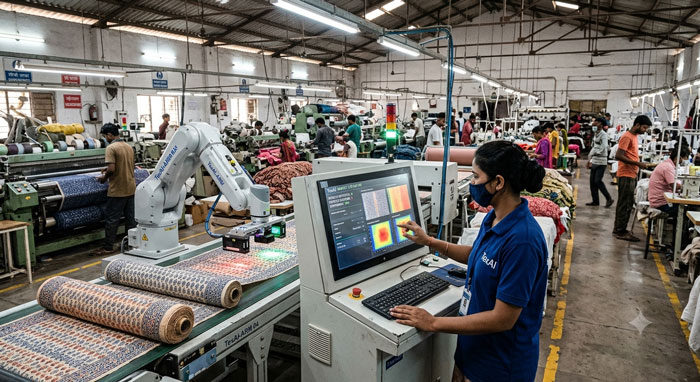
Radhakrishnaiah Parachuru recommends strategies for small, medium and large companies to optimise the performance of textile and related industries while keeping job losses to a minimum by using Artificial Intelligence
The strongest current evidence supports an augmentation-first strategy: accelerate individual tasks, redesign jobs and workflows around human-AI collaboration, and use freed employee capacity to promote growth, quality, innovation, customer service and new products before considering workforce reductions.
The International Labour Organization estimates that one in four global workers has some exposure to generative AI, but only 3.3 per cent of the global workforce falls in the highest-exposure category. Job transformation is considered more appropriate than wholesale replacement.
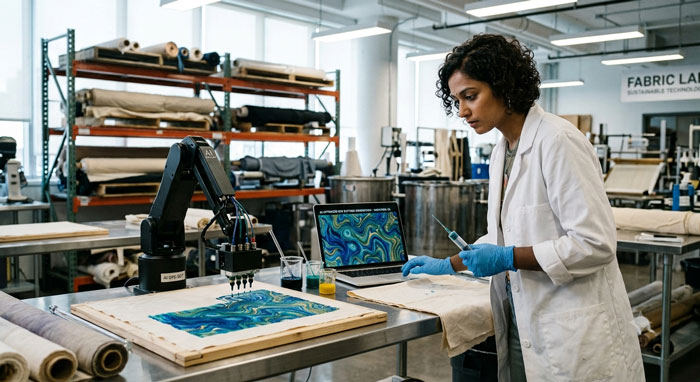
Small companies: Fewer than 50 employees
Choose available AI capabilities rather than build them. Small firms generally should begin with secure, proven commercial AI copilots and software already integrated into office, accounting, customer relationship management, design, analytics or other business systems.
Target administrative burden first. High-value initial applications include preparing correspondence and proposals, summarising documents, creating marketing content, writing product descriptions, supporting customer communications, bookkeeping, research, data analysis and routine reporting.
Evidence from small and medium-sized enterprises strongly favors augmentation over layoffs. Among AI-using SMEs surveyed by the Organisation for Economic Co-operation and Development, 65 per cent reported higher employee performance; 45 per cent reported cost savings; 35 per cent reported the ability to perform previously unavailable tasks; 35 per cent reported new products or services; and 26 per cent reported increased revenue.
Job losses have been limited so far. The OECD found that 83 per cent of AI-using SMEs reported no change in overall staff requirements. About 9 per cent reported reduced staffing needs, and roughly 6 per cent reported increased staffing needs. About one-third reported lower employee or owner workload.
Use AI to overcome skill shortages rather than replace employees. Among SMEs experiencing skill gaps, 39 per cent reported that generative AI helped compensate. AI also reduced dependence on outside contractors for 14 per cent of SMEs, creating a potentially attractive savings opportunity without layoffs.
Do not eliminate human supervision and approval. Owners or experienced employees should review important quotations, contracts, technical statements, financial information and customer commitments. AI-generated output should not automatically become company policy or customer-facing fact.
Measure savings in dollars and hours, not eliminated positions. Track owner hours saved, turnaround time, sales leads, response time, mistake reduction, contractor expenses avoided and new revenue generated. Reinvest saved hours in selling, customer retention, product development and business expansion.
Major SME adoption barriers require attention before scaling. Unsuitable applications, legal concerns, confidentiality of information entered into AI systems and inadequate staff skills all rank prominently in OECD research.
Desirable small-company model: Enabling inexpensive AI copilots to complement employees can achieve higher individual productivity, reduced outsourcing and overwork, increased sales and capacity, and stable or growing employment.
Medium companies: 50 to 249 employees
Create a small central AI team with departmental champions. A two- or three-person core group can establish approved tools, security requirements, training, measurement and governance. Knowledgeable employees in operations, sales, engineering, human resources and finance can identify worthwhile applications.
Redesign jobs at the task level rather than eliminating occupations. Break each position into the following categories:
- Human-only tasks.
- AI-assisted tasks.
- AI-executed, human-reviewed tasks.
- Genuinely automatable tasks.
Reassign employees whose repetitive workload declines to judgment, customer interaction, problem-solving, innovation and exception handling.
Prioritise two to four measurable workflows before enterprisewide deployment. Customer support, sales proposals, purchasing analysis, quality documentation, maintenance information, scheduling and internal knowledge retrieval are good candidates when they represent real bottlenecks.
AI can substantially raise worker performance. A major workplace study involving 5,172 customer-support agents found that AI assistance increased overall productivity by approximately 15 per cent. Less-experienced workers improved by approximately 30 per cent, and the lowest-skill group gained approximately 36 per cent. Newer employees also learned faster.
Knowledge work can show similarly large gains.
Protect junior positions and apprenticeships while reducing entry-level tasks. AI performing some junior tasks can damage a company’s future talent pipeline. Evidence indicates that inexperienced employees may obtain some of the largest learning and productivity benefits from AI assistance.
Train before automating. Provide paid, job-specific instruction covering effective AI use, verification of outputs, data security, privacy, exception handling and domain judgment.
Adopt a redeployment-first workforce policy. Fill vacancies internally, transfer people from automated tasks into growth or bottleneck functions, reduce unnecessary external contracting and use normal attrition before considering involuntary layoffs.
Do not assume AI automatically improves every process. In a controlled study of experienced software developers working on familiar repositories, access to early-2025 AI tools significantly increased task-completion time. AI performance therefore should be measured against a real baseline, not assumed.
The human-AI approach may not automatically be better than either working alone. A meta-analysis found that human-AI systems performed better than humans alone, on average, but not necessarily better than the stronger of the human or AI systems alone. Careful division of responsibilities matters.
Good medium-company model: Workflow analysis guides employee training, measurable productivity improvement, role redesign and redeployment, and selective scaling.
Large companies: 250 or more employees
Large organisations need central governance combined with delegated implementation by business units. AI should ultimately connect manufacturing, supply chain, engineering, information technology, customer service, sales, human resources and finance rather than remain a collection of individual copilots.
Individual productivity does not guarantee corporate profitability. McKinsey’s 2026 survey found that 80 per cent of respondents reported improved personal productivity from AI, but only 37 per cent reported positive earnings.
Workflow redesign differentiates the leaders. Nearly three-quarters of McKinsey’s AI high performers reported fundamentally redesigning workflows, compared with only about one-quarter of other organisations. Successful companies pursue development and innovation alongside efficiency.
Large firms are scaling faster. Among organisations with at least $1 billion in revenue, 54 per cent reported enterprise-level AI scaling, compared with roughly one-third of smaller organisations.
Convert saved employee time into enterprise value. In a recent study, 42 per cent of regular frontline AI users reported saving at least eight hours per week, yet 66 per cent received limited or no guidance about how to use the time saved. Companies should formally redirect released capacity toward innovation, customer service, engineering backlogs, quality improvement, preventive work and revenue creation.
Current financial benefits still favor efficiency over growth. Deloitte reports that organisations most commonly achieve productivity and efficiency gains (66 per cent), better decisions and analysis (53 per cent), cost reductions (40 per cent) and better customer relationships (38 per cent), while only about 20 per cent report improved products and innovation or increased revenue.
Wipro provides an important redeployment example. In early September 2026, Wipro reported AI-created productivity capacity equivalent to approximately 20,000 workers and reassigned the affected capacity rather than simply eliminating it. Wipro also reported training more than 100,000 employees in advanced AI capabilities.
Create an internal AI-era talent marketplace. Map employees’ domain knowledge and transferable skills, and proactively match workers released from automated tasks with vacancies, new AI-enabled functions, customer-facing roles and emerging growth businesses.
Develop role-specific reskilling at scale. Training should include AI operation, domain validation, data interpretation, cybersecurity, AI supervision, problem-solving, critical thinking and communication, not just generic AI awareness.
Keep humans responsible for consequential decisions. Hiring, promotion, termination, safety, legal conclusions, major financial decisions and sensitive customer actions require meaningful human monitoring. U.S. employers remain responsible for complying with employment discrimination laws when they use AI systems in employment decisions.
The National Institute of Standards and Technology’s AI Risk Management Framework provides an expandable approach covering reliability, safety, security, transparency, privacy, accountability and harmful-bias management. It is designed for organisations of different sizes and sectors.
Large-scale automation requires four conditions:
- Positive risk-adjusted economics.
- Equal or better quality.
- Acceptable security and legal risk.
- A credible employee-redeployment plan.
Best large-company model: Enterprise workflow redesign results in an AI-human operating model, large-scale reskilling, internal talent mobility, reinvestment of released capacity, and growth and innovation.
Current examples of AI application in the textile-industry
Quality control & fabric inspection: WebSpector, UK uses line-scan cameras, machine vision, machine learning and deep-learning AI to detect, classify and grade fabric defects at production-line speed. It can inspect plain, patterned, jacquard, printed and technical fabrics and generate digital defect maps and optimised cutting plans. Sheltonvishion, UK reports 2–3 per cent improvement in first-quality yield for dyeing/finishing processes.
Predictive machinery maintenance: Jaya Shree Textiles, Grasim Industries, India — The company reports using several types of monitors and sensors to monitor bearings, gearboxes, fans and other equipment across Jaya Shree’s integrated linen operation. AI analyses the sensor patterns, assigns reliability scores and predicts developing faults so maintenance can occur before equipment failure. The plant has more than 42,000 spindles plus weaving, knitting, dyeing and other machinery.
Production optimisation: Rieter’s ESSENTIAL digital spinning-mill platform connects production, efficiency, energy, quality and machine data. Its ESSENTIAL optimise module combines AI with textile-process expertise to identify process deviations and recommend corrective action. AI can trace a downstream yarn problem back to cards, combers, draw frames or individual spinning positions, allowing intervention during the shift rather than after production. This improves fiber yield, quality, productivity and equipment utilisation.
Design & prototyping: SOHO FASHION, a publicly listed Chinese textile and garment company, is using AI for pattern generation and style refinement, followed by 3D modeling and virtual garment/product development. Faster first drafts, more design alternatives, reduced physical-development iterations and better communication between designers, manufacturers and customers are the benefits.
Sustainability / circularity: Portugal’s LIPOR pilot textile-recycling plant uses two PICVISA ECOSORT TEXTILE systems integrating AI with hyperspectral vision. The system automatically classifies post-consumer textiles by fiber and material composition so they can be directed toward appropriate recycling streams.
AI-assisted dye formulation and process control: Datacolor’s current self-learning SmartMatch/Match Textile technology is a particularly strong example because it learns from previous dyeings to improve recipe prediction, which directly affects first-shot matching, chemical consumption, re-dyeing and wastewater generation.
Final observations
Across all three company sizes, the most desirable three-step strategy is to automate tasks, augment people and redeploy capacity. AI should first remove low-value, repetitive work and allow employees to spend more time on judgment, relationships, creativity, technical problem-solving, innovation and revenue-generating activities.
Evidence does not support the assumption that maximising AI-driven headcount reduction maximises corporate performance. The stronger emerging model is this:
AI productivity gains can lead simultaneously to released employee capacity, reskilling and redeployment, higher quality, innovation and growth, with minimal job loss.
Citations
- https://sheltonvision.co.uk/
- Textile Industry Case Study for AI Driven Predictive Maintenance, Pratishtha Yadav, March 12, 2024, https://www.sensegrow.com/blog/customer-stories/textile-industry-case-study-for-ai-driven-predictive-maintenance.
- The Smart Path into the Digital Future, October 27, 2025. https://www.rieter.com/company/news-and-success-stories/details/the-smart-path-into-the-digital-future
- Soho Fashion: How AI + 3D Keep Design and Clients Perfectly in Sync. https://www.style3d.com/case-studies/soho-fashion-ai-3d-client-alignment/
- A Case Study – Empowering Circularity: How ECOSORT TEXTILE Drives Innovation at Lipor’s Pilot Unit in Portugal. https://picvisa.com/casos-de-exito/lipor-textile/a-case-study-picvisa-lipor-portugal-advancing-textile-sorting-for-a-circular-future/
- Dyer Color Formulation Software: Match Textile, https://www.datacolor.com/business-solutions/product/datacolor-match-textile/?utm_source=chatgpt.com
About the author:

Radhakrishnaiah Parachuru is a Principal Research Scientist (Emeritus Status) at Georgia Institute of Technology, MSE. He served as an expert witness in 65 litigations. Testified in courtrooms across eight different states within the US. He resolved dozens of product/material-related disputes through independent testing.