



Haryana, a northern Indian state, has a rich history and culture. Pottery, embroidery, and weaving are essential components of Haryana’s artistic tradition. The bright Phulkari dupatta from Haryana is well-known both in India and beyond. The region is also famous for patronizing the leather, wood, bead, zari, bone carving craft etc. Panipat region maintains the legacy of Handloom weaving especially carpet and upholstery weaving, the result of this craft practices, at present the Panipat has become the industrial hub for Textile Manufacturing Industry. Panipat is around 90 km from Delhi, which has provided the region with ample prospects.
The Panipat textile cluster is centered on and near Panipat City and the surrounding suburban areas. The sector has seven sub-sectors including handloom, woolen carpets, shoddy yarn spinning, power loom products, wet processing, hosiery and woolen yarn. These units have a support of over 75,000 people and are anticipated to generate 110 billion in income.
Significance of the study
Panipat, popularly known as the Handloom City, is a handloom product manufacturing power-house, generating carpets, cushions, velvet comfy, couch fabrics, bed sheets, drapes, and rugs, among other things. Additionally, it has developed into a center for the recycling sector, leading to the creation of yarn from used clothing. The study’s purpose was to conduct a field inquiry to learn about the historic weaving method and document its loom, raw materials, weaving process, and traditional products of cultural significance.
Method and materials
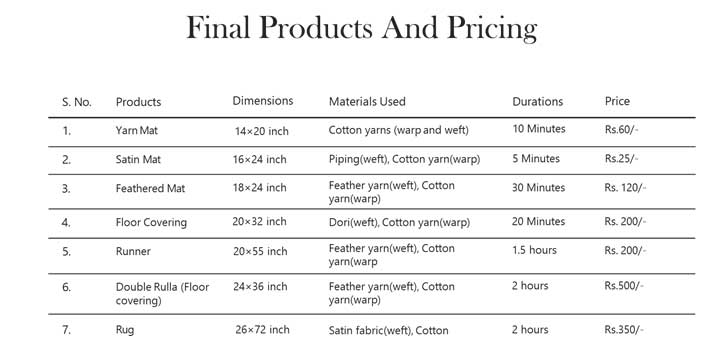
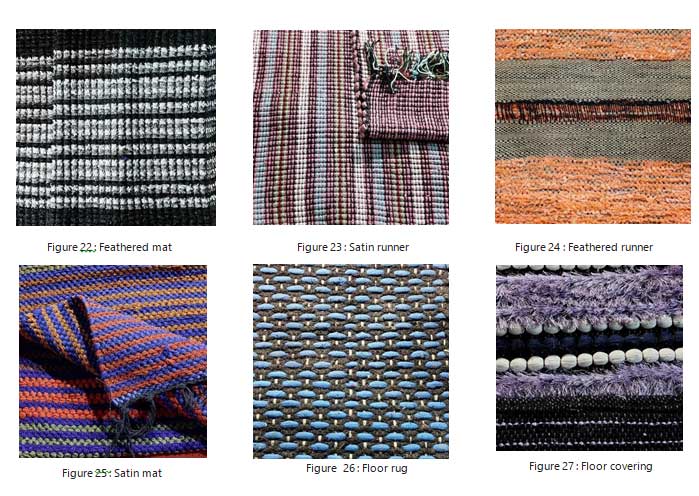
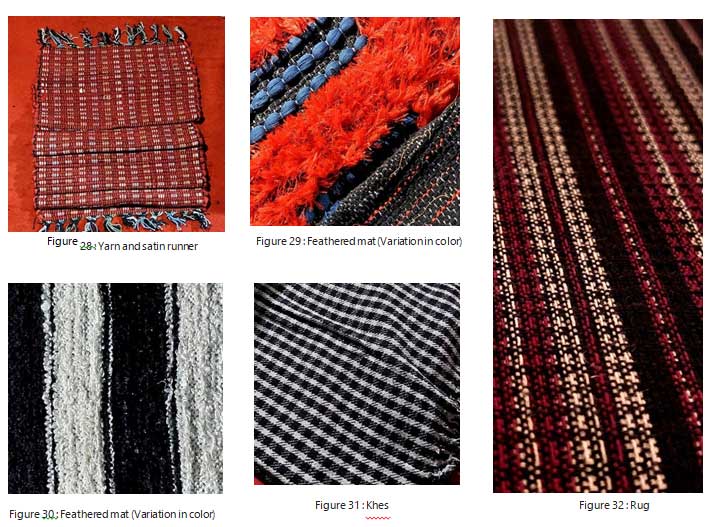
About twenty artisans were selected using purposive sampling technique and data was collected using interview schedules and open-ended questionnaire. To justify the cultural significance of the craft, traditional products were deeply studied with their dimensions, materials, technique of production, price range, finishing, target market etc. During the field study, Double Cloth Khes, Punja Dhurries, Tapestries, Mats and runners’ traditional products were studied and documented in detail. The study also highlights the beautiful amalgamation of traditional yarns with synthetic & fancy yarns used into the traditional weaving products.
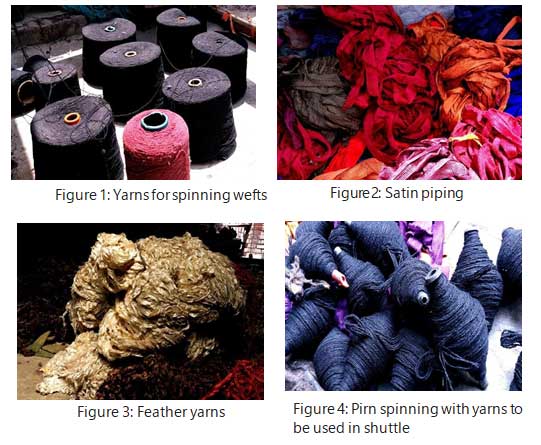
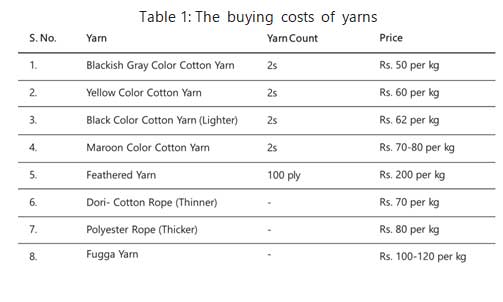
Raw materials: A variety of raw materials are needed to create the upholstered goods. Blanket piping leftovers were typically utilized as weft which was supplied from various Panipat Mills, other yarns were purchased from local market. Cotton yarns were used as warp (Tana) and weft (Bana) and they were bought in cones based on weight.
Tools and equipment
Equipment
Spinning wheel (Charkha): The weft yarn is prepared into a Pirn shape using a wooden charkha before being inserted onto a shuttle. For its ability to travel smoothly, mustard oil is commonly utilized.
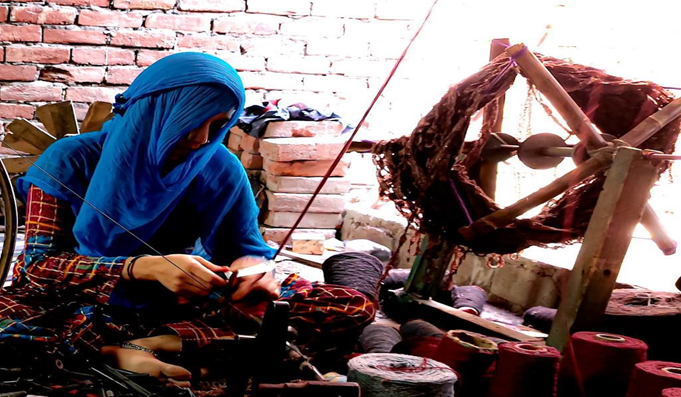
Figure 5: lady spinning the yarns on the spinning wheel (Charkha)
Warp Machine (Tana Machine): There were two main components of the iron Tana machine at the artisans’ workstation. Tana is looped around one of them, a huge horizontal cylinder that rotates on its axis. Also, there is a vertical frame (Creel) that supports cones (Pinde), each of which contains warp strands that are removed and combined to generate a warp beam on the cylinder.
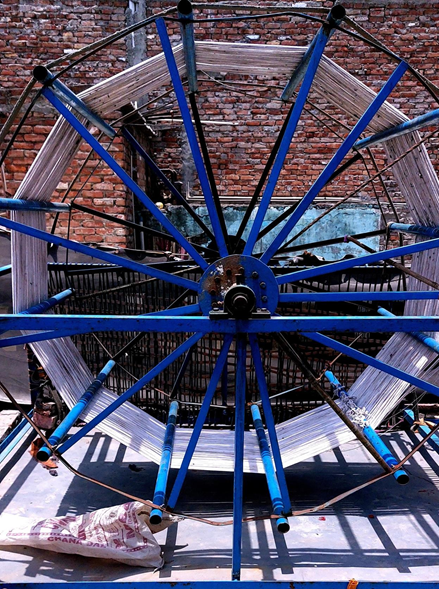
Figure 6: Warp machine
Pit loom (Khaddi): A pit loom naturally implies that the loom is placed in a pit with paddles positioned beneath it so the craftsperson may run the loom with their legs. The loom was built using wood and some iron components. The loom is the mainstay of the weaving process. The craftsmen’s native tongue refers to the pit loom as Khaddi.
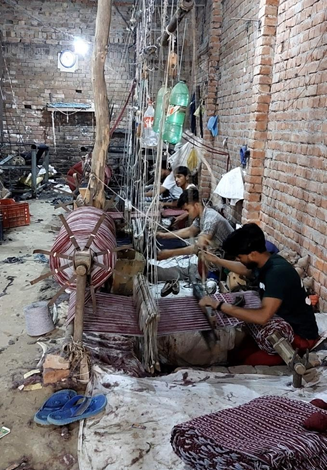
Figure 7: Pit Loom at Panipat
Back beam: Back Beam is the iron roller behind the weaver’s beam on the loom.” It’s also called a “back rest” because it keeps the warp force up and keeps the warp sheet away from the warp beam.
Cloth beam: A “cloth roller” or “cloth beam” is another name for a wooden roller that is used to wind fabric onto it and is under the front rest.
Front rest: The front rest, which is also called the breast rest, is the iron roller in front of the loom that is placed above the front rest.
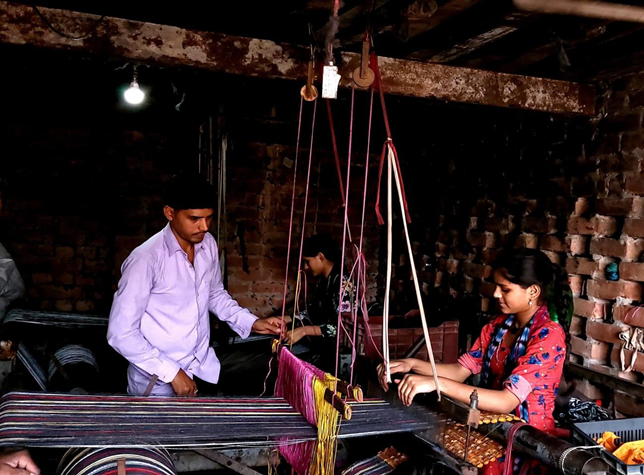
Figure 8: Weaving on handloom at Panipat
Tools
Nalli (Pirn): The stick is a hollow cylinder of wood or plastic and is locally termed “nalli”. It is packed with weft yarn. It is made by a spinning process on a spinning wheel. The pirn is held in the shuttle by a pin. Because of the filling of yarn, it is often thicker in the middle and thinner at both ends.
Bobbin (Pinde): Narrow cylindrical rods with yarns looped around them, locally known as pinde, are bought from the market. It is heavier than pirn due to the higher amount of yarn that is wrapped around it.
Shuttle: A shuttle is a wooden spindle-shaped tool with points on both sides, made to retain pirn inside of it. It was designed and built by local carpenters. It is tossed between the shed created by the movement and the cross-up lifting of the warp to place the weft.
Blade (Churri): In the course of weaving the weft thread is cut by an iron blade, razor sharp.
Scissors (Kainci): For cutting yarns (especially the weft strands) a pair of scissors made of iron is employed.
Sui (Needle): A needle is a sharp-pointed metallic device used to hand finish items.
Pilas (Pliers): A metal hand tool with jaws, joints and handles, used to repair machinery.
Sewing machine: The yarn runners and mats are sewn at the ends by use of a hand driven sewing machine.
Tape measure: This is a flexible ribbon-like design made of plastic and used to measure length and breath of items. Both sides are scaled for linear measurement. It is often marked in 150 cm increments.
Results and discussion
Process
- The weaving procedure starts with one craftsperson preparing the Tana and another craftsperson preparing the weft threads for yarn-based items. It was done manually using a wooden charkha (spinning wheel). To produce a pirn of 50 kilogram yarn it takes around two days.
- Khaddi is set up by craftsperson for weaving after preparing warp and weft. At the back of the khaddi (Weavers Beam) the warp is put on a roller.
- Finally the warp was wrapped around the Cloth Roller after passing through the Kanghi (Reed) (Cloth roller). To start the weaving the shuttle was alternately tossed from one side to the other into the weft. The warp was raised and lowered with paddles. The artist hammered the weave with a reed, stretching the cloth slightly in the middle to prevent it from stretching farther.
- When the goods are finished the fabric is pulled out of pit loom. The fabric was cut into pieces according to the size of the finished object. Hand knotting of loose ends and stitching the loose ends together by sewing machine were the two procedures employed in finishing items.
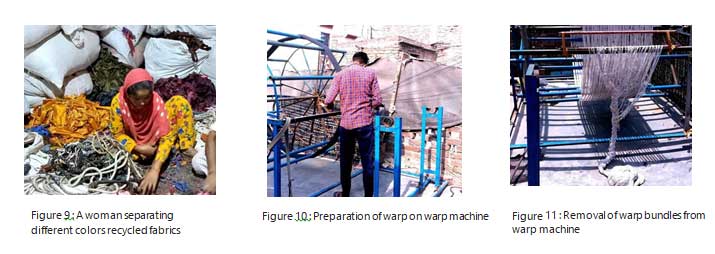
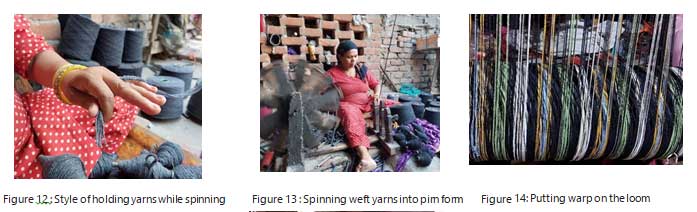
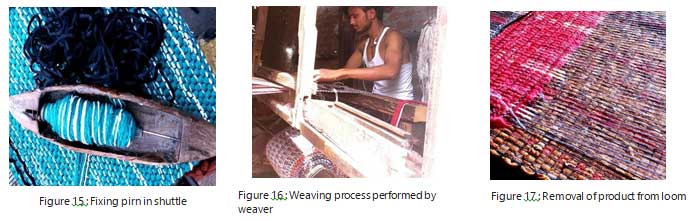
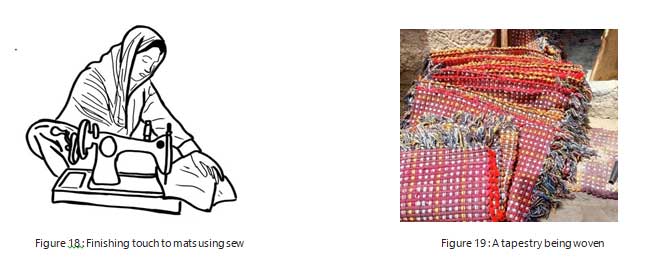
And finally, the products were packed in bulk to be supplied in market and for exhibitions products were packed individually in plastic wraps.
Design and motifs
The mats and runners are highly demanded in daily use products which are produced in bulk in Panipat. Since the production is in bulk, the artisans use plain weave with variations in the yarns to make unique designs.
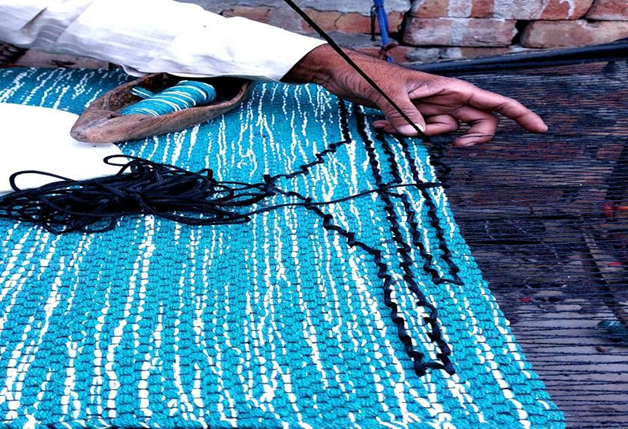
Figure 20 : A weaver weaving on the product
Finishing
The fabric was removed from the cloth beam after the weaving process is finished. The products were cut into different pieces before each one receives its finishing touch. The products were finished using one of two alternative techniques: either hand knotting the warp end or sewing the ends together using a sewing machine.
Products were frequently created in response to specific orders, particularly in large quantities. After creating bundles, the bulk goods are placed in plastic bags. Additionally, the goods produced for shows and fairs are wrapped separately in clear poly bags.
As the weaving is done using a hand loom, it is intrinsic that some- times there might be the minimal fault. The newbies make some mistakes at the initial stage, but those products are renewed by experienced artisans. Not a single product is wasted because of minimal fault.
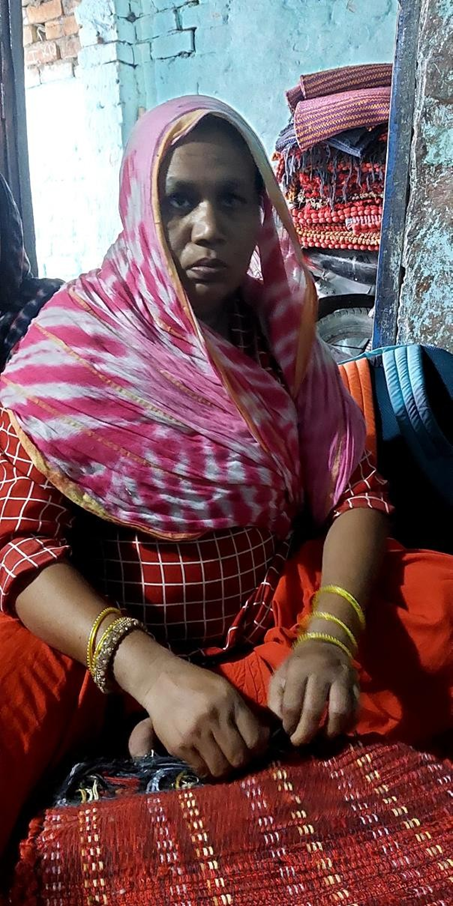
Figure 21: Woman knotting the final product after removing it from loom
Conclusion
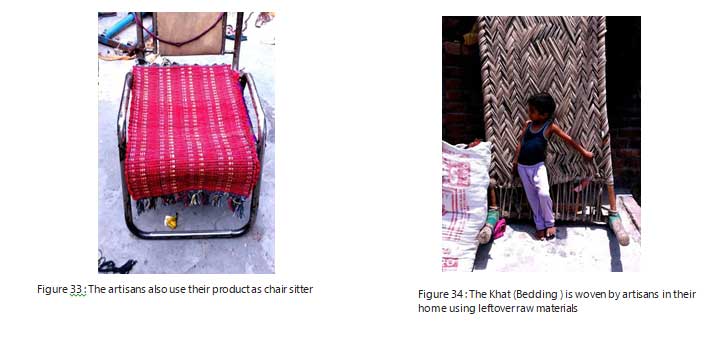
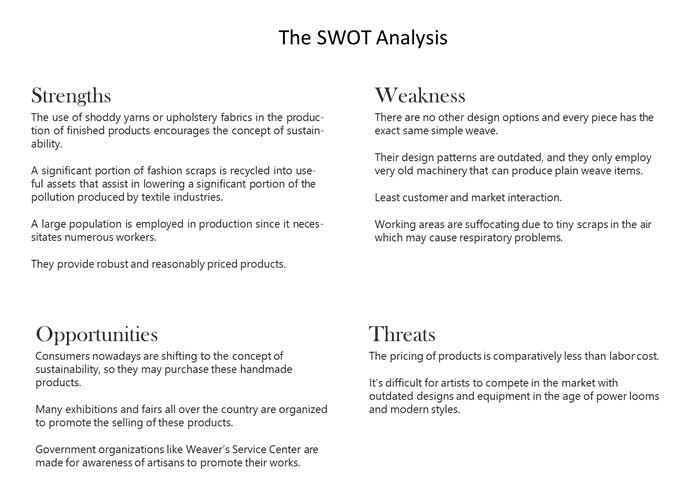
It was concluded that there are innovative artisans or crafts persons who are upcycling waste yarns as efficiently as possible into lovely goods. Many artisans and their families are working in the city on handlooms even in the era of power looms.
References
- https://panipat.gov.in/about-district/
- https://www.britannica.com/place/Panipat
- https://www.incredibleindia.org/content/incredibleindia/en/destinations/ panipat.html
- https://www.holidify.com/pages/city-of-weavers-in-india-2015. html
- https://textilevaluechain.in/in-depth-analysis/textile-market- report/panipat-city-of-handlooms-international-home-textiles- hub/
- Handmade In India https://haryana.gov.in/about-haryana/
- https://www.holidify.com/pages/haryana-culture-80.html
- https://www.businessworld.in/article/Handloom-industries- in-Panipat-struggle-to-survive-post-lockdown/27-07-2020-301770/
- Crafts of Himachal Pradesh\
About the author:

Dr Shruti Gupta is an Assistant professor with the department of Textile Design and completed her doctoral research and masters from the department of Fabric and Apparel Science, Lady Irwin College, Delhi University. She has Qualified UGC-NET for Lectureship and JRF. Passion for textiles brought her to join NIFT in the year 2010. She has worked in the industry for 8 years before joining NIFT and has been an academician now for 14 years. She specialises in textile knowledge & processes, print design, craft studies, elements of design, material studies, surface techniques and computer-aided designing.