


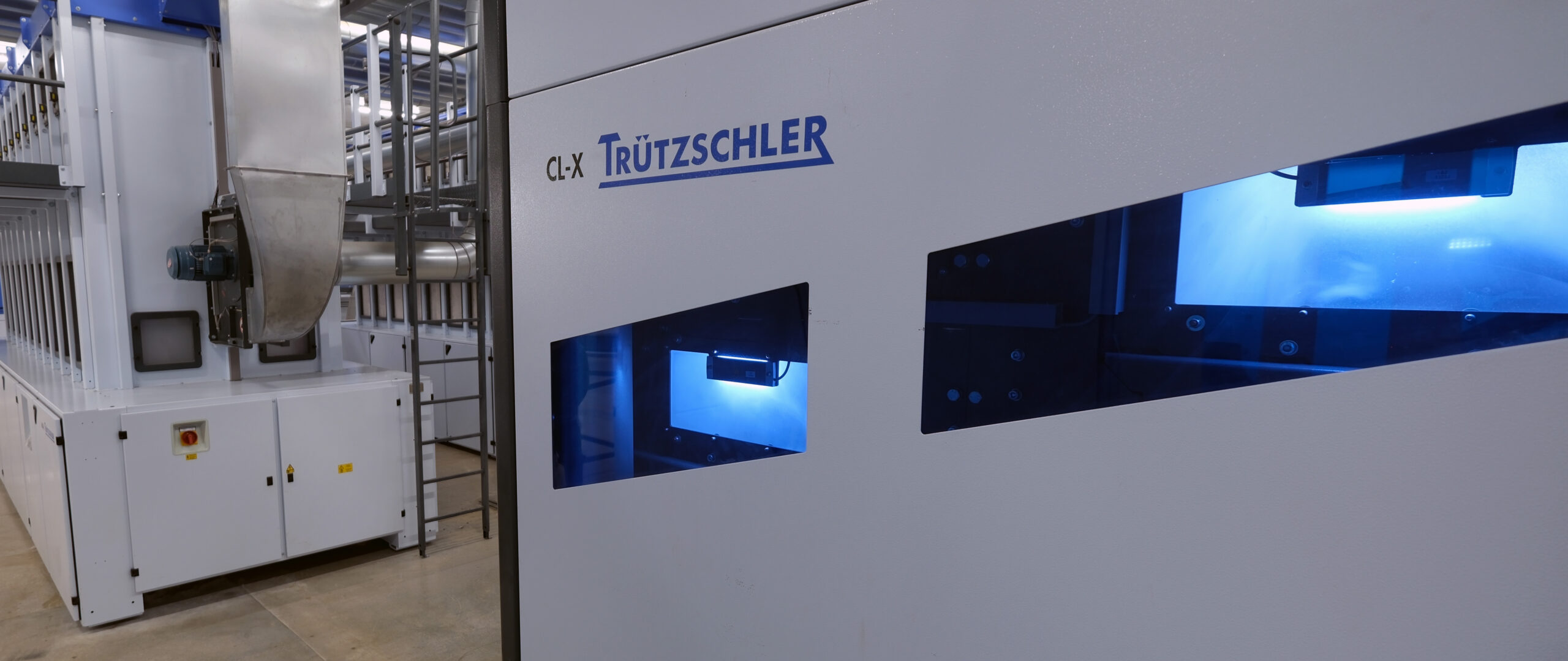
Since its market launch, the CL-X has firmly established itself in blowroom lines worldwide. Hundreds of installations confirm its ability to deliver superior cleaning efficiency, lower waste, higher productivity and significant energy savings. Now, new customer applications show that the CL-X not only continues to excel in spinning preparation – it is also entering a completely new field of application: ginning.
Cotton gins perform the very first industrial processing step of cotton. Seed cotton arrives directly from the field and must be dried, cleaned and separated into three components: cotton fibres, cotton seeds and waste. While the fibres are pressed into bales for spinning mills, the waste fraction is sold separately – often still containing a considerable share of usable fibres.
In conventional ginning processes, this waste can contain up to around 0,8% good cotton fibres. These fibres still have value, but they are transported and sold in mixtures with trash, resulting in lower prices and unnecessary logistics costs. This is where the CL-X comes into play.
Installed directly downstream of the ginning machine, the CL-X enables significantly more effective fibre recovery. Thanks to its precise cleaning action, usable fibres are separated more efficiently from trash before shipment. The result: higher fibre yield, less waste volume – and greater economic value from the same amount of raw cotton.
Success story from Brazil
A Brazilian customer has now successfully implemented this concept. In a ginning operation processing around 500,000 tons of cotton per year, approximately 65% – or 65,000 tons – is typically separated as cotton seeds and waste during the cleaning process. Within this portion, approximately 4,000 metric tons (or 0.8%) of the waste consists, among other things, of high-quality fibres that should be separated, as they would otherwise be lost at this stage of the process.
By integrating the CL-X into the ginning process, the customer was able to further separate the ginning waste, splitting it into real waste and usable fibres that can be recovered at this early stage. This resulted in a significantly higher share of high-quality, marketable fibres, which in turn reduced the amount of waste
that needed to be transported. In addition to lower logistics costs, the customer benefits from substantially better prices for the recovered fibres.
Convinced by the results, the Brazilian ginnery has already placed follow-up orders for four additional CL-X machines for its ginning operations – a strong endorsement of the concept’s economic and technological potential. This application clearly demonstrates how CL-X performance can create added value well beyond the spinning mill.
Confirmed excellence in spinning preparation
While the ginning application highlights the CL-X’s versatility, new results from spinning mills further confirm its leadership in established use cases.
In Vietnam, a customer compared the CL-X with the previous pre-cleaning solution under identical production conditions. The CL-X reduced waste by approximately 0.5% to 0.8% in total while simultaneously improving yarn quality. These improvements led to enhanced efficiency on the customer’s rotor spinning operations, reduced material loss and a more consistent yarn output. At the same time, power consumption dropped by around 40%, resulting in substantial energy savings, lower operating costs and a clear sustainability benefit. The customer reports high satisfaction, particularly with the machine’s operational stability and output quality.
Equally impressive results were achieved at a Turkish spinning mill processing 100% cotton at 1,100 kg/h. Replacing a competitor machine with the CL-X led to 80% less waste, around 30% lower energy consumption and noticeably higher yarn quality downstream. In addition, the blowroom operation became more stable and efficient. Where two machines had previously been required, one CL-X now handles the cleaning task alone, setting a new benchmark for both productivity and simplicity. Encouraged by these results, the customer has already decided to upgrade its blowroom line with further CL-X machines.
Smart technology, strong cleaning performance
The technological foundation for these results in spinning preparation and ginning is the CL-X’s advanced cleaning concept. At its core is the proven WASTECONTROL system, which continuously monitors trash content and raw material quality by using real-time data. When too many good fibres are detected in the waste, the system automatically suggests an optimised setting to minimise fibre loss – ensuring consistently high cleaning performance and maximum fibre yield across varying conditions.
One machine, multiple opportunities
From spinning preparation to ginning, the CL-X once again proves why it has become a benchmark in cotton cleaning. Its ability to deliver measurable economic, quality and sustainability benefits – even in entirely new applications – demonstrates the strength of its underlying concept and how smart pre-cleaning technology continues to unlock new potential along the entire cotton value chain.
About the Trützschler Group:
The Trützschler Group SE is a German textile machinery manufacturer headquartered in Mönchengladbach, Germany. The company is divided into three business units: Spinning, Nonwovens and Card Clothing. Trützschler Spinning is the global technology and market leader in spinning preparation in the cotton and man-made fibre sector. Trützschler Card Clothing is the global market leader in the production of high-performance card clothing for cards and roller cards. Trützschler Nonwovens is a leading supplier of complete production lines and machinery for needle-punched, hydroentangled (spunlaced), through-air and chemical bonded nonwovens. Trützschler machines, installations and accessories are developed and produced in nine locations worldwide. This includes four locations in Germany (Dülmen, Egelsbach, Mönchengladbach, Neubulach), as well as sites in China (Jiaxing and Shanghai), India (Sanand), the USA (Charlotte) and Brazil (Curitiba). Local service companies in Türkiye, Mexico, Uzbekistan and Vietnam and local service teams in Pakistan, Bangladesh and Indonesia provide customer proximity in key regions for the textile processing industry.