


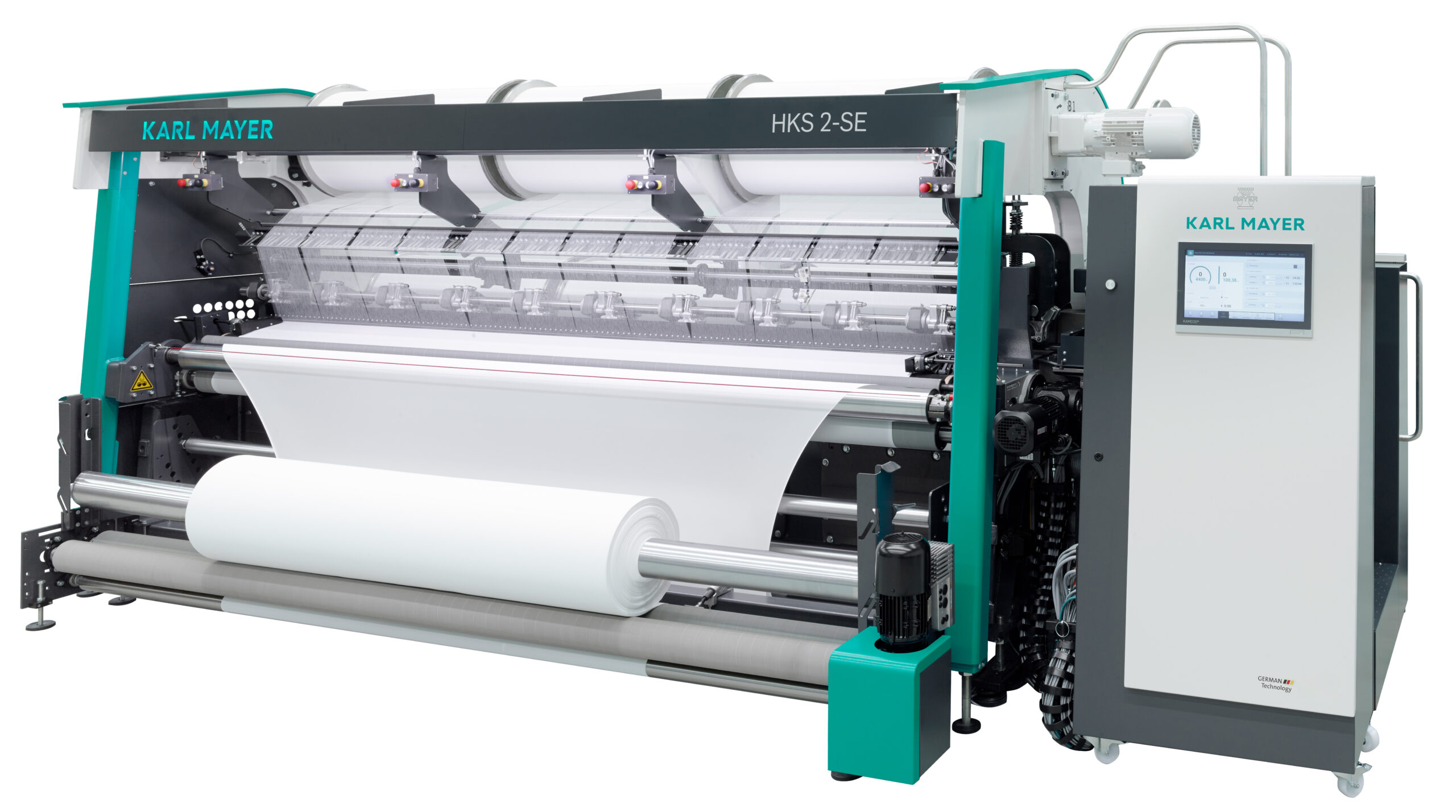
As India’s textile industry advances towards greater productivity, sustainability and technology-driven manufacturing, global machinery leaders are playing an increasingly important role. In this interview, Mark Smith, Deputy VP Sales Business Unit Warp Knitting, Karl Mayer, speaks with Divya Shetty about Karl Mayer’s contribution to the evolution of warp knitting and warp preparation technologies. The discussion explores the company’s high-speed machinery, smart operating solutions, local service capabilities and training initiatives in India.
Karl Mayer has been one of the leading names in German textile machinery for decades. How has the company contributed to the global advancement of warp knitting and warp preparation technologies?
Karl Mayer has always set the pace for innovation. Just think of the development of Piezo Jacquard technology and, later, the string bar system, both of which revolutionised patterning in lace raschel machines. Another milestone was the introduction of carbon technology in warp knitting machines, significantly improving temperature stability.
Our latest innovations focus on increasing efficiency, flexibility and ease of operation. Thanks to highly advanced technology, our HKS 2-SE is the fastest tricot machine in the world. The trend toward larger working widths further enhances machine productivity. Warp knitting is already the most efficient textile manufacturing technology compared to weaving and knitting, and our record-breaking machine speeds make it even more attractive.
In addition, the versatility of lappings and usable yarns enables the production of an exceptionally wide range of fabrics. Warp knitting machines can produce both woven-like articles and fabrics more commonly associated with weft knitting. Furthermore, the expansion and differentiation of our product portfolio, including the HKS PLUS models, provide customers with even greater flexibility.
We are also making operation easier through the development of smart solutions. Examples include the Spring Motion Assistant, which allows guide bars to be unhooked quickly and without tools, and a new adjustment mimic that enables precise and straightforward sinker lever settings, making adjustments so simple that they can be carried out even while wearing a suit.
In warp preparation, we have established a strong reputation with the world’s most advanced sizing machine. Featuring a completely new sizing concept, the PROSIZE achieves outstanding results in terms of efficiency, sizing quality and sustainability.
In addition, our MULTI-MATIC has revolutionised the production of pattern chains. This unique warp sampling machine is so efficient that it makes the production of short to medium-length warp beams economically viable.
Our PROWARP HT sectional warping machine delivers outstanding warping quality and productivity, making it the ideal solution for manufacturers aiming to establish themselves in the technical textiles sector.
How is Karl Mayer supporting Indian textile manufacturers in improving productivity, product quality and production efficiency?
India is one of the most important markets for warp knitting worldwide, with strong growth in both traditional textile applications and technical textiles. Karl Mayer supports Indian manufacturers by providing highly productive and reliable machine technology that helps them increase output, maintain consistent quality and optimise resource efficiency.
Beyond machinery, we offer comprehensive support through local sales and service teams, technical consulting and training programs, for example in Surat, right where our customers are. Karl Mayer Academy in Surat contributes significantly to skills development in the Indian warp knitting sector with training courses ranging from technical basics to management training.
Our Care Solutions offers ensure maximum machine availability with digital services such as Remote Support flat for efficient remote diagnosis and maintenance, and a dashboard for efficient performance monitoring of the machines.
Our support enables our customers to reduce downtime, improve process transparency and shorten the time from product development to market launch.
We also work closely with Indian textile producers to develop innovative fabrics for applications such as fashion &apparel, home textiles, and technical textiles. In particular, our global Textile Innovation Centers are places for exchange, creativity, and the joint development of textile innovations.
By combining advanced warp knitting technology and application expertise, we help our customers enhance competitiveness, improve production efficiency and respond more quickly to changing market demands.
Which segments in India are currently showing the strongest demand for these technologies?
In India, we currently see particularly strong demand in technical textiles, which are being driven by investments in infrastructure, mobility and renewable energy. Die Schussgewirke der Wefttronic II G sind im Straßen- und Schienenbau äußerst gefragt. Die Verstärkungsgelege der Max Glass Eco sind Bestseller für die Verstärkung von Composites, die in Windrkaftlanlagen und im Bereich Mass transport, beispielsweise im Bau von Zügen, eingesetzt werden.
Another important growth segment is the apparel and sportswear market, where manufacturers are looking for innovative, lightweight and functional fabrics that meet both domestic and international demand. Hier geht die Entwicklung zur Verarbeitung von funktionellen Garnen, also Chemiefasern, und damit zur Wirkerei als das effizienteste Verfahren, diese zur Fläche zu verarbeiten: Der Trend zu funktionellen Stoffen für Bekleidung, Athleisure und Sportswear treibt viele Hersteller zum Umstieg von einfachen Netztextilien, beispielsweise für traditionelle Bekleidung und Stickgründe, auf hochwertige Semi-Stretch und elastische Wirkwaren aus Filamentgarnen. Home textiles also remain a key area, supported by India’s strong export orientation and the growing requirement for high-quality textile products.
In warp preparation, customers are increasingly investing in technologies that support higher efficiency and consistent quality and optimised production processes – also in our MULTI-MATIC, PROWARP and PROSIZE. We provide a complete range of warp preparation services from a single source. Our customers in India appreciate this very much.
In India, we currently see particularly strong demand in technical textiles, driven by investments in infrastructure, mobility and renewable energy. The weft insertion fabrics produced on the WEFTTRONIC® II G are highly sought after for road and railway construction applications. The non-crimp fabrics manufactured on the MAX GLASS ECO are bestsellers for composites used in wind energy mills and in the mass transportation sector, for example in train manufacturing.
Another important growth segment is the fashion & apparel and sportswear market, where manufacturers are looking for innovative, lightweight and functional fabrics that meet both domestic and international demand. The development is moving toward the processing of functional yarns, especially man-made fibers, and therefore toward warp knitting as the most efficient technology for processing these materials into textile surfaces. The trend toward functional fabrics for apparel, athleisure and sportswear is encouraging many manufacturers to move away from simple net textiles, traditionally used for conventional garments and embroidery grounds, and toward high-quality semi-stretch and elastic warp-knitted fabrics made from filament yarns.
Home textiles also remain a key area, supported by India’s strong export orientation and the growing demand for premium-quality textile products.
In warp preparation, customers are increasingly investing in technologies that deliver higher efficiency, consistent quality and optimised production processes, including our MULTI-MATIC®, PROWARP® and PROSIZE®. We provide the complete range of warp preparation technologies and services from a single source. Our customers in India greatly appreciate this comprehensive approach.
German textile machinery is known for precision, reliability and innovation. How does Karl Mayer maintain these strengths while adapting its solutions to the needs of Indian customers?
KARL Mayer combines German technological excellence with a “global expertise, local support” approach. We maintain the traditional strengths of German textile machinery, namely precision, reliability and continuous innovation while combining them with a strong local presence in India. We operate close to our customers through our dedicated Indian location with service center, technical teams and Academy, ensuring that global technology is adapted to local market requirements.
At the same time, Karl Mayer works closely with Indian manufacturers to understand their production requirements, fabric trends and cost considerations. Through local training programs, machine optimisation services and fabric development support, we help customers maximise productivity while maintaining the high quality and efficiency standards associated with German engineering.
With rising focus on sustainability, energy efficiency and cost optimisation, how are Karl Mayer’s technologies helping textile mills reduce waste, improve resource use and become more competitive?
Sustainability, energy efficiency and cost competitiveness have become key priorities for textile manufacturers worldwide, including in India. At Karl Mayer, we support these goals through technologies that help customers produce more with fewer resources while maintaining high product quality. Our latest machine generations are designed for highest productivity. Particularly in warp preparation, reducing energy consumption is a key focus area for us, for example through solutions such as CASCADE®, which significantly lowers energy consumption in drying processes through intelligent steam recycling.
Furthermore, advanced technical solutions and process optimisation features help reduce waste, minimise material losses and ensure consistent production quality. This not only lowers operating costs but also improves overall equipment effectiveness.
In addition, we support customers in developing innovative fabric structures that use materials more efficiently while meeting demanding performance requirements. By combining productivity, quality and sustainability, we help textile mills strengthen their competitiveness and prepare for the future in an increasingly demanding market environment.
Looking ahead, what role can collaboration between German textile machinery companies and Indian textile manufacturers play in strengthening India’s position in the global textile value chain?
India has all the prerequisites to further strengthen its position as a leading global textile manufacturing hub. In our view, close collaboration between German textile machinery companies and Indian textile manufacturers can play a key role in accelerating this development.
German technology providers contribute advanced machinery, process expertise, automation and innovation capabilities, while Indian manufacturers bring entrepreneurial strength, manufacturing excellence, scale and a deep understanding of local and international market requirements.
By working together, both sides can drive innovation, improve productivity and develop high-value textile products that meet the growing demands of global customers. This is particularly important in areas such as technical textiles, functional fabrics, sustainability and digital manufacturing, where technology and application know-how are becoming increasingly important competitive factors.
In addition, partnerships in training, research and product development can help build skills, foster innovation and accelerate the adoption of advanced manufacturing technologies.
We believe that such collaboration will not only benefit individual companies but also strengthen India’s position in the global textile value chain, moving the industry further toward higher-value, technology-driven and sustainable production.