


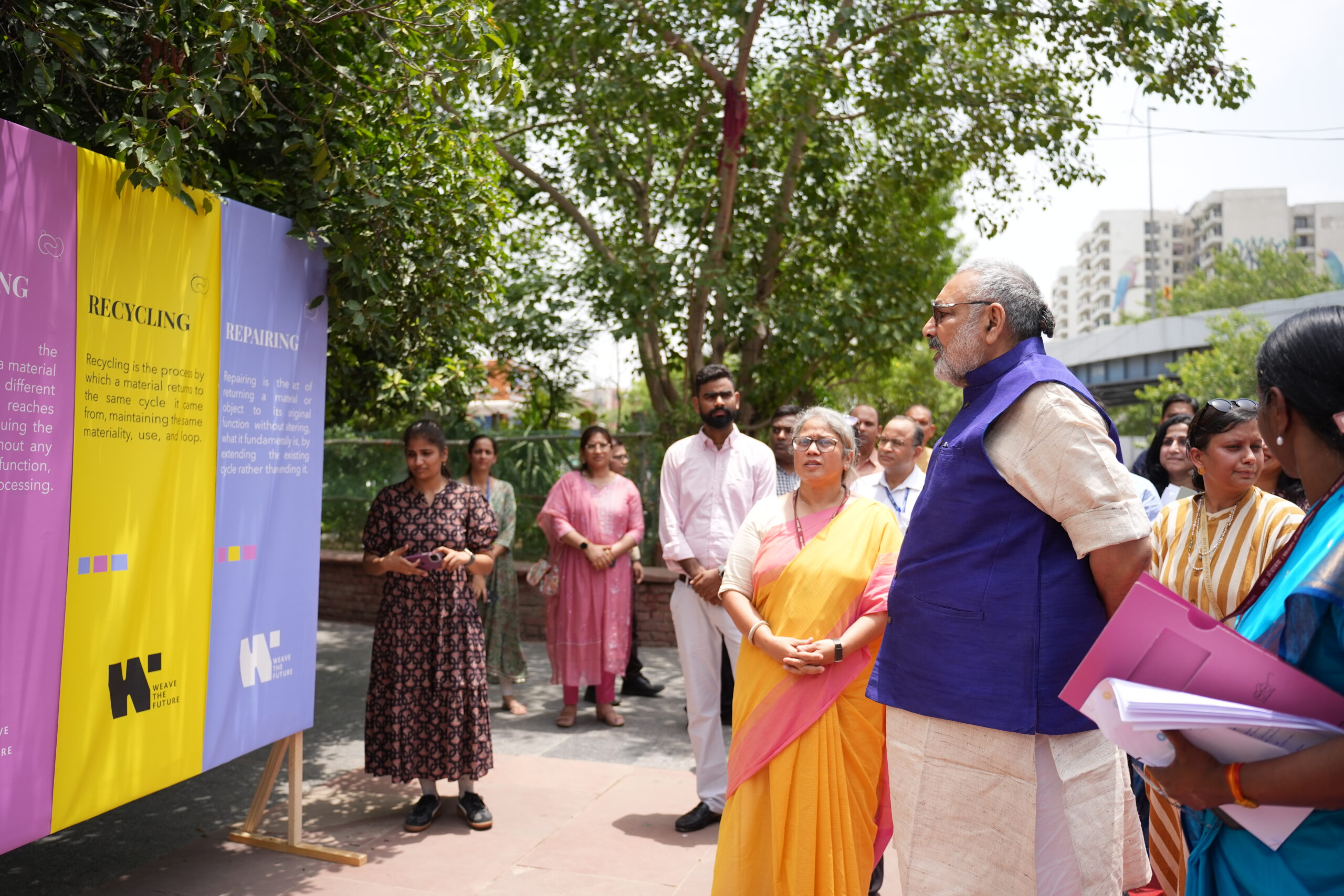
Union Minister for Textile, Shri Giriaj Singh visits the exhibition highlights India’s rich craft traditions and their relevance in building a sustainable future.
Union Minister of Textiles Giriraj Singh visits ‘Weave the Future 4.0’ at Dilli Haat, INA, New Delhi. Other who visited alongside included Neelam Shami Rao, Secretary, Ministry of Textiles; Dr M Beena, Development Commissioner (Handlooom), Amrit Raj, Development Commissioner (Handicraft), Thomas McClenaghan, Minister Counsellor & Head of Sustainable Modernisation, European Union and other senior representatives of Ministry of Textiles, Government of India.
Speaking at the exhibition, Giriraj Singh said that “As textile consumption continues to rise, it is imperative that we strengthen circular economy practices, promote responsible production, and scale innovative solutions that transform textile waste into valuable resources. Initiatives such as Weave the Future 4.0 demonstrate how entrepreneurship, innovation, and sustainability can converge to create both economic opportunities and environmental impact. Equally important is ensuring that the millions of workers who form the backbone of this sector benefit from dignified livelihoods and improved incomes. India is committed to positioning itself as a global leader in sustainable textiles, contributing not only to the nation’s growth but also to the world’s transition towards a more responsible and resilient textile ecosystem.”
An initiative of DC Handlooms, Ministry of Textiles, Government of India, Weave the Future 4.0 – Upcycling Edition is the fourth edition of the platform, focusing on the relationship between materials, communities, and the environment. The exhibition explores how traditional knowledge, responsible resource use, and innovative practices can come together to create sustainable solutions for everyday living.
Scheduled from 12–17 July 2026 at Dilli Haat, New Delhi, the six-day exhibition brings together more than 100 brands, makers, artisans, recyclers, thrift collectives, and innovators from across India. It showcases a wide range of approaches including upcycling, recycling, repair, repurposing, and circular design, highlighting how materials can be transformed through creativity and conscious practices.
Dr M Beena, Development Commissioner (Handlooms), Ministry of Textiles, Government of India, said, “Weave the Future has evolved into a national platform that connects India’s handloom and craft heritage with innovation-led solutions for textile waste management. This edition brings together artisans, students, startups, designers, and recycling enterprises to explore collaborative approaches towards addressing the growing challenge of textile waste through upcycling, repair, recycling, and circular design practices that we Indians have followed through generations. The strong participation by young entrepreneurs in Weave the Future 4.0 reflects the growing interest in sustainable consumption and resource efficiency. It also highlights the importance of creating platforms that encourage practical and scalable solutions while generating livelihood and entrepreneurship opportunities across the value chain.”
Visitors at Weave the Future 4.0 can experienced a diverse range of activities and exhibits, including:
- Upcycled and recycled products developed by artisans, designers, brands, and innovators
- Interactive installations exploring textile waste, material recovery, and circularity
- Repair, reuse, and recycling demonstrations
- Workshops and knowledge-sharing sessions on sustainable design and craft-led innovation
- Conversations around circular fashion, conscious consumption, and regenerative futures
As part of Weave the Future 4.0, the ‘Marammat’ workshop was organised today, 13th July, and will be held again on 17th July in collaboration with Rafooghar. This hands-on workshop uses fabric to explore ideas of rupture, repair, and resilience. Through processes such as cutting, stitching, mending, and layering, participants engage with cloth as a medium for personal expression, reflection, and transformation. Embracing irregular threads, raw edges, and visible repairs, the workshop encourages slowing down, caring, and reconnecting – with materials, surroundings, and oneself – promoting repair as a process of renewal rather than imperfection.