



Ecosystem thinking will gain ground, connecting suppliers, manufacturers, and customers through shared digital platforms to improve transparency, coordination, and responsiveness across the value chain, says Jyoti Taskar and Deepali Plawat.
At the start of a production shift in a textile unit in India, machines come alive in layers. Spinning frames stabilise, knitting machines settle into precise motion, processing lines warm up and operators take their set positions along the shop floor. For decades, this rhythm has been guided by human judgment for instance, a technician sensing imbalance through sound, a supervisor identifying fabric faults by eye etc.
Today, in an increasingly growing number of textile factories, that judgment is being quietly reinforced by digital intelligence. Sensors monitor vibration, energy use and process stability in real time. Vision systems scan fabric continuously for defects. Data platforms translate thousands of signals into alerts, forecasts, and recommendations. The production manager still treads the floor but decisions are increasingly shaped by real-time insights instead of post-shift reports.
This is the reality of smart manufacturing in the Indian textile industry. Not a dramatic leap into fully autonomous factories, but an uneven yet steady transition where digital technologies are first applied to solve familiar problems like downtime, quality variability, energy inefficiency, and delivery uncertainty. Research across the global textile and apparel sector reiterates this pattern in adoption of smart manufacturing techniques. Industry 4.0 adoption is still at an early stage, focused more on operational improvements than futuristic automation.
As global buyers demand faster turnaround, verified sustainability and traceability across supply chains, this transition has become a strategic necessity. Smart manufacturing is set to redefine how India will compete, comply and grow in the global textile value chain.
- Textile tech drivers
Smart manufacturing is often misunderstood as full automation. On the contrary, it is built on the convergence of multiple technologies rather than any single breakthrough. While each technology addresses a specific challenge, their combined impact enables real-time visibility, predictive control, and informed decision-making across the textile value chain. The following technologies form the backbone of this transformation.
1.1 Advanced machinery: Automation has progressed beyond mechanisation into intelligent process control. Modern spinning, knitting, and finishing equipment can self-adjust parameters to maintain consistency, optimise resources and minimise manual intervention. However, most textile firms deploy automation selectively to target bottlenecks.
1.2 Smart connectivity: Internet of Things (IoT) forms the foundation of smart manufacturing in textiles by connecting physical machines to digital intelligence. Sensors capture data on machine health, quality, energy, and environment, while networks transmit this information to software systems that turn it into actionable insight. In practice, IoT enables predictive maintenance, real-time quality monitoring, and transparent tracking of energy and resource consumption. Its real impact lies not in data collection alone, but in linking live shop-floor information to planning and decision-making systems.
1.3 Artificial intelligence: AI and machine learning transform raw data into actionable insights. In textiles, they are most commonly used for:
- Defect detection and quality prediction
- Process optimisation
- Production planning and scheduling
The true impact of smart manufacturing emerges when machines are seamlessly connected with Manufacturing Execution Systems (MES), Enterprise Resource Planning (ERP) and supply-chain platforms.
1.4 Green technologies: Energy monitoring, chemical optimisation, and waste reduction systems are increasingly embedded into smart manufacturing initiatives. While sustainability is often cited as a motivation, the literature suggests that real-time carbon and environmental tracking is still underdeveloped in textile operations.
2. Smart factory impact
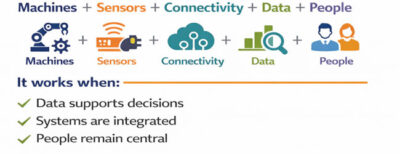
As smart manufacturing is adopted, its effects begin to show across different areas of a textile factory influencing routine operations as much as the machines themselves. Productivity improves, quality becomes more consistent, resources are used more carefully and roles on the shop floor begin to evolve. Together, these changes show how digital tools are quietly reshaping the way textiles are made, managed and delivered.
2.1 Operational efficiency: Where smart manufacturing is implemented effectively, measurable gains are reported:
- Reduced machine downtime
- Improved work efficiency
- Lower energy consumption These improvements are achieved not through radical automation, but through better visibility, faster decision-making, and proactive control
2.2 Quality consistency: Continuous monitoring and AI-based inspection reduce variability and late-stage defect detection. This is particularly critical for export-oriented manufacturers facing stringent quality and compliance requirements.
2.3 Resource optimisation: Smart manufacturing enables data-driven sustainability. Energy, water, and chemical use can be monitored and optimised in real time rather than audited retrospectively. While many firms are still at an early stage, the direction is clear: sustainability is moving from intent to system.
2.4 Workforce transformation: Contrary to common fears, the literature consistently shows that Industry 4.0 in textiles reshapes roles rather than eliminates them. Smart Manufacturing technologies strengthen human judgment rather than replacing it. Operators become process monitors, technicians become system integrators and engineers become data-informed decision-makers. Human–machine collaboration emerges as a defining feature of smart manufacturing
- Challenges and opportunities
Despite its potential, smart manufacturing is not easy to implement. Many textile factories face practical and structural challenges that slow adoption and limit impact. Understanding these barriers is essential to moving from pilots to real transformation.
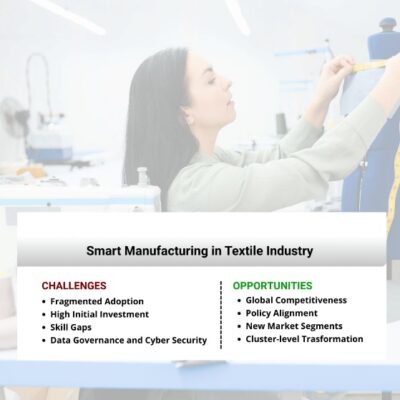
3.1 Challenges and structural barriers: While the potential of smart manufacturing is clear, scaling it across textile operations remains difficult. Many factories adopt digital tools in isolated pockets without full integration. This fragmentation limits impact and delays return. High upfront investment continues to be a hurdle, especially for small and medium enterprises where payback must be visible. Skill shortages add to the challenge, as smart manufacturing demands a blend of process expertise and data literacy. As connectivity increases, concerns around data governance and cybersecurity also come to the fore, with many firms still unprepared for this shift.
3.2 Opportunities for India’s Textile Sector: At the same time, the opportunity for India’s textile industry is substantial. Smart manufacturing enables a move beyond cost-based competition toward reliability, traceability, and speed—qualities increasingly valued by global buyers. It aligns closely with national priorities on productivity, sustainability, and technology-led growth. Intelligent systems also support the expansion of technical textiles and functional fabrics, where consistency and performance are critical. At a cluster level, shared digital platforms can reduce individual investment pressure while accelerating adoption across entire textile hubs.
Future outlook
The next phase of smart manufacturing in textiles will focus on turning data into decisions by building closed-loop systems that respond automatically to real conditions on the shop floor. At the same time, the shift toward Industry 5.0 will place greater emphasis on collaboration between skilled workers and intelligent systems, rather than automation alone. Sustainability will also become more systemic, with carbon, water, and chemical metrics embedded directly into production planning and control. Finally, ecosystem thinking will gain ground, connecting suppliers, manufacturers, and customers through shared digital platforms to improve transparency, coordination, and responsiveness across the value chain.
Conclusion
Smart manufacturing marks an important turning point for the Indian textile industry. It is less about building futuristic factories and more about using technology to solve real, everyday challenges on the shop floor. As adoption grows, success will depend not on how much technology is installed, but on how well it is aligned with people, processes, and practical goals. For India’s textile sector, smart manufacturing is a practical pathway to long-term competitiveness and a stronger global presence.
References:
- Hitesh Manglani, George L. Hodge & William Oxenham (2019) Application of the Internet of Things in the textile industry, Textile Progress, 51:3, 225-297, DOI: 10.1080/00405167.2020.1763701
- Industry 4.0 in textile and apparel sector: a systematic literature review Ana Julia Dal Forno, Walakis Vieira Bataglini, Fernanda Steffens and Antonio Augusto Ulson de Souza Department of Textile Engineering, Federal University of Santa Catarina, Blumenau, Brazil
- https://www.tech4lyf.com/blog/smart-factory-revolution-real-life-case-studies-from-india/
- https://www.investindia.gov.in/team-india-blogs/green-textiles-smart-fabrics-new-frontier-investors-indias-textile-industry
- https://www.globaltextiletimes.com/articles/industry-4-0-in-textiles-how-smart-factories-are-evolving/
About the authors
Jyoti Taskar is the Head of Marketing and Sales at Ahmedabad Textile Industry’s Research Association (ATIRA) and Deepali Plawat is the Senior Deputy Director at ATIRA.