


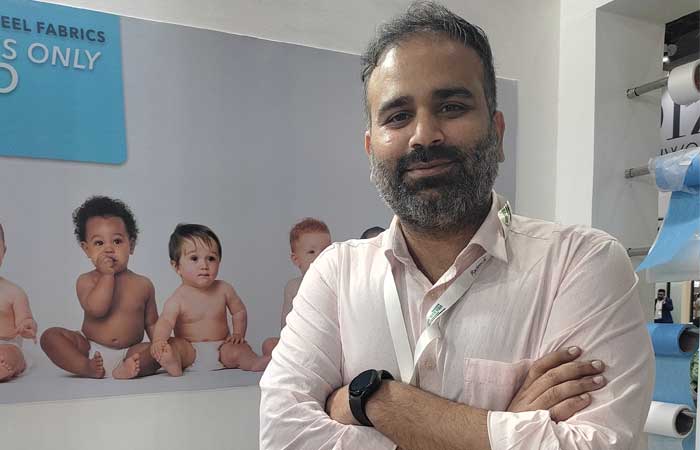
Ktex Nonwovens was established in 2008 with a single production line and an initial capacity of 6,000 tonnes per year, manufactures spunbond and spunmelt nonwoven fabrics primarily used in hygiene products, feminine care, adult diapers, and medical applications such as gowns and masks. Over the past six years, the company has grown significantly, now producing 35,000 tonnes annually, making it one of the fastest-growing nonwoven fabric manufacturers in India and the second largest in terms of production capacity within the hygiene sector. Nikhil Vaswani, Global Sales & Marketing Head, Ktex Nonwovens, in this interview with Divya Shetty, shares the current state of the Indian hygiene care market and how his company is contributing in this growth.
What cutting-edge technology does Ktex Nonwovens employ in its plant, and how does it contribute to sustainability in the Indian context?
We operate a state-of-the-art bicomponent machine, the first of its kind in India, producing the softest nonwoven fabric on the market, closely resembling cotton. Our plant, located in Rajput, approximately 100 km from Mundra Port, houses three production lines—a combination of Chinese and German machinery. The German lines include Ecofill and Reifenhauser systems. Line two is a bicomponent SMMS line, and line three is a Reifenhauser 6-beam SSMMMS line. This advanced technology enables us to significantly reduce the fabric’s weight while maintaining its properties, contributing to reduced plastic usage and promoting sustainability in the Indian context. We operate a recycling plant that focuses on alternative energy sources, such as wind and solar.
What factors contribute to India’s strong position in the global hygiene care market, particularly in products like diapers, femcare, and adult care?
India holds a strong position in the global hygiene care market due to its low market penetration in products such as diapers, femcare, and adult care. As incomes rise, there is a shift from cloth to disposable diapers, in contrast to other regions where the trend is moving towards reusables. India’s growing affordability for disposable products, including diapers, sanitary napkins, and adult diapers, underscores its significant market potential. While Africa is also a strong market, India’s large and unified population of approximately 1.4 billion presents substantial growth opportunities. Over the next decade, we anticipate a significant increase in the number of manufacturers in the diaper and femcare sectors.
The growth observed in the Indian market has attracted considerable interest from international companies. As a result, these companies are likely to invest significantly in India, either by establishing their own facilities or forming partnerships with Indian manufacturers.
Could you provide more details about your global presence? Also, where do you source your materials from?
At present, we source our raw materials from two key suppliers: Exxon in Singapore and another supplier based in the Middle East. Exxon stands out for its exceptional quality, particularly in the hygiene products sector, where its materials deliver superior performance.
In terms of market distribution, around 75-80 per cent of our products are sold within India. The remaining 20-25 per cent is exported to international markets, with a strong focus on Africa and the United States, which are our primary export destinations.
What recommendations would you offer the government to help further strengthen and develop the hygiene sector in India?
We recommend that the government address the issue of foreign companies dumping products in India or shipping companies imposing excessively high global shipping rates. One potential solution could be the exertion of soft power to mitigate these practices. Although dumping is frequently associated with China, many countries benefit from free trade agreements which offer reduced raw material prices and other advantages, enabling them to sell products at lower prices in India. This situation creates challenges for Indian manufacturers, who struggle to compete on price. Additionally, despite free trade agreements intended to benefit consumers through zero-duty provisions, manufacturers sometimes inflate prices to capture the duty savings as additional margin, negating the intended benefits.
What are the future plans of Ktex Nonwovens?
In the short term, we have successfully expanded our production lines and now aim to focus on research and development, sustainability, and reducing plastic usage. KTex is committed to being a future-ready company, and the market continues to present significant growth opportunities. By analysing data from countries with advanced markets, we can gain insights into premium product quality and pricing strategies.