

The Intelligent Mill
The future of Indian textiles lies in balance. Balance between tradition and technology, between scale and sensitivity, and between craftsmanship and data, states Rohit Khemka.
For decades, the Indian textile industry has been admired for its scale, skill, and legacy. Today, however, a quiet but meaningful shift is taking place. Manufacturing is no longer only about producing fabric efficiently. It is about producing fabric intelligently. Smart manufacturing is changing how textiles are designed, produced, and ultimately used, and in the process, it is redefining what fabric itself can be.
At its core, smart manufacturing is about using technology to make better decisions. Decisions that are faster, more informed, and more responsible. In a sector as layered and complex as textiles, this change is proving to be deeply impactful.
From traditional mills to thinking factories
Indian textile manufacturing has traditionally been labour-intensive and experience-driven. Knowledge has been passed down through generations, and this foundation remains invaluable. What has changed is the addition of systems that can measure, monitor, and respond in real time.
Today, automation and digitally connected machines allow manufacturers to track loom performance, energy usage, fabric defects, and production speeds on a continuous basis. Industry observations suggest that mills adopting basic automation and monitoring systems have seen productivity improvements of nearly 15 to 25 per cent, along with reduced wastage and rework.
This transition is not about replacing people. It is about supporting skilled teams with tools that improve consistency and reduce dependency on guesswork, something global buyers increasingly expect
The rise of versatile fabrics
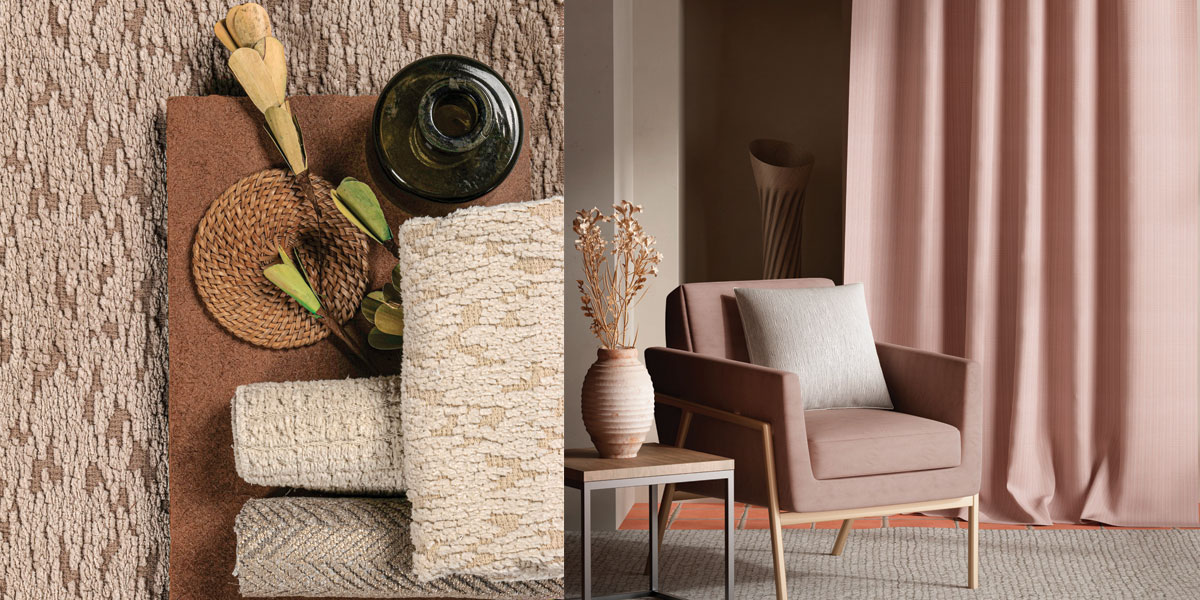
One of the most visible outcomes of smart manufacturing is the growing versatility of fabrics. Textiles are no longer designed for a single fixed application. Today, a fabric may be used for upholstery, wall coverings, soft furnishings, or even displayed as a framed surface, depending on its finish and performance.
Advanced finishing technologies, digital printing, and controlled coating processes have made it possible to create fabrics that are stain-resistant, UV-stable, waterproof, fire-retardant, or acoustically effective without compromising on design. This has expanded the role of textiles well beyond fashion and into architecture, interiors, hospitality, and public spaces.
Digitally controlled finishing systems also allow more precise application of chemicals and coatings. In many cases, this has led to a reduction in chemical usage by 20 to 30 percent compared to conventional processes. At the same time, consistency across production batches gives designers and architects greater confidence when specifying fabrics for large projects.
Data and AI
Data has become one of the most valuable assets in modern textile manufacturing. Through connected machines and analytics platforms, manufacturers can monitor yarn quality, fabric density, machine efficiency, and delivery timelines in real time.
Artificial intelligence is helping convert this data into actionable insights. Predictive maintenance systems can flag potential machine issues before breakdowns occur, helping reduce unexpected downtime by up to 40 percent. Similarly, data-driven quality checks help identify defects early in the process, improving overall yield and reducing material loss.
In practical terms, this means better planning, tighter timelines, and greater reliability, all of which are critical in a highly competitive market.
Sustainability through smart systems
Sustainability has become inseparable from manufacturing decisions. Smart systems now allow accurate measurement of water consumption, energy use, and emissions. This visibility enables manufacturers to optimise processes instead of relying on assumptions.
In textile processing, smart water management solutions have helped reduce water usage by approximately 15 to 20 percent in several facilities. Energy monitoring systems support better load management, lowering operational costs while aligning with environmental standards required by international buyers.
Smart manufacturing also supports traceability and responsible sourcing, both of which are becoming essential for export markets and premium domestic segments.
The changing role of the workforce
As technology becomes more central, the nature of work inside textile units is evolving. While repetitive tasks are increasingly automated, the need for skilled operators and technicians who understand both textiles and digital systems is growing.
This shift presents a challenge, particularly in training and skill development, but it also presents an opportunity. Factories that invest in upskilling their workforce alongside technological upgrades tend to see more sustainable and long-term gains.
Challenges and realities
The move toward smart manufacturing does come with challenges. High initial investment, integration with existing machinery, and resistance to change are real concerns, especially for small and mid-sized manufacturers. However, these challenges are gradually being addressed through phased adoption, technology partnerships, and government-supported initiatives.
It is important to note that smart manufacturing does not require a complete overhaul. Even incremental steps, such as digitising quality checks or automating a single production stage, can deliver meaningful improvements.
Looking ahead
The future of Indian textiles lies in balance. Balance between tradition and technology, between scale and sensitivity, and between craftsmanship and data.
Smart manufacturing is not about making the industry impersonal or mechanical. On the contrary, it allows creativity to flourish by removing inefficiencies and limitations. It enables fabrics to be more versatile, more responsible, and better aligned with how people live and build today.
For the Indian textile industry, this shift represents more than operational improvement. It is an opportunity to reposition itself globally as a leader in intelligent, design-driven, and sustainable textile manufacturing.
That is a future worth weaving.
About the author
Rohit Khemka is the Founder of RR Décor. Known as a pioneer in bringing about a change in how people view and use Bhagalpur silks, Khemka has established a name for himself in the interior furnishing industry.
