

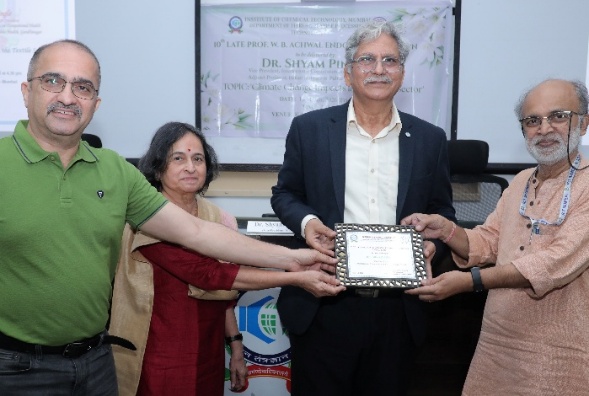
Prof W B Achwal endowment oration 2026 held at ICT Mumbai
Dr Shyam Pingle speaks on climate risks in the textile sector.
The Prof W B Achwal Endowment Oration 2026 was held on March 13 at the KV Auditorium of the Institute of Chemical Technology, Mumbai, drawing an enthusiastic response from participants representing industry, academia, and the student community.
The annual oration honours the legacy of the late Prof Waman B Achwal, remembered as a distinguished academic and multifaceted personality. He secured the top rank in Textile Technology and earned a double PhD from UDCT India and RWTH Aachen University, Germany. Over the years, Prof Achwal built a reputation as an eminent scientist and consultant, advising numerous industrial organisations and government bodies across several countries. He was also a Gold Medallist of the Society of Dyers and Colourists, UK, and was known for his interests in literature, drama, and sports.
The event opened with reflections by Deepti Deobagkar, former Professor of Molecular Genetics and Director of the Bioinformatics Centre, who shared personal memories of her father, Prof Achwal. Her address highlighted his academic dedication, intellectual curiosity, and broad cultural interests.
The keynote oration was delivered by Shyam Pingle, VP – International Commission on Occupational Health, on the theme “Climate Change Impacts in the Textile Sector.” In his address, Pingle highlighted the growing influence of climate change on India’s textile industry, particularly from an occupational health perspective, noting that climate-related risks are increasingly affecting workers across the entire textile value chain.
He presented several examples of climate-responsive occupational health measures, including heat risk management, engineering controls, health surveillance, and stronger integration of workplace health policies with climate adaptation strategies.
Pingle emphasised that climate change should not be viewed solely as an environmental issue but also as a challenge linked to workforce sustainability, productivity, and social equity. He called for urgent policy action and greater integration of occupational health considerations into climate resilience planning within the textile sector.
