


Color Service, a world leader in automatic dosing system, has an innovative solution that allows to use both powder and liquid dyes.
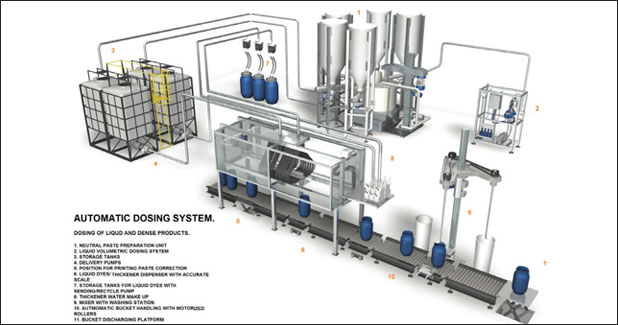
Print houses use dyes in powder or liquid form. In fact, 90 per cent of print houses use only powder dyes such as reactive and disperse (though this has to be first dissolved before application and needs to be prepared fresh). Only 10 per cent of them use liquid pigment dyes. Liquid dyes need separate storage tanks and need to be kept in constant circulation in order to avoid sedimentation and spoiling the entire batch. In either case, dosing of dyes needs to be accurate in order to print right the first time. Manual dosing leads to many problems. It is time consuming and maintaining accuracy becomes a herculean task. Most printing automation focuses on dosing for liquid dyes only. Color Service, a world leader in automatic dosing system, has an innovative solution that allows to use both powder and liquid dyes. The Color Service automatic printing colour kitchen is composed of two main units – thickener preparation unit and paste dosing unit. Both units can work either standalone or together.
Thickener preparation unit
Thickener preparation for printing requires special care. Manual addition of chemicals can change the composition of the mix. The addition of chemicals needs to be precise and the viscosity too needs to be maintained in order to ensure good quality print. When thickeners are mass produced and stored for a long time, it may affect the viscosity and render the whole mix useless. Hence, the best practise is to make the thickener fresh daily as per the requirement.
The thickener preparation unit from Color Service cooks the thickener automatically with minimum manual intervention. All powder and liquid ingredients can be added automatically and can work with different recipes. The unit is equipped with fiberglass silos for powder chemicals (supplied by Color Service) and liquid chemical dispenser to add powders and liquids in to the mixture. The unit not only allows setting the quantity but also the order of powders and liquids that needs to be added in the mix. A powerful stirrer along with a scraper stirs the mix perfectly and gives a homogenous thickener. The thickener is delivered to a storage tank via a gear pump and a collector. Each thickener tank is equipped with a level sensor to measure the quantity of the thickener. There are two different filling equipment – a blower pump for powder dyes and a pneumatic diaphragm pump for liquid. Except for filling of powder silos and liquid chemical tanks, the operator does not have to do anything during the entire process. All silos for powder and liquid are equipped with level sensors. Depending on the consumption filling, operation can be done daily or on weekly basis.
Printing paste dosing unit
Dosing unit prepares the printing paste in small or big quantity based on customer’s recipes. This unit has unique function that allows to dose powder directly.
Depending on the quantity of print paste required, the unit picks up a drum and delivers it to an initial thickener dosing head. Just a small of amount thickener is dosed here in order to avoid sticking of the dyes. The unit then adds dyes on initial layer of the thickener.
For liquid dyes such as pigments, dosing can be done in the same head. But for powder dyes, the drum goes to a powder dosing unit on a conveyor. After complete dosing of powder, the drum goes back to paste dosing unit. The drum is moved to the next stage to complete the remaining amount of thickener. A label is put on the drum to identify the content, batch, print machine, etc., before it goes to a stirrer unit.
What sets the stirrer unit apart from the ordinary stirrers is that it allows mixing powders and liquids together. Drum is turned as well as stirrer travels up and down for proper mixing. There are two stirrers. When one stirrer mixes the drum, the other goes for washing.
This system allows simultaneous operation. The whole unit is divided in three stages: thickener initial layer+dyes dosing, final thickener dosing, and stirring. When the work is completed in a stage, the drum passes to the next stage and a new drum is placed.