


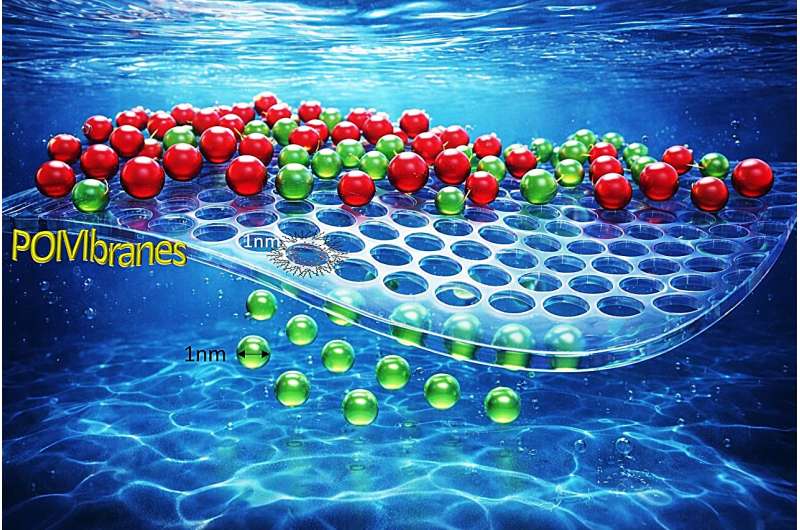
This precision is inspired by biological gatekeepers like aquaporins, which filter molecules using pores of exact dimensions.
Researchers have developed a new class of highly precise filtration membranes that could significantly reduce energy use and enable large-scale water reuse in industrial processes. Published in the Journal of the American Chemical Society, the study involved scientists from CSIR-Central Salt and Marine Chemicals Research Institute (CSMCRI), IIT Gandhinagar, Nanyang Technological University (Singapore), and the S N Bose National Centre for Basic Sciences.
Industrial separations—such as purifying medicines, removing textile dyes, and processing food—are among the most energy-intensive operations worldwide, accounting for nearly 40–50% of global industrial energy consumption. Many factories still rely on traditional methods like distillation and evaporation, which are expensive and carbon-heavy. While membrane-based separation is considered cleaner, most current polymer membranes have irregular pore sizes and deteriorate over time, limiting their precision and long-term stability.
To overcome these challenges, the research team engineered a new class of ultra-selective crystalline membranes called “POMbranes,” featuring pores roughly one nanometre wide—thousands of times thinner than a human hair. This precision is inspired by biological gatekeepers like aquaporins, which filter molecules using pores of exact dimensions.
The team used polyoxometalate (POM) clusters, which contain a permanent, naturally occurring one-nanometre hole. By attaching flexible chemical chains to these clusters, the researchers enabled them to self-assemble into continuous, defect-free ultrathin films when spread on water. Adjusting chain length controlled the packing density, forcing molecules to pass only through the engineered nanoholes.
Testing showed the membranes can separate molecules differing by just 100–200 Daltons—an accuracy difficult to achieve with conventional membranes. The technology demonstrated nearly ten times better separation performance than existing systems, while remaining flexible, stable across different pH levels, and scalable to large sheets.
This innovation holds strong promise for India’s textile and pharmaceutical sectors. Textile dyeing and finishing produce vast volumes of polluted wastewater, and the new membranes could selectively remove dye molecules while enabling water recycling, reducing freshwater use and chemical discharge. In pharmaceuticals, the membranes could improve drug purification and solvent recovery, lowering energy consumption while meeting strict quality standards.
With their tunable structure, high selectivity, and chemical resilience, POMbranes could become a foundational technology for sustainable manufacturing, offering a nature-inspired solution to critical industrial separation challenges.
News source: Phys Org