


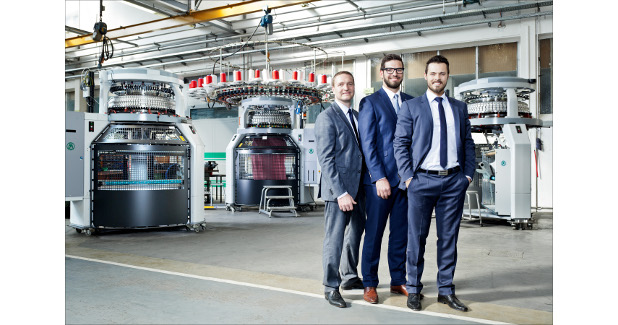
Circular knitted fabric is growing increasingly popular as an upper material for leisure and sport shoes. The high level of productivity makes circular knitting especially interesting for the manufacture of “fabric†shoe uppers. Circular knitting machine manufacturer Mayer & Cie. has in its extensive portfolio several machines that are suitable for the manufacture of shoe upper material. The long-established manufacturer’s new OVJA 1.6 EE – 3WT/2WT is the first machine in the company’s product range that was specially designed for this purpose.
“Circular knitted fabric has long been in use in footwear, for the insole or the lining, for example,†says Hardy Bühler, Key Account Manager Brands at Mayer & Cie. “Circular knitting of shoe uppers,†he adds, “is a relatively recent trend. Demand has increased enormously over the past three or four years, and it has grown all over the world.â€Â
Advantages of circular knitting over conventional
The conventional means of manufacturing shoe upper material for sport shoes has until now been either flat knitting or warp knitting. Circular knitting clearly has the edge over both of these in terms of productivity and variety of patterns. A circular knitting machine’s output is around ten to twenty times that of a flat knitting machine and a warp knitting machine needs several warp beams to produce the patterns required for shoe upper material. The warp beams have to be prepared, which requires a labour input that is only worthwhile if larger quantities of the patterned fabric are to be manufactured. If a circular knitting machine is to produce a pattern, it can be changed swiftly and without complications by means of the design software. As a result, smaller lots are profitable on a circular knitting machine.
“The potential for circular knitting in the manufacture of shoe upper material is hugeâ€Â, says Mayer & Cie.’s Key Account Manager Brands in view of these advantages. “And we are well prepared to make good use of it.†This is a reference to Mayer & Cie.’s existing portfolio, which is considered to be the most comprehensive in the market. Above all, the production of shoe upper material is a use, Bühler says, for which Mayer & Cie.’s well-known OVJA range of circular knitting machines is optimally suited.
Reinforcement for a compact portfolio
The OVJA 1.6 ET 3 WT, for example, is an established machine in the Mayer & Cie. product range. With its stitch transfer option for the production of perforated or hole designs it has already proved suitable for the manufacture of shoe upper material. “Only recently it enabled us to acquire a new customer who supplies the footwear industry,†Bühler says. The OVJA 1.6 ET 3 WT is very versatile in terms of the patterns it can produce, especially because it can transfer stitches on every third system. Its three-way technology ensures maximum design flexibility by means of individual needle selection. It makes a wide range of structures, including the above-mentioned hole structure, possible. Using a conversion kit the OVJA 1.6 ET 3 WT can also be quickly used as a full jacquard machine to produce multi-coloured shoe designs.
The newcomer to the range, specially designed for use in the shoe upper sector, is the OVJA 1.6 EE – 3WT/2WT. It uses three-way technology in the cylinder and two-way technology in the rib dial, thereby ensuring maximum pattern variety. This combination makes it an optimal footwear machine that is especially suitable for the production of multi-coloured designs along with microstructure elements.
Other machines in the MCT range that are fit for the production of shoe upper material are, for example, the Technit D3, the OVJA 1.6 E and the OVJA 0.8 E. The Technit D3 knits three-threaded on the cylinder side and produces spacer structures with four needle tracks. The OVJA 1.6 E offers an almost unlimited number of knitted structures, while the OVJA 0.8 E is the right machine for coarseknit jacquard and hole structures.
The OVJA 1.6 ET 3 WT is an established machine in the Mayer & Cie. portfolio. It has proven suitable for producing shoe uppers.
“Demand for circular knitted shoe uppers has increased enormously over the past three to four yearsâ€Â, says Mayer & Cie.’s Hardy Bühler.
Mayer & Cie. is a leading international manufacturer of circular knitting machines. The company manufactures the entire range of machines required for making modern textiles. Fabrics for home textiles, sportswear, nightwear and swimwear, seat covers, underwear and technical uses are made on knitting machines.
Founded in 1905, Mayer & Cie. generated sales of EUR 105 million in 2016 with about 500 employees worldwide, according to preliminary figures. In addition to its headquarters in Albstadt, Germany, where around 370 people work, and subsidiaries in China and the Czech Republic, Mayer & Cie. is represented by sales partners in around 80 countries.