


Use of high speed pinned rollers has spread relatively recently in India in the last 10-12 years, affirm Brian A Leach and Kishore Kumar Khaitan.
In a spinning mill fibre preparatory for cotton or synthetics, the critical importance of regular maintenance of beaters is well known. However, though there is a replacement or regrinding schedule for wired cylinders and card clothing, there is surprisingly no similar schedule for pinned beaters in most mills.
The reason for this is not hard to find. Pinned beaters have longer lifecycle of 3-8 years (depending on the stage of the process where they are used and the rate of production); require no regrinding during their operating cycle unlike wired rollers; machine manufacturers, in general, have also not provided their clients with a proper maintenance schedule for pinned rollers; hence there is also a lack of awareness or guidelines for the same. .
Yet another reason is that the use of high speed pinned rollers has spread relatively recently in India in the last 10-12 years. This is due to their superior performance when compared to saw-tooth rollers, in terms of life, maintenance costs and quality of fibre opening. The major benefits are:.
- Pins provide extended product life
- Pins are kind to fibres reduced fibre rupture leading to yarn strength improvements.
- Pins provide fibre process flexibility
- Pinned products are easily repairable (cost savings)
- Extruded aluminum tubes and profiles are lightweight alternatives of most metallic wire applications with cast or steel base rollers
- High tech pin fixing methods provide pin point accuracy without grinding.
- Pin designs provide improved fibre transfer /doffing
Due to the above listed benefits, an increasing number of mills are going for conversion of their saw tooth beaters to pinned beaters by retrofitting pinned rollers in place of the saw tooth ones. The payback period for such conversions is less than a year in most cases!
The main reason for lack of sufficient attention to pinned rollers is that since pinned rollers operation is usually trouble free and they require very little attention over their operating cycle, the maintenance department of the Mill tends to take them for granted and do not have any sense of urgency associated with their upkeep.
The fact is that pinned rollers can do more damage if they are used beyond their useful life as compared to over-used wired beaters, hence their timely replacement or repair is of critical importance to ensure quality, productivity and low fibre loss. Pinned Beaters in poor condition can lead to a dramatic increase in fibre rupture& neps besides reduction in thrash removal efficiency. Use of pinned beaters beyond their useful life also increases the wear on the wired rollers used in the preparatory process, thus also leading to indirect increase in maintenance costs.
We now explain how the opening action of saw tooth wire is characteristically different from pins and how this affects fibre characteristics. In FIGURE 1, you see an illustration of saw tooth wire opening action. As you will observe, the opening action is done by the knife-edges of the saw tooth, which tend to cut open the fibres. This causes fibre rupture and lint generation. This tends to increase the percentage of short fibres and the level of neps. The thrash contained in the fibre supply also tends to disintegrate into micro dust due to the saw tooth action.
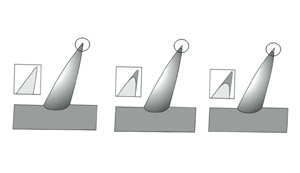
In comparison, the pin has a smooth round surface and a spherical tip, which opens the fibres through a gentle untangling action. This is evident from observation of FIGURE 2. It is obvious that fibre rupture would be minimised as well as the consequent generation of micro dust and lint would also reduced considerably with the use of pins. The round profile of pins also has another significant advant