


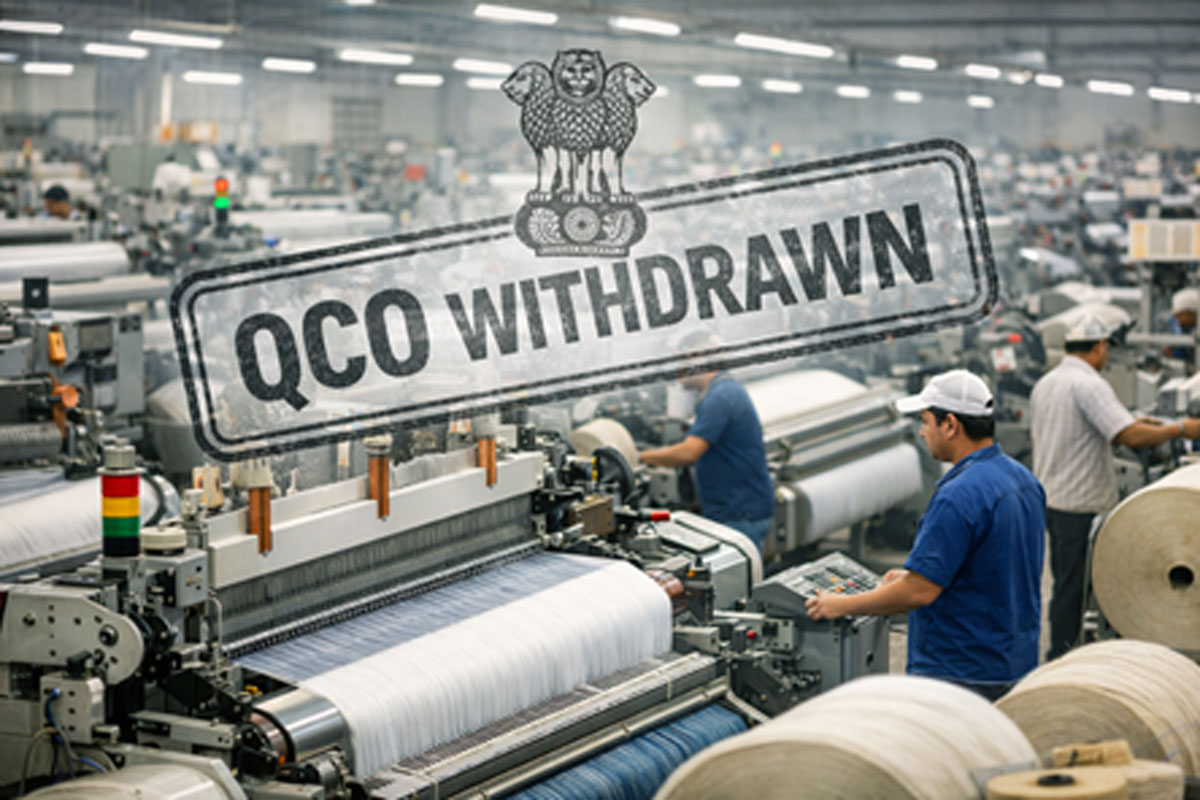
The Union Ministry of Heavy Industries has withdrawn its August 24, 2024 order concerning quality standards for machinery and electrical equipment safety.
India’s textile industry has welcomed the central government’s January 2026 decision to withdraw the Quality Control Order (QCO) on machinery and electrical equipment safety, a move that removes mandatory certification requirements for a wide range of imported textile machinery. The Union Ministry of Heavy Industries has withdrawn its August 24, 2024 order concerning quality standards for machinery and electrical equipment safety.
The government cited “public interest” considerations under the Bureau of Indian Standards (BIS) Act, 2016, following sustained industry concerns about compliance costs, supply disruptions, and the limited domestic availability of advanced textile machinery. The decision comes as a significant relief for textile manufacturers, exporters, and foreign investors who had raised alarms over the potential impact of the QCO on the sector’s competitiveness.
The Omnibus Technical Regulation, introduced in August 2024, was designed to create a mandatory safety and certification framework for a broad range of machinery and electrical equipment across sectors. It was originally scheduled to come into force on October 1, 2026, after multiple deferrals. The regulation covered machines, electrical equipment, and their assemblies, sub-assemblies, and components, with certain exemptions for products already covered under other BIS QCOs, goods manufactured in India exclusively for export, and construction equipment regulated under the Central Motor Vehicles Rules, 1989.
However, textile industry stakeholders argued that the QCO would impose disproportionate compliance burdens on a sector heavily dependent on imported machinery. They warned that mandatory BIS certification could lead to production delays, increased costs, and supply chain disruptions. This was particularly concerning for major textile hubs such as Surat, where advanced machinery is essential for maintaining productivity, quality, and export competitiveness.
Industry bodies like the South Gujarat Chamber of Commerce and Industry (SGCCI) highlighted that the textile market in India is currently valued at around $65 billion and is expected to reach $350 billion by 2030. Achieving this growth, they said, would require investments of approximately $15 billion in nearly 450,000 high-speed weaving machines, many of which are not manufactured domestically. Representatives also noted that the embroidery segment relies heavily on imported machinery, with equipment needing replacement every two to three years due to rapid technological upgrades.
According to industry leaders, nearly 95 per cent of machinery used in the textile sector is imported. They warned that rigid safety certification norms could have disrupted production, delayed modernisation efforts, and potentially led to job losses across the textile value chain.
With the QCO now withdrawn, import flows remain unrestricted, ensuring continued access to specialised weaving, processing, and embroidery machinery. The move also eliminates compliance costs and lead-time risks associated with safety certification and documentation. For manufacturers planning large-scale modernisation projects, the decision brings much-needed certainty and supports ongoing investments in capacity expansion and technology upgrades.
As the textile sector continues its growth trajectory, the withdrawal of the QCO is being viewed as a positive step towards preserving India’s competitiveness in global markets, enabling the industry to modernise and expand without regulatory bottlenecks.