


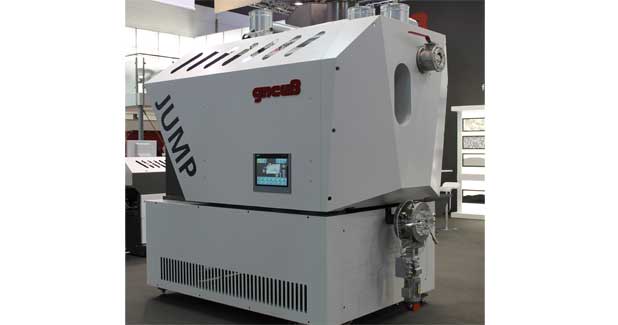
At this year’s ITMA, Gneuss will present its innovative PET recycling process with Gneuss’ reactor technology. The Gneuss Recycling Technology enables the processing of high-volume, industrial PET waste from fibre, nonwoven or film production, and from contaminated post-consumer bottle flakes. The recycling technology is based on the Gneuss Processing Unit (GPU) with MRS extruder, rotary filtration system and online viscometer, combined with Gneuss’ JUMP reactor. This is a sophisticated processing step to accurately boost the IV of the PET polymer in the melt phase.
The first important processing stage, melt decontamination, takes place in the GPU. With its excellent devolatilisation capacity, the MRS extruder can process PET waste with high residual moisture levels and/or contamination (such as spin finish oils) without the need for any pre-treatment of the waste. In the Multi Rotation Drum, eight satellite screws produce a large melt surface and surface exchange rate, so that an optimum devolatilisation and decontamination result can be achieved with conventional water ring vacuum pumps. All volatile foreign substances, such as water and/or spinning oils, are removed.
Solid impurities are subsequently filtered out by the melt filter. Rotary Filtration Systems operate continuously, process constant and automatically, and guarantee a particle-free melt thanks to finest filter elements with filter fineness down to below 20 µm.
During the second important stage of the process, the purified and homogenised polymer is delivered into the JUMP reactor. Here, too, a large surface area of the polymer melt and optimum residence time of the polymer under vacuum are decisive factors. The polymer passes over several slow turning elements, which create a polymer film, the surface of which is constantly renewed. The reactor vessel is kept under vacuum and by regulating the residence time and speed of rotation of the agitating devices, the polycondensation reaction can be altered to achieve higher viscosities. The IV value of the PET melt can be specifically influenced over a wide range so that an increase of 0.02 to a maximum of 0.3 dl/g is possible. The design of the JUMP prevents the entry of oxygen, so discolouration (yellowing) of the polymer is minimised.
After passing through a stilling section in the reactor, the polymer melt is pumped either directly into the production process (e.g. direct extrusion melt spinning, strapping) or into a pelletising (chip cutting) system.
With this recycling technology, combining an MRS extruder with the JUMP reactor, industrial waste can be turned into a high-quality and directly usable melt in a very short time. Thanks to the enormous line flexibility, different PET qualities can be produced.
The JUMP process is an extremely efficient alternative to a Solid State Polymerisation (SSP) as there is no energy needed to cool the polymer down and then reheat it. Further, the reaction time in the melt phase is considerably faster than in the solid phase, which also contributes to the better economics of the JUMP system. Last but not least, the JUMP offers major advantages over an SSP in terms of space requirements and even maintenance.