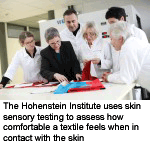
The Hohenstein Institute will be holding its new webinar, "Feeling good means … wearing comfortable clothes!" on February 2, 2015. This one will be about skin sensory functions. The free webinars, in German at 13.00 hrs (CET) and in English at 16.00 hrs (CET), will introduce the Hohenstein Institute’s testing for skin sensory functions. This offers an objective way of measuring how textiles feel on the skin, and also indicates any potential for improving the products being tested. As well as the tests themselves, the webinar will also introduce the "Skin sensorial comfort vote" quality label. The quality label shows the mark awarded to a product that has been tested, giving consumers a useful indicator of the skin sensory comfort of the textile. This is particularly useful for online and mail-order retailers, as it gives the customer an objective assessment of how the products will feel to wear, without him or her having to try them on.
Anyone who is interested can sign up for the online event at www.hohenstein.com/skinsensory-webinar. The technical requirements for taking part in the webinar are a PC connected to the Internet and loudspeakers or a headset. The free desktop application GoToWebinar, which is available from the Hohenstein Institute, must be installed before the webinar starts. The Hohenstein Institute Press Office will be happy to help with any technical questions about this.
The Hohenstein Institute has been measuring the comfort of textiles for about two decades. It uses various skin sensory and thermophysiological tests to assess how textiles feel on the skin. The test methods were developed by the Hohenstein Institute itself. The test process was validated in numerous wearing tests using volunteers, so that subjective sensations could be measured objectively. The results of these tests are used to produce a comfort vote indicating the skin sensory comfort of a textile. The various figures are obtained by measuring skin sensory parameters. These include the stiffness of a textile and the wet cling index, i.e. how much a textile clings to sweaty skin. The sorption index shows how quickly a textile absorbs sweat from the skin. The Hohenstein Institute also uses the surface index to measure whether the surface of the test sample is too rough or too smooth or neutral from a skin sensory point of view. The number of points where a textile material contacts the skin is measured via the surface characteristics. In order to receive a skin sensorial comfort vote, a textile must not only pass skin sensory tests but also thermophysiological tests. Here, the Skin Model is used to measure water vapour resistance (i.e. breathability) and thermal insulation.
Feeling good means…wearing comfortable clothes!
 By
By