


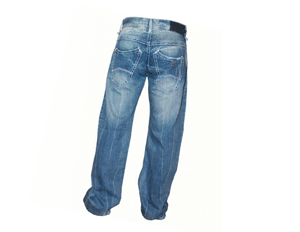
Dye quantity present in fabric, time of process and salt content have effect on the fading of denim, find M Boopathi and VR Giri Dev.
Denim products are one of the fast moving consumer durables and have become symbolic of a casual lifestyle in modern times. The global demand for denim is estimated to reach $56 billion within this decade. Denim fabrics are usually dyed with indigo apart from other synthetic dyes. Fabrics dyed with indigo dyes have a niche market for production of fashionable apparels and the garment finishing in terms of fading plays a crucial role in marketability of the denim garments.
Several commercial methods of fading such as sanding, sand blasting, brushing, prewashing, rinsing, stonewashing, sand washing, snow washing, stonewashing with enzymes, bleaching and laser fading have been successfully applied to the denim products to achieve the desired colour fading and worn-out effect. More innovations and subtle modifications has been taking place in field of fading in recent past to overcome limitations such as surface discoloration with abrasion, wear and tear of the fabric, back staining and damage to the equipment used for fading. In short, new and novel methods are developed aiming at new fading effects which are cost effective, environmentally friendly apart from offering new design patterns.
The oxidising chemicals such as hypochlorite, persulphate, permanganate, ozone and other oxidizing agents are used by industries to achieve desired fading effect.
Hypochlorite based fading is prevalent in garment finishing industries and the major problem associated with this method is the poor storage stability of hypochlorite and handling issues. To overcome above limitations, in situ generation of hypochlorite by electrochemical method has been successfully adopted in paper industry for bleaching of wood pulp. The same technique has also been extended to study the fading of indigo dyed denims. The study has focused on electrochemical generation of sodium hypochlorite along with bromine containing oxidising agents in a two stage process. In the present work, single step in-situ generation of hypochlorite was adopted for fading of denim fabrics using Taguchi experimental design. In addition to that, based on the preliminary studies, fabric parameters namely weight per square metre was also included in the design to study its influence on quality of fading.
Materials
Commercial denim fabrics with varying weight per square meter (136, 238, 340 & 493) were procured from local manufacturer. In house developed electrochemical cell was used for fading process. Graphite electrodes procured from alpha aesar, US was used for the study. Commercial DC Power supply used for electro deposition was used for regulating the DC supply in the cell. Laboratory Scale reagents namely NaCl and H2O2 was procured from SRL chemicals Pvt Ltd., India and used without any purification.
Methods
Pretreatment: Denim fabrics were prepared for electrochemical treatment by immersing them in hot water for period of 30 minutes to ensure removal of water soluble impurities present in the fabric. The fabric was than dried and taken to fading trials.
Fading by electrochemical method: Denim fabrics were prepared with sample size 5 x 5 cm2 for electrochemical fading trials. The schematic diagram of the electrochemical cell used in the study is given in Figure 1. The distance between the electrodes was fixed at 4 cm. Sodium chloride was used as an electrolyte in the cell. The factors such as salt concentration (%), voltage and its application duration (min) were varied apart from fabric weight per square m2. Taguchi experimental design was adopted for carrying out the experimental runs.
Taguchi experimental design: Taguchi approach is a simple and robust techniqu