Close Menu
Indian Textile Journal
  • Home
  • Textile Machinery
    • Allied Equipment and Accessories
    • Automation
    • Dyeing, Processing & Finishing
    • Knitting
    • Printing
    • Spinning
    • Weaving
  • Tech Textiles
  • Sustainability
  • Resources
    • Trade Fair
    • Events
    • Videos
  • Interview & Opinion
  • Subscribe Now
  • Advertise
  • Digital
  • Apparels & Garments
  • Fibres & Raw Materials
  • Home Textiles
  • Industry Update
Facebook X (Twitter) YouTube LinkedIn
Indian Textile Journal
Epson
  • Home
  • Textile Machinery
    • Allied Equipment and Accessories
    • Automation
    • Dyeing, Processing & Finishing
    • Knitting
    • Printing
    • Spinning
    • Weaving
  • Tech Textiles
  • Sustainability
  • Resources
    • Trade Fair
    • Events
    • Videos
  • Interview & Opinion
  • Subscribe Now
  • Advertise
  • Digital
  • Apparels & Garments
  • Fibres & Raw Materials
  • Home Textiles
  • Industry Update
Indian Textile Journal
Home » Fabric harvests solar energy!
Industry Update

Fabric harvests solar energy!

By September 26, 20161 Min Read
Share Facebook Twitter LinkedIn WhatsApp Copy Link
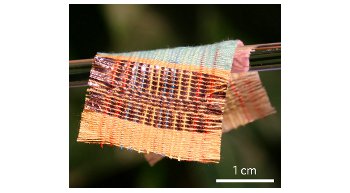
Georgia Tech researchers have reported the development of micro-cable textile that harvests energy from sun and mechanical motion, according to a team led by Professor Zhong Lin Wang, Regents Professor in the School of Materials Science and Engineering at Georgia Tech.
Solar cells made from polymeric fibres were woven into fabric with triboelectric fibrous nanogenerators using a common weaving method. According to the researchers, the tribogenerators use triboelectricity and electrostatic induction phenomena to generate energy from movements. For harvesting energy from sun, photoanodes that could be woven with fibres were used.
With regard to applications, Professor Wang envisions that the fabric that is 320 micron thick with woolen yarns can be integrated with other structures such as wearable garments. These smart textiles can power electric watches and charge a cell phone.
By: Seshadri Ramkumar, Texas Tech University, USA
Previous Article50% TN subsidy for ‘Mini Textile Parks’
Next Article Fabric harvests solar energy!

Related Posts

Mafatlal Industries expands D2C footprint with launch of ‘Mafatlal Home Fashion’

October 13, 2026

CMAI’s statement on the deferment of MDR on UPI merchant payments

October 13, 2026

CARE Ratings upgrades Mafatlal Industries to ‘CARE A-‘ with stable outlook

October 12, 2026
Recent Posts
  • What Makes Premium Bedding Different? The Materials and Construction Behind Better Sleep
  • Rajesh Nigam: Our biggest challenge is competition from Chinese manufacturers
  • Smita Jhanwar: We are today a diversified, product-agnostic enterprise
  • Jeanologia’s EIM expands beyond finishing to measure full textile supply chain impact
  • Lenzing Unveils REMOD Denim
  • Toray creates composite polyester-nylon yarn with 93% recycled material
  • Path Breaking Textile Machine Innovations That Faded Away
  • Sanjay Savkare: The Maharashtra Textile Policy has set a clear objective of increasing cotton processing over five years
Facebook X (Twitter) YouTube LinkedIn
  • About us
  • Contact us
  • Privacy Policy
  • Terms and Conditions

SISTER PUBLICATIONS

Construction World Equipment India Industrial Product Finder Infrastructure Today

© 2026 Indian Textile Journal. All Rights Reserved.

Type above and press Enter to search. Press Esc to cancel.