


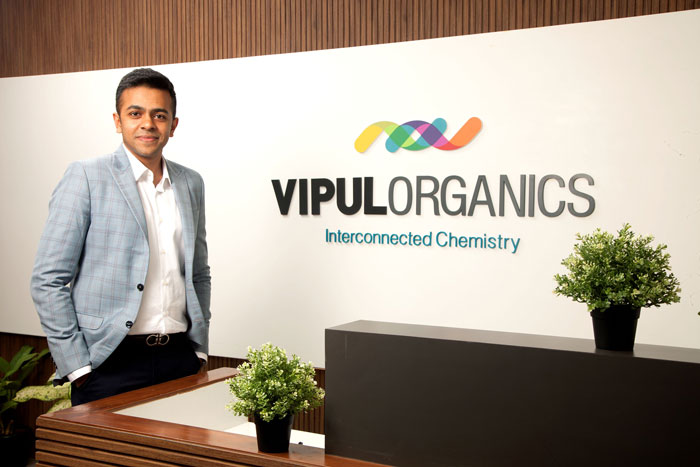
As the textile industry faces growing pressure to reduce its environmental footprint, innovations in coloration chemistry, digital technologies and water management are becoming increasingly important. From resource-efficient pigment-based dyeing to safer chemical formulations and advanced wastewater recovery systems, manufacturers are exploring solutions that balance sustainability with performance and cost competitiveness. Mihir V Shah, Executive Director, Vipul Organics, in a conversation with Divya Shetty, discusses how the company is advancing sustainable textile processing through innovative pigment dispersions, auxiliary chemistry, digital colour-matching tools and membrane technologies, while addressing the industry’s evolving requirements for responsible manufacturing and circularity.
How can low-liquor and resource-efficient coloration technologies help reduce the environmental footprint of textile processing?
At Vipul Organics, we see pigment-based printing and garment dyeing as an important route to reducing water consumption in textile coloration. Our SunPrint range of pigment dispersions offers colour depth and brightness comparable to conventional dyes in suitable applications, while reducing or eliminating multiple washing and rinsing stages.
A key focus has been overcoming the traditional challenge of softness and hand feel in pigment-based garment dyeing. Through sustained development of our auxiliary chemistry, we have made significant progress in achieving softness comparable to conventional dyeing in suitable applications.
With rising dye costs adding to the commercial imperative, pigment-based solutions offer textile manufacturers an opportunity to combine resource efficiency with cost competitiveness. Our approach is to deliver integrated solutions that bring together pigment dispersions and auxiliary chemistry to achieve the required colour, softness and durability while reducing water consumption.
As regulations tighten around hazardous substances such as PFAS, how is Vipul Organics advancing safer and more sustainable textile chemistry without compromising performance?
At Vipul Organics, we believe that safer chemistry must deliver on both environmental responsibility and application performance. All our manufactured pigment dispersion products have achieved ZDHC Level 3, and our OEKO-TEX® ECO PASSPORT credentials reinforce our commitment to responsible chemical management.
Our focus is on developing high-performance pigment dispersions and auxiliary systems that support more resource-efficient coloration. We have invested significantly in auxiliary chemistry to address traditional limitations in pigment-based garment dyeing, particularly softness and hand feel, while maintaining the colour depth and brightness expected by the market.
The transition to more responsible chemistry must also account for colourfastness, durability and compliance with applicable restricted-substance requirements. Similarly, PFAS-free alternatives must deliver the functional performance required for their intended applications.
Our objective is to help textile manufacturers adopt more responsible coloration solutions without compromising product quality, consistency or commercial viability. We see continued innovation in pigment dispersions and auxiliary chemistry as central to this transition.
How are digital tools improving colour consistency, reducing rework and supporting more efficient resource utilisation?
At Vipul Organics, advanced colour-matching software helps us improve first-time-right shade achievement, reduce repeated trials and strengthen consistency across formulations. We also use specialised software for formulation and coatings management, supporting systematic technical data management, formulation control and reproducibility.
In textile processing, every additional shade correction or repeat trial can increase the consumption of chemicals, water, energy and production time. Better colour matching, backed by formulation expertise and appropriate auxiliary chemistry, can therefore contribute to lower material wastage and more efficient operations.
We believe technology delivers the greatest value when combined with application knowledge and product innovation. As digitalisation and AI-assisted formulation evolve, opportunities to improve predictive shade matching, recipe optimisation and consistency between laboratory development and bulk production will become increasingly important.
How can your chemical and membrane technology solutions support water circularity, resource recovery and more sustainable textile lifecycles?
At Vipul Organics, our approach to sustainability extends from resource-efficient coloration to wastewater treatment and water reuse. Through our membrane technology business, Adimem Technologies, we are developing solutions across microfiltration (MF), ultrafiltration (UF), nanofiltration (NF), reverse osmosis (RO) and membrane bioreactor (MBR) technologies.
These technologies can support industrial wastewater treatment and water recovery, reducing dependence on freshwater. Depending on effluent characteristics and treatment requirements, membrane systems can also form part of Zero-Liquid Discharge (ZLD) schemes.
Textile wastewater can contain colourants, dissolved salts, organic matter and residual processing chemicals. Appropriately designed treatment systems can improve effluent quality and enable water reuse, with further recovery opportunities depending on technical and economic feasibility.
Alongside these solutions, our pigment dispersions and auxiliary chemistry support efforts to reduce water consumption at the coloration stage. We believe combining efficient processing with wastewater treatment and reuse is an important step towards a more resource-efficient textile industry.
Circularity must also consider the end-of-life stage of fabrics. Recyclability and biodegradability depend on fibre composition, colourants, finishes and the recycling or disposal process. The industry therefore needs solutions that deliver the required performance during use while supporting compatibility with appropriate recycling pathways.
Through Vipul Organics and Adimem Technologies, our focus is on bringing together responsible coloration chemistry and membrane technology to help advance more efficient water management and a more circular manufacturing ecosystem.