


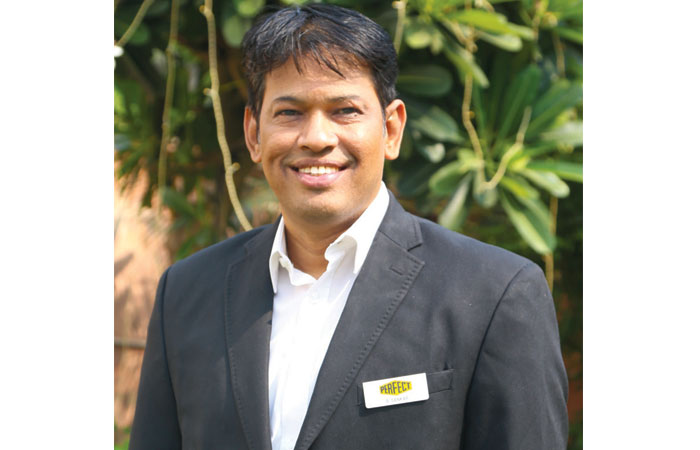
Heading into India ITME 2026, Perfect Group continues to anchor its legacy of over five decades in textile engineering through cutting-edge automation and sustainability. In this interview, B Sankar, General Manager (Technical and Development), Perfect Group, highlights how the Ahmedabad-based enterprise is tackling industry-wide shifts. From pioneering roll-shop automation with the ACG 600 EL to driving circular manufacturing via the proprietary renGen hard-waste recycling technology, Perfect Group delivers engineered precision, minimising waste and maximising global efficiency.
Could you share a short summary of your company?
Headquartered in Ahmedabad, Gujarat, Perfect Group is a premier engineering enterprise with over five decades of experience in the textile machinery sector. Operating through two specialised divisions, the Group delivers high-precision capital equipment and maintenance solutions globally.
- Perfect Engineering Corporation: Focuses on capital machinery, advanced textile waste recycling systems, and specialised processing lines. Its portfolio spans hard-waste recycling (yarn, woven, and knitted waste), cotton dropping and nonwoven trim recycling, modern blowroom lines, high-production cards, hygiene textile machinery, and Overhead Travelling Cleaners (OHTC) for spinning, weaving, knitting, and twisting applications.
- Perfect Equipments Pvt. Ltd.: Specialises in card-room and roll-shop maintenance machinery, commanding over 80 per cent market share in core maintenance categories due to unmatched reliability and technical support.
Our manufacturing facilities utilise advanced CNC machine tools from the USA, Japan, and Germany, ensuring superior component accuracy and extended machine life. A flagship milestone is our Automatic Cot Grinding System (ACG 600 EL), widely adopted by leading Indian textile groups—including Vardhman, Trident, Welspun, Sintex, Nahar, Arvind, Grasim, Nitin Spinners, Sagar Group, and RSWM—as well as mills across the USA, Central America, Europe, Turkey, Uzbekistan, Vietnam, and Indonesia.
Furthermore, our proprietary two-stage hard-waste recycling process, renGen, has set an industry benchmark by recovering high-quality, spinnable fibres from yarn and fabric waste. Driven by precision engineering, robust build quality, and dependable after-sales service, we build enduring partnerships without compromising on quality, the recycling plans hand over to leading Indian textile companies like Vardhman, Welspun, Usha Yarn, Gima tex, Sangam Ltd, T.C. Spinners (YCD Industries), Grasim, Agrawal Industries, Nandan Denim, Singhal Spintex, etc., and at customers of Bangladesh and African country.
What key trends are currently driving the textile and apparel sector, and how do your innovative solutions address them?
The global textile and apparel (T&A) industry is rapidly evolving around three core imperatives: automation, sustainability, and circular raw material sourcing.
Automation is vital for boosting productivity, reducing manpower dependency, and ensuring consistent yarn quality. Perfect Group pioneered roll-shop automation with the ACG 600 EL, delivering measurable operational savings across domestic and international mills.
Simultaneously, global apparel brands demand recycled fibres that do not compromise end-product performance. Over the past 15+ years, Perfect has engineered fully automated hard- and soft-waste recycling lines. Our integrated hard-waste line combines precision cutting, two-stage fibre opening, renGen carding, online liquid conditioning, and automated storage-bin systems to convert textile waste directly into spinnable fibre bales with minimal manual intervention. By preserving staple length while minimising neps and short fibres, renGen enables seamless blending with virgin cotton for ring-spun yarns.
At Perfect Group, our strength lies in converting practical industry challenges into reliable engineering solutions. Whether through our Automatic Cot Grinding System or our pioneering renGen recycling technology, our focus remains on innovation that delivers tangible operational value.
As eco-consciousness rises across the T&A sector, how are your offerings helping mills and manufacturers hit their green goals?
With over 15 years of dedicated R&D in textile waste recovery, Perfect Group helps T&A manufacturers transform production waste from a disposal liability into a profitable raw material stream.
Our specialised recycling lines process both pre- and post-consumer waste—including yarn, woven/knitted fabrics, cotton droppings, and nonwoven trims. Unlike conventional single-stage opening methods that damage fibre integrity, our two-stage renGen technology preserves staple length for demanding spinning applications. Notably, fibres processed via our lines have successfully produced 40s Ne ring-spun yarn containing up to 20 per cent recycled cotton, depending on feedstock and mill parameters.
True sustainability requires producing recycled fibres capable of re-entering high-value textile production. By enabling mills to reclaim in-house waste, our solutions cut virgin cotton dependency, reduce landfill burden, and establish commercially viable circular manufacturing.
As you prepare for India ITME 2026, what are your core focus areas, and which new technologies will take center stage at your booth?
India ITME 2026 serves as a premier global stage for Perfect Group to demonstrate cutting-edge Indian textile engineering. At this edition as every time being displayed, we will unveil two new process-automation innovations designed to streamline mill workflows, maximise operational efficiency, and minimise manual intervention through intuitive, intelligent machine design
Alongside these launches, we will showcase our comprehensive recycling and specialty processing portfolio, including:
- Complete hard- and soft-waste recycling lines powered by renGen technology.
- Specialised nonwoven trim waste recycling systems and high-production carding solutions.
- Bleached cotton converting machinery for surgical rolls, zig-zag cotton, cotton balls, and ear buds.
Visitors will be able to inspect physical before-and-after fibre samples to evaluate the superior quality and consistency achieved by our integrated lines, underscoring how Indian engineering delivers globally competitive solutions.
Which T&A segments are you targeting at India ITME 2026, and how do your solutions meet their specific operational needs?
At India ITME 2026, we are targeting high-growth opportunities across spinning, weaving, knitting, nonwovens, and technical textiles:
- Spinning mills: Recovering spinnable fibres from cotton droppings, hard waste, and yarn waste to lower raw material costs.
- Weaving, knitting & garment manufacturers: Converting pre- and post-consumer fabric offcuts and cutting-room waste into reusable fibres.
- Nonwoven producers: Reclaiming edge trims and production waste through dedicated recycling systems.
- Hygiene & medical textiles: Supplying precision carding and converting lines for surgical cotton, rolls, and balls.
- Technical & sustainable textiles: Enabling closed-loop fibre recovery to meet strict brand sustainability mandates.
Rather than offering standalone machines, our strength lies in delivering customised, turnkey recycling plants engineered for high throughput, automation, and rapid return on investment.
How are you incorporating AI, automation, and digitalisation into your T&A solutions
Automation and digital intelligence are central to Perfect Group’s product roadmap. We equip our machinery with PLC-based control architectures, intuitive HMI touchscreens, and automated process monitoring, giving operators real-time visibility into machine status, operating parameters, and production metrics.
Our modern recycling lines synchronise every stage—from waste feeding and cutting to fibre opening, liquid spraying, bin blending, and baling—into a continuous automated workflow. Internally, we are deploying an enterprise-wide ERP system to optimise production planning, inventory control, and customer responsiveness.
Looking ahead, we are actively exploring smart sensors, IIoT data acquisition, predictive maintenance, and AI-assisted process optimisation to further elevate energy efficiency, fibre consistency, and ease of operation.
What are your key growth objectives for the next 3 to 5 years?
Over the next three to five years, Perfect Group aims to cement its status as a premier global engineering partner for sustainable textile processing and automation. Our strategic priorities include:
- R&D and product innovation: Accelerating investments in next-generation carding, automated handling, and advanced recycling technologies.
- Portfolio expansion: Engineering tailored, end-to-end recycling solutions for broader pre- and post-consumer waste streams.
- Manufacturing excellence: Upgrading production infrastructure and precision machining capacity to meet rising global demand.
- Global market expansion: Strengthening international distribution networks and technical partnerships across key textile hubs.
- Smart automation: Deepening PLC, digital monitoring, and automated material-handling integration across all machine lines.
- After-sales ecosystem: Expanding installation, commissioning, and technical support teams worldwide to guarantee maximum uptime.
How do you view the growth potential of India’s textile machinery and accessories industry?
India’s textile machinery and accessories sector stands at an inflection point. As India consolidates its position as a global T&A manufacturing powerhouse, demand for automated, energy-efficient, and sustainable machinery is surging—particularly across technical textiles, man-made fibres, nonwovens, and circular recycling.
Leveraging a strong domestic mill ecosystem, skilled engineering talent, and cost competitiveness, Indian manufacturers can capture greater global market share by focusing on six imperatives:
R&D & proprietary innovation: Shifting from conventional replication to developing patented, differentiated technologies.
Precision & build quality: Prioritising component accuracy, energy efficiency, and long-term reliability to win global trust.
Automation & digitalisation: Embedding intelligent controls, IIoT diagnostics, and predictive maintenance.
Global service infrastructure: Establishing responsive international spare-parts and technical support networks.
Industry–academia collaboration: Partnering with textile research institutes and universities to commercialise practical innovations.
Policy support: Utilising government incentives for R&D, technology upgradation, and export promotion.
Guided by our philosophy of ‘Make in India, Innovate for the World,’ Perfect Group remains committed to driving this transformation—proving that Indian engineering can lead the global transition toward automated, sustainable textile manufacturing.