


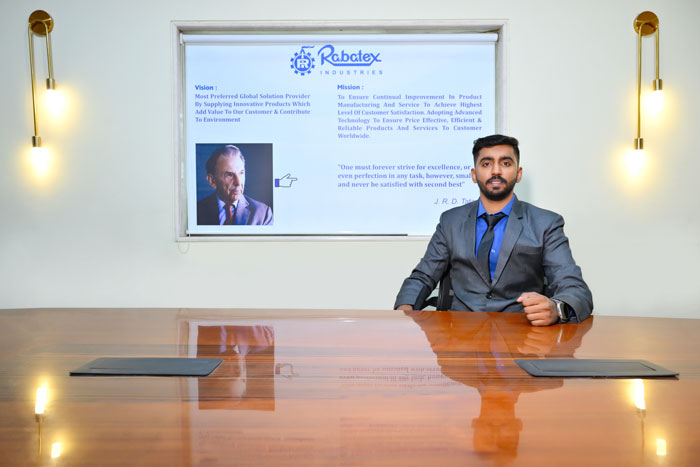
Rabatex began in 1962 in Ahmedabad as a precision engineering workshop, making crankshafts and sub-assemblies for textile machinery. That origin still shapes how we work: we approach every machine as component engineers first. Over six decades, the business has grown into a specialist in weaving preparatory machinery and intra-mill material handling, with a team of more than 300 people. Keyur Panchal, Executive Director, Rabatex Industries, discloses his plans for the upcoming India ITME 2026 show.
Could you share a brief background on your company?
Our portfolio covers high-speed computerised sectional warping machines; a complete fabric sampling line of sample warping, mini sample warping, single-end sizing and sample weaving machines; and speciality creels for monofilament, glass, carbon and geo-textile yarns. Since 2024, we have built a dedicated range for mother mono yarn, led by the Splitmatic split sectional warper, and our most recent launch is a hank reeling machine for the hank dyeing process. Alongside these, we manufacture beam and fabric-roll handling equipment and the RAPID Vertical Lift Module for automated storage.
We operate four manufacturing plants in Ahmedabad, with a new and considerably larger unit due to start operations at the end of this year. More than 3,800 of our sectional warpers and over 6,200 material handling and storage systems are installed across more than 38 countries, including the US, Canada, Turkey, Brazil, Egypt and South Africa. Our customers range from decentralised weaving units to large integrated mills producing denim, shirting, suiting, home textiles, synthetics and technical fabrics.
If I had to name one USP, it is that we engineer around the customer’s yarn and shop floor rather than sell a catalogue machine. Combined with dependable after-sales support, that is why more than 43 per cent of our business comes from repeat orders.
hich industry shifts are currently defining the textile and apparel market, and how are your proprietary solutions responding to these demands?
I see four shifts happening at the same time, and they reinforce one another.
The first is the steady move towards synthetics. Cotton availability and pricing have become less predictable, while fashion and sportswear brands want lighter, finer fabrics. Mother mono yarn, split into fine filaments for low-GSM fabrics, shows how quickly yarn technology is moving.
The second is the speed of product development. Buyers now place smaller orders more often, so a mill’s ability to produce and approve a sample quickly increasingly decides whether it wins the business.
The third is technical textiles. Carbon, glass, aramid and basalt need a level of tension control and filament separation that conventional warping machines were never designed for.
The fourth is the rising cost of labour and floor space, which is pushing automation into areas mills used to overlook, such as beam movement and stores.
Our response has been to build machines for each of these shifts rather than adapt older designs. The Splitmatic takes mother yarn straight from the package to the beam, and more than 75 of these machines have been installed since its launch in 2024. Our sampling line can produce a warp beam of under 500 metres from as few as 16 yarn packages, so a mill can develop a design without disturbing its production line. We have developed dedicated creels and warpers for composite yarns, and our vertical storage brings warehouse-grade automation into the mill.
With sustainability becoming a priority for textile and apparel manufacturers, how are you supporting your clients in reaching their environmental objectives?
In our segment, sustainability is largely an engineering question: how much yarn, power, chemical and handling a process consumes for every metre of good warp. When we design a machine, we look either to remove a step from the process or to cut the losses within it.
The clearest example is mother mono yarn. The conventional route splits the yarn onto cops before warping, which turns roughly 120 to 180 packages into 1,200 to 1,400 cops and adds an entire rewinding stage. By splitting directly onto the beam, the Splitmatic removes that stage, along with the energy, labour and handling damage that came with it. The entire direct split warping process now costs less than half of what cop preparation alone used to cost, before warping had even begun.
Across the rest of our range, precise tension control and electronic stop motions reduce yarn waste on our sectional warpers, single-end sizing lowers chemical consumption and effluent load, and our sampling machines let mills develop a fabric with a fraction of the yarn a production trial would use. Handling equipment matters too: a damaged beam or fabric roll is waste that rarely gets counted.
Within our own operations, we have installed a sewage treatment plant at our new unit and are steadily reducing our carbon footprint. For a steel-based machinery business that is not easy, but it is a commitment we take seriously.
How are you gearing up for India ITME 2026? What exciting solutions are you launching, and what key advantages will they offer attendees?
India ITME comes once in four years, and for a company whose customers are spread across almost every Indian weaving cluster, it is the most important domestic platform we have. Every machine on our stand this year will be a new-generation version, with a fresh design and more advanced features than its predecessor.
The centrepiece is our complete fabric sampling line: the sample warping machine, the mini sample warper, the single-end sizing machine and the mini loom. Together they let a mill or design house take a new design from yarn to woven sample in-house, using a fraction of the yarn and time a production line would need. Our sample warper can prepare a beam of under 500 metres from as few as 16 yarn packages, which makes short, frequent development runs practical.
Alongside the sampling line, visitors will see our redefined advanced sectional warping machine. It builds on what mills already value in our warpers, such as precise section tension, recipe management and electronic stop motions, and adds new features in automation and operator convenience that we will unveil at the show. Together, the two give visitors a complete view of warp preparation, from the first sample beam to full-scale production.
What key developments are driving the textile and apparel sector, and how do forward-thinking products and solutions address these ongoing shifts?
Our stand is built around three groups of visitors.
The first is weaving mills planning to modernise warp preparation, across cotton, denim, shirting, suiting, home textiles and synthetics. Modern high-speed looms demand consistent warp quality, and many mills are still running older warpers. Our redefined sectional warper is designed for that upgrade. Holding ITME in Greater Noida also brings us closer to the textile clusters of northern India, such as Panipat, and of Rajasthan, such as Bhilwara, where we have long had a service presence and where home textile and suiting mills form a large part of the base.
The second is the development side of the industry: design houses, exporters and mills that create fabrics for international brands. Order sizes are shrinking and approval cycles are getting shorter, so sampling speed directly affects export competitiveness. Our fabric sampling line lets them develop in-house without blocking production capacity.
The third is synthetic weavers, who remain a key segment for us even though the Splitmatic will not be on the stand. Surat in western India led the shift to polyester and nylon, and the southern region, including Palladam, Tirupur and Erode, is now following quickly with mother yarn. Our team will be available to discuss Splitmatic configurations from 128 to 160 creel ends, and our permanent technical team in Erode supports customers across the south.
In response to the growing need for smart manufacturing, automation, and AI in the textile industry, how are current solutions evolving to bridge these technological gaps?
I would separate the three, because our industry is at a different stage with each.
Automation is well established in our machines. Our sectional warpers are PLC-controlled, with servo-driven reed tables and traverse, load cells for section and beaming tension and, on heavier models, laser sensors that measure yarn build-up and set the feed automatically. The aim is to take judgement-dependent adjustments away from the operator, so that the tenth beam matches the first.
Digitalisation is now standard across our range. Our latest warpers store recipes for hundreds of patterns, log end breakages and machine events, support remote diagnostics and can pass production data to a mill’s ERP or MES. The RAPID Vertical Lift Module runs on our own inventory software, with barcode tracking, access control by user profile and integration with ERP and warehouse management systems.
AI is the newest layer. We have started work on AI models that can be integrated with our products, driven largely by export-oriented customers, particularly for the RAPID VLM and our fabric sampling solutions. I would rather not over-promise here, because AI goes through the same R&D discipline as everything else at Rabatex. We run three to four research and trial projects every year, many of them on the customer’s own yarn. Each one goes through repeated design iterations, extended yarn trials and, at times, tonnes of scrapped material before we are satisfied. Some trials become products; others tell us what not to build, and both outcomes are valuable. With AI, the test is the same: it must solve a real shop-floor problem before it reaches a customer.
Throughout, we keep the interface simple. Mills run multiple shifts with operators of varying experience, and a capable machine that is difficult to use helps no one.
What are the strategic growth projections and expansion plans for the company over the next three to five years?
Over the next three to five years, our priority is to grow without losing the responsiveness our customers rely on.
The biggest step is very close. Our new manufacturing unit in Ahmedabad, spread over 2 lakh sq ft and built with world-class manufacturing capabilities, will start operations by the end of December 2026. It gives us the room to serve rising domestic and export demand while keeping lead times tight. Our team will grow with it, as will the network of component partners around our plants.
In product development, we will keep our pipeline of research and trial projects running. The priorities are technical textile preparatory machinery, further development of mother mono yarn processing as finer deniers come into commercial use, and gradual integration of intelligence and data capability across our range.
Diversification will come mainly through storage and intralogistics. We have completed more than 100 ASRS installations, and that experience has shown us that our engineering and controls work well beyond textiles. We see warehousing and intra-plant automation as a significant adjacent business.
On exports, we want to build service and spares capability in each key market rather than depend on agents alone, with a focus on Turkey, Europe, Latin America, Africa, South-East Asia and North America. ITMA 2027 is already planned as our next major international showcase after India ITME.
What is the outlook for India’s textile machinery sector, and what steps are needed to boost global competitiveness?
I am optimistic, and for concrete reasons. In warp preparation, spinning and processing, reputable Indian manufacturers now build machines that compete with European suppliers on technology and outperform them on cost, delivery time and service responsiveness. Domestic investment is supported by the PLI scheme, the National Technical Textiles Mission and the PM MITRA parks, and global buyers diversifying their sourcing are looking seriously at India.
We should also be honest about the gaps. India still depends heavily on imported high-speed weaving machines. A large share of the critical electronics in Indian machinery, including drives and controls, is still imported. And the industry faces pressure from substandard and used machinery entering the country, sometimes under incorrect HSN classifications.
Several steps would make a real difference. Firmer enforcement against used and misclassified imports would create a level field for manufacturers who invest in quality. Predictable timelines for incentive schemes matter, because delays lead mills to postpone capital spending, as we saw in 2023–24. A deeper domestic base for drives, sensors and precision components would reduce cost and supply risk. Closer industry–academia collaboration, of the kind we have had with institutions such as IIT Delhi and SITRA, can shorten development cycles. And Indian manufacturers must invest in overseas service networks, documentation and certification, because buyers abroad judge a machine as much by the support behind it as by its specifications.