


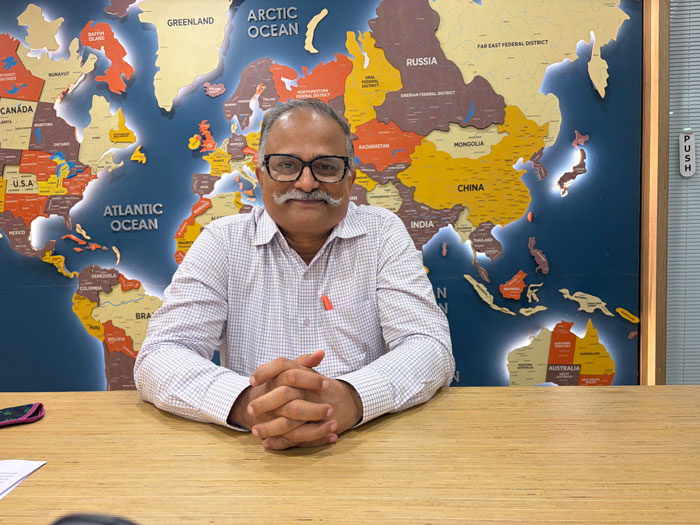
As India’s textile machinery industry navigates a modernisation-led recovery, India ITME 2026 is set to spotlight technological innovation, global collaboration and emerging manufacturing opportunities. With over 1,800 exhibitors and technology providers expected from more than 40 countries, the exhibition promises to showcase the future of textile manufacturing. Ketan Sanghvi, Chairman, India ITME Society, speaks to Divya Shetty about industry investment trends, technological advancements, import dependence and India’s growing potential as a global textile machinery hub.
What is the latest update on preparations, exhibitor participation and exhibitor profiles for India ITME 2026?
The ITME 2026 exhibition is shaping up to become a significant platform for the global textile machinery and engineering industry.
If we look at it from various aspects, the response from the industry has been very encouraging, with strong participation from leading machinery manufacturers and technology companies, not only from India but also from around the world.
We hope that this exhibition will bring together manufacturers, technology providers, buyers, industry professionals, government officials and other stakeholders of the textile industry under one roof, creating opportunities for business networking, technology discovery and strategic collaborations. As the world becomes more global, this becomes increasingly necessary.
We also expect international participation to be an important highlight of this edition, with participation from over 1,800 companies and technology providers from more than 40 countries. This global presence reinforces India as well as the ITME Society.
India ITME 2026 is also going to be an important meeting point for the international textile machinery and engineering ecosystem. It will provide Indian textile machinery manufacturers with access to global technologies and solutions.
In short, we expect the exhibition to feature several concurrent programmes, including B2B meetings, international conferences, product launches, over 3,600 live machinery demonstrations and industry-focused networking initiatives.
These programmes are designed to go beyond a conventional exhibition and facilitate meaningful business and knowledge exchange.
What will distinguish India ITME 2026 from previous editions? How will it differ in terms of technology showcases, new product launches and other aspects?
Our plan is to focus on making the exhibition more technology-driven, business-oriented and experience-led.
While every edition of India ITME has reflected the changing needs of the industry, this edition will place even greater emphasis on live technology, innovation and meaningful industry interaction.
One of the key highlights, we expect, will be the technology showcases. Visitors will have the opportunity to explore the latest developments in textile machinery, engineering, automation, digitalisation, smart manufacturing, sustainability and all kinds of allied technologies.
The emphasis will not only be on displaying machines but also on demonstrating how these technologies can improve productivity, efficiency, quality and competitiveness.
Live machinery demonstrations will add another dimension to the visitor experience. Seeing machinery and technology operating in real time allows visitors to better understand their applications and evaluate solutions with respect to their own manufacturing requirements.
Then, we are going to have new product launches. The exhibition will provide companies with a platform to introduce new technologies, machinery and innovative solutions directly to a relevant audience of textile manufacturers, buyers, technology users and industry decision-makers.
This makes the exhibition an important launchpad for companies looking to enter new markets and strengthen their presence in India.
There will also be a focus on B2B meetings and business networking. The objective is to facilitate more focused interactions between exhibitors and potential buyers or various stakeholders, such as consultants, government officials and technology providers. This will enable visitors to move from simply exploring products to having meaningful commercial and technical discussions.
The visitor experience will be further strengthened through technical conferences, industry dialogues, product launches, live demonstrations and knowledge-sharing programmes.
We will have multiple opportunities to learn, interact, compare technologies and identify solutions, all under one roof.
What will ultimately distinguish India ITME 2026 is the combination of technology, live experiences, business opportunities and global participation.
As an exhibition that is organised once every four years, we want visitors to make the most of this opportunity, not merely to see what is available today but to understand the technologies and solutions that can shape the future of the textile industry.
What is the present state of the Indian textile machinery industry in terms of domestic demand, capacity utilisation and investment sentiment?
After a few years of depression, the textile industry, as well as the textile machinery industry, is witnessing a gradual improvement in terms of both domestic demand and investment sentiment, although the pace of growth varies across individual segments.
In spinning, for example, capacity utilisation has improved compared with the earlier period. Large-scale greenfield expansion remains limited, probably due to the high capital investment involved and geopolitical uncertainties.
However, several companies are looking at modernisation, replacement and technology upgradation plans, preparing budgets for new machines and exploring options. This reflects a cautious but positive outlook.
If we go by the optimum age of machinery, which is another parameter or metric that we look at, there is huge scope for modernisation in the spinning segment to reduce operating costs through modern technology.
In weaving, investments are increasingly focused on high-speed shuttleless looms, automation, energy efficiency, reduced manpower and digital monitoring.
The processing sector is also showing some improvement, especially supported by demand for processing in fashion fabrics. Manufacturers are looking at investments in modern processing and finishing technologies to improve quality, productivity and value addition.
Digital textile printing is another area that is growing fast. Sustainable technology is also gaining interest, including among garment manufacturers, especially those looking at backward integration to efficiently cater to smaller lot sizes, faster turnaround times and changing market requirements.
Technical textiles continue to be an important growth area, with new entrants as well as conventional textile companies exploring diversification in this segment.
Since many technical textile products are highly specialised and application-driven, investment is also coming through focused or single-line projects from smaller and emerging players. However, in this segment, we are still largely dependent on imported machinery.
The experience for the industry is a gradual, modernisation-led recovery rather than aggressive capacity expansion.
Improving utilisation levels, growing demand for man-made fibres and value-added products, the government’s focus on the growth of the technical textiles segment, and the need for advanced technologies are supporting demand for machinery.
Investment sentiment remains cautiously positive, with spending increasingly directed towards technology upgradation, automation, energy efficiency and flexible manufacturing.
India still depends heavily on imported machinery and critical technologies for certain textile segments. Where do you see the biggest opportunities for Indian manufacturers to strengthen their domestic capabilities?
India has developed strong domestic capabilities across several textile machinery segments. However, we are still progressing and expanding our manufacturing capabilities across the entire spectrum.
There are significant opportunities and challenges in bridging critical technology gaps and reducing import dependence.
We feel this is an evolving learning curve. With continued technological development, industry-academia collaboration, supportive government measures and greater investments in indigenous manufacturing, India is well-positioned to progressively strengthen its capacities and capabilities across the entire textile manufacturing sector.
If we go through the various segments, India has established a very strong manufacturing base in spinning, from blow room to ring frame, and all the global leaders in the spinning segment have set up bases in India.
However, some segments still remain key gaps, with limited manufacturing. For example, we have automatic cone winders, open-end spinning, air-jet spinning and, lately, state-of-the-art man-made fibre spinning systems.
These are probably opportunities for companies to explore. Winders and TFO twisters also have scope to improve their technological capabilities and competitiveness to match the global market.
Apart from that, spinning is probably the best-off segment compared with the others.
In weaving, India has developed good capabilities in preparatory machines, with domestic manufacturers now catering not only to the Indian market but also exporting a significant percentage of their production.
The major opportunities lie in state-of-the-art shuttleless looms, including air-jet, rapier and water-jet looms, where domestic manufacturing capabilities are still limited compared with global technology levels.
We remain significantly dependent on imports, particularly from China, followed by European and Japanese manufacturers.
Developing advanced shuttleless weaving technology domestically would therefore substantially reduce import dependence.
Of course, there are some challenges along the way, but if these are addressed in the correct manner, there are significant opportunities in this area, which is probably the largest sink for foreign exchange spending in the entire textile machinery industry.
In processing and finishing, Indian manufacturers have also developed good capabilities. Many Indian manufacturers are now offering competitive machinery, almost reaching or getting close to the level of global manufacturers in terms of technology and automation.
Some gaps remain, for example, in the area of complete, continuous bleaching, dyeing and finishing ranges, where European and Chinese manufacturers continue to have a strong presence.
There is an opportunity for Indian manufacturers in this segment to strengthen their engineering, automation, process control and complete-line capabilities.
One of the biggest opportunities is in the garment sector, particularly industrial sewing machines.
Despite India’s large apparel manufacturing base, domestic development of industrial sewing machinery remains fairly limited, resulting in continued dependence on imports.
Most sewing machines, I believe, are still imported today, with very few exceptions.
Despite being among the highest value-added segments of the textile value chain, machinery investment requirements are fairly low. I think there is potential for faster localisation.
We have a few manufacturers, such as Usha and Singer, but there is definitely scope for improvement.
There is also limited manufacturing capacity in the technical textiles segment, particularly in nonwovens. This presents opportunities for many manufacturers.
However, many of these projects are significantly capital-intensive, so companies have to be mindful of not only capital investment but also the shifting geopolitical situation.
Overall, there are opportunities, as I have discussed. An exhibition like this can help the entire industry explore some of these opportunities and come together to discuss what is appropriate for them.
Automation, digitalisation, AI and energy efficiency are increasingly influencing textile manufacturing. Which technology trends do you expect to dominate India ITME 2026?
I think these are key buzzwords found everywhere in the industry today, and every exhibition looks at focusing on these key segments.
As per our understanding, automation and Industry 4.0 should be among the major themes, with machinery increasingly incorporating automated process control, real-time monitoring, predictive maintenance and reduced human operation as well as intervention.
AI and data-driven manufacturing are also expected to gain greater prominence.
Energy and resource efficiency are always going to be focus areas in a country like India, and even globally now, given the various pressures on fuel and energy these days.
Textile manufacturers always look to reduce the consumption of power, water, chemicals and other strategic resources.
There is huge demand for sustainability to be built into machinery through design to support waste reduction, lower emissions and more efficient processing.
Of course, digitalisation, connected manufacturing and software are areas where industries continue to focus on solutions.
These will enable greater integration across production processes and provide manufacturers with better visibility and control over operations at a much more efficient and cost-effective scale than was possible earlier.
The exhibition covers approximately 20 chapters, spanning capital machinery, ancillary equipment, components and accessories, as well as software and data-driven solutions.
These technology trends are expected to be visible across the entire value chain.
How competitive has Indian textile machinery become globally in terms of technology, quality and cost? What needs to change for Indian manufacturers to gain a larger share of the international market?
There has been a significant improvement in the global competitiveness of the Indian textile machinery industry. This is a result of continuous efforts through collaborations, joint ventures and FDI, particularly from Europe and Japan.
India has now developed a strong culture of adopting and adapting some of the best technologies available globally, enabling domestic machinery makers to improve their technology, quality and presence in both Indian and international markets.
While there are a limited number of large Indian machinery manufacturers with a global footprint, several companies are steadily expanding their international presence.
Their competitiveness, I don’t think, is driven by cost advantage alone any longer. Indian manufacturers are increasingly offering reliable, appropriate technologies suited to specific textile operations.
At the same time, several leading global textile machinery companies have established manufacturing facilities in India through 100 per cent FDI and joint ventures in partnership with Indian companies, particularly in the spinning segment.
This trend is expected to magnify further, strengthening India’s manufacturing ecosystem, technology capabilities and integration with the global supply chain.
The country also benefits from a favourable manufacturing environment comprising a large domestic textile industry, a skilled technical workforce, competitive operating costs and an established engineering base.
As textile manufacturing continues to expand across developing economies, India is well-positioned to emerge not only as a major market for the textile machinery industry but also as an important global manufacturing and sourcing base.
The spinning sector demonstrates what India can achieve. In weaving, processing and possibly downstream segments, a little more work needs to be done.
To gain a larger share of international markets, manufacturers need to strengthen R&D, product innovation, automation, digitalisation, and energy and resource efficiency.
They also have to ensure that they set up globally competitive supply chains, where good-quality components and spares can be available to Indian companies at a reasonable cost, thus eliminating supply-chain shocks emanating from geopolitical situations or foreign exchange fluctuations.
With stronger technology development, consistent standards, competitive costs, and increasing domestic manufacturing and demand, India has the potential to progressively strengthen its position as a global textile machinery manufacturing hub.