


A systematic understanding of polymerization parameters and rigorous chip gradation is essential for minimising waste and ensuring optimal performance, explains Dr Soumyen Kumar Pal and Dr Pankaj Gandhi
Polyester chips (Polyethylene Terephthalate)—are the essential raw material for synthetic textile fibres, packaging films, and plastic bottles. They are produced by polymerizing Purified Terephthalic Acid (PTA) and Mono-ethylene Glycol (MEG) into granular polymer pellets. Main raw materials are Purified Terephthalate Acid (PTA) and Mono-Ethylene Glycol (MEG). Normally Antimony Trioxide is used as catalyst for the production of polyester polymer. This paper explores the continuous polymerization process, key quality parameters, and standard gradation specifications for industrial applications.
Manufacturing process of polyester chips
Poly(ethylene terephthalate) (PET) is one of the most widely used polymers, as it ranks fourth in the worldwide production of plastics [Jiang M et al, 2023] and is the polymer most used to produce food containers (especially bottles for water and soft drinks) and textile fibres [Sevigne-Itoiz et al, 2015].The manufacturing process of polyester polymer generally consists of Paste Preparation, Esterification, Pre-polymerisation, Polycondensation, Filtration and Pelletisation stages. The exact process and operation conditions depend on the plant design of 3-reactors, 4-reactors or 5-reactors CP Process, Polymer Lustre and End uses. Other important stages may include the addition of catalyst, stabiliser and addtives.
Paste preparation: Paste preparation is the first important operation in the PTA-based polyester manufacturing process. Paste or slurry preparation of Purified Terephthalic Acid (PTA) and Mono-ethylene Glycol (MEG) is the critical first mixing step in the continuous production of Polyethylene Terephthalate (PET) known as Polyester chips. Industrially, PET is synthesized by transesterification of direct esterification of PTA with EG. With advancement in processes to obtain purified TPA, the capacity of PET produced from the direct esterification of TPA and EG has increased significantly in the last two decades. The esterification step of the TPA process is a dissolution limited process due to the extremely low solubility of TPA in EG [S M Aharoni, 2005]. Higher reaction temperatures and pressures are required for the esterification step to dissolve the TPA in EG.
The main objective is to blend solid PTA powder and liquid MEG into a homogenous, mixture (slurry/paste) before feeding it into the esterification reactor. Solid PTA powder is continuously weighed and fed via a pneumatic or mechanical metering system, while liquid MEG is precisely measured using flow-control loops. The components enter a stirred vessel equipped with high-efficiency anchor or pitched-blade agitators to prevent the heavy PTA particles from settling at the bottom. Molar Ratio is maintained at an average MEG-to-PTA ratio of 1.15:1 to 1.25:1 to ensure complete conversion and smooth transferring through pumping. Catalysts of antimony trioxide are mixed directly into the paste to streamline uniform distribution through the polymer chain. Temperature is kept warm at around 40°C to 60°C inside an insulated, agitated paste preparation tank to lower viscosity and aid suspension without triggering premature polymerization.
Esterification: The slurry is continuously pumped into a primary esterification reactor operating under pressure and elevated temperature. As heat is applied, the carboxylic acid groups react with the glycol hydroxyl groups, yielding monomer units. In general at 600 TPD, Reactor Level at 40+10%, Temperature at 277+30C and SFT Density at 1316 kg/m3 are maintained for Dupont type CP process. Mostly Level is maintained at same rate, higher temperature and lower SFT density are required with higher TPD. Water vapour is continuously boiled off and routed to a distillation column. Ethylene glycol is separated from the water in the column and recycled back into the reactor to maintain efficiency.
Pre-Polymerization: Polymerization is split into two or three distinct stages of Pre-Polymerzation and Polymerization to manage increasing melt viscosity and optimize glycol removal. In general, typical parameters like Level at 500+100 mmWc, Pressure at 20+3 mmHg, Pre-Heater Temperature at 288+30C are maintained at 300 TPD. Normally, higher Level and Temperature are maintained with higher TPD while Pressure is kept at constant rate. When the esterification conversion reaches 92%–98%, the resulting liquid monomer melt is transferred to the pre-polymerization stages under vacuum to build molecular weight.
Polymerization: Polyester polymerization is an equilibrium-limited step-growth polycondensation reaction. Two oligomer chains end-capped with hydroxyl groups react to form a longer ester chain and liberate a free molecule of glycol. Because this reaction is reversible, high vacuum and elevated heat are applied to continuously vaporize and remove the liberated EG. In general, Level at 500+150 mmWc and Outlet Temperature at 288+50C are maintained at 300 TPD in PP. Operating Pressure depends on the requirement of IV in final product of chips. A horizontal, specially designed reactor with rotating wipers, discs, or cages. Because high melt viscosity prevents glycol bubbles from escaping, these agitators create extremely thin liquid films over large surface areas under high vacuum to maximize MEG evaporation.
Melt filtration: The polymer melt passes through a filtration system before pelletizing. The purpose is to remove foreign particles, gels and other solid contamination. Filtration is required to avoid spinneret blockage, filament breaks during spinning, excess increasing of pressure across the filter. Performance of filtration depends on filter design and micron rating.
Pelletisation: The filtered PET melt is extruded through a die plate containing multiple holes depending on polymer output and chips sizes. The polymer strands are passed through cold water for solidification and cut into small pellets / granuales using a suitable pelletiser / cutter. The resulting pellets are known as polyester chips. It is then dried to control moisture before packaging in bag. Chips size and shape affect conveying, drying and melting behaviour during further processing.
Important parameters and specifications of polyester chips
Polyester chips are a critical intermediate in the manufacturing of polyester yarn, film and other high-performance applications. The quality of chips is determined not only by the polymerisation process, but also by the proper control of raw materials and process parameters. Specifications act as the essential bridge between raw polymer manufacturing and downstream processing (spinning and film extrusion). Because small variations in chemical structure or physical purity alter how the polymer behaves under heat and pressure, strict specifications are required to guarantee quality, safety, and operational efficiency. Polymers must flow uniformly through extrusion nozzles, spinnerets. Out-of-spec parameters lead to broken yarn filaments, uneven film.
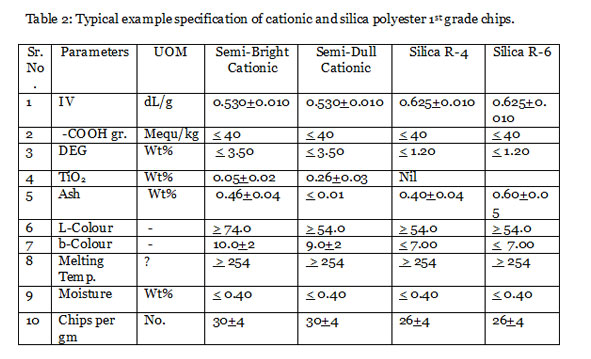
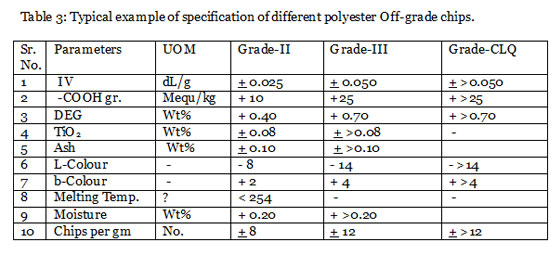
The key specification for gradation of chips is normally done on the test results of parameters like Intrinsic Viscosity (IV), -COOH group, DEG Content, TiO2/Ash Content, L & b-colour Values, Moisture Content, Melting Point and Chips/g besides physical observation. These parameters are being checked shift wise depending on testing plan which may vary from industry to industry. It may be one or two samples per shift depending on availability of manpower and the requirements from downstream process. Target values of all these parameters are depend on end application and the CP used for production of polymer chips. All these are not identical in all industry. Proper gradation of polyester chips is not merely a method of classifying material, it is an important quality-management and process control tool. Mostly used typical specification of different types of chips for gradation purpose are shown in Table-1 & Table-2. Target values as well as tolerance limit of 1st grade chips also may vary from organisation to organisation, consistency is being the most utmost importance. The off-grade chips are graded in another 2-4 categories like Grade-II, Grade-III, Grade-CLQ so on according to the type and severity of deviation from the normal production specification. This may not be same for all organization. In general, marginally outside the limit of 1st grade specification, may be released in Grade-II as per internal specification sheet.
Semi-Dull polyester chips is the most commonly used polyester chips in Indian Industry for the production of Semi-Dull POY and FDY products for using mainly for apparel application. Intrinsic Viscosity is the most important properties of polyester chips. IV is a fundamental measure of a polymer’s capability to increase the viscosity of a solution or melt. It is directly proportional to the polymer’s molecular weight and chain length. PET is a semicrystalline polymer. The degree of crystallinity depends on several parameters, such as the crystallization temperature, the molecular weight and the molecular weight distribution. A higher molecular weight induces a lower degree of crystallinity and more defects in the crystals [Baldenegro-Perez et al, 2014]. An increase in the degree of crystallinity, on the other hand, increases the yield stress and decreases the maximum elongation at break(X Lu et al, 2001).
In polymer chemistry and rheology, Intrinsic Viscosity is defined as the inherent specific viscosity as the solute concentration approaches to zero. Higher IV means higher polymer melt viscosity. Correct IV prevents melt fracture, erratic extrudate swell (die swell), and filament dripping at the spinneret, maintaining stable threadline tension. Higher IV yields longer polymer chains and stronger inter-molecular entanglements, providing higher tensile strength and elongation resistance in both Partially Oriented Yarn (POY) and Fully Drawn Yarn (FDY). POY requires a precise IV window (typically 0.620–0.640 dL/g) to ensure uniform drawability during downstream texturing without causing filament breaks or uneven dye uptake. FDY undergoes high-speed drawing in-line during spinning, requiring slightly higher or strictly uniform IV (typically 0.630–0.660 dL/g) to withstand extreme thermal and mechanical stresses on the godet rolls. In general, IV is being checked with either 0.5% or 1.0% concentration in the Industries. If it is checked at 1.0% concentration, the reported value of IV will be less by 8 to 10 points as compared to 0.5% concentration. Typical values of IV checked with 0.5% concentration of 1st grade chips of different lustre are given in the Specification sheet in Table-1. The Target value of IV may vary from Industry to Industry for 1st grade. The application of Semi-Dull, Hombright and Full-Dull in the apparel sector, while Full-Bright chips are in the Film application for packaging or jari sector. Slight lower IV is optimised in Full-Bright chips for film production for easy drawing during manufacturing stages. On the other hand, slight higher IV is maintained during Hombright to have optimum efficiency during production of FDY products, raw white as well as coloured products. Consistence IV in chips is required for POY / FDY products in the Spinning to avoid pack pressure variation for getting uniform dyeing behaviour in the final products. Tolerance limit of 0.010 are for releasing the chips product in 1st grade, but actually control limit of 0.003 is being normally maintained during chips production in CP.
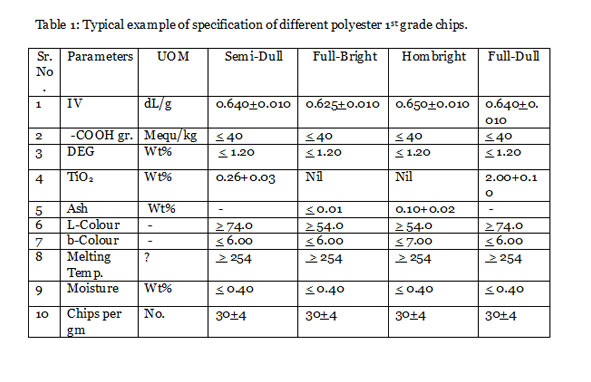
Cationic chips can be produced in both Batch Poly as well as in Continuous Polymerisation (CP) plant. But most successful cationic chips are being produced in Batch Poly. Sodium 5-sulfoisophthalate (SIPM) is used as third co-monomer for the production of Cationic Dyeable chips. Incorporating SIPA introduces ionic groups (–SO3Na) into the main polymer chain. During dyeing, the sodium ions (Na+) undergo an ion-exchange reaction with positively charged dye cations, forming a strong chemical complex. The copolymerization lowers molecular chain regularity and crystallinity compared to standard PET, increasing dye diffusion rates. Dyeing is normally carried out at 115-1200C. The specification of Cationic chips produced in Batch Poly are given in the Table-2. Normally lower IV in the range of average value of 0.530-0.540 are maintained in both Cationic chips for smooth drawing due to presence of branching of cationic salt.
Silica chips can be produced in both Batch Poly and CP Process. It is found to successful in both the cases. The specification of Silica Chips produced in CP process are given in the Table-2. Silica chips are used in the production of polyester film. Normally, core is made of bright polyester chips and Silica chips along with Bright chips are being used in top & bottom surface. Proportion of Silica chips is controlled to have required haze in the film. IV is maintained in lower side nearly similar to Full Bright chips.
In polyester spinning, end groups like carboxyl directly govern process stability, filament quality, and downstream performance. Too high end groups accelerates thermal and hydrolytic degradation during processing, reducing thermal stability.
Diethylene Glycol (DEG) is an inevitable byproduct formed during the synthesis of polyethylene terephthalate (PET) through the esterification and polycondensation of Purified Terephthalic Acid (PTA) and Monoethylene Glycol (MEG). Controlling DEG content is critical in fiber manufacturing, as its presence directly alters the chemical structure, thermal properties, and physical characteristics of Partially Oriented Yarn (POY) and Fully Drawn Yarn (FDY). Natural DEG in the range of 0.80-1.00% is observed in final chips of mostly all lustre expect cationic products. Additional DEG is added to maintain average DEG of 1.20% in some industries. DEG% is found to be in higher side in cationic products in the range of 2.50-3.50 depending on processing parameters and use of recycled EG in Batch Poly. Dyeing uniformity is a major concern in Batch Poly cationic products due to variation in DEG content. With increase in DEG content typically depresses the polymer melting point reduces, lowering the overall degree of crystallinity and crystal perfection. DEG is incorporated into poly(ethylene terephthalate) (PET) during industrial synthesis in order to control crystallisation kinetics. DEG is known to be a weak point in the thermal degradation of PET, which is problematic during the recycling of the polymer[A Helen et al, 2001]. The amorphous regions created by DEG make the polymer matrix looser, allowing dye molecules to diffuse more easily at lower temperatures. To achieve the uniform dyeing, maintaining of DEG in chips in a narrow range is the utmost important. Fluctuations in DEG content across polymer batches result in varying amorphous fraction sizes, leading to severe dye streakiness (barré effect) in the final fabric. Higher or fluctuating DEG levels lower the melt viscosity which leads to unstable melt tension at the spinneret, causing melt fracture, filament flickering, and increased yarn breakages. High DEG content significantly reduces FDY tenacity and modulus because the ether units weaken the overall molecular cohesion.
Titanium Dioxide is added as a delustrant agent in polyethylene terephthalate (PET) polymerization to eliminate the unwanted glass-like shine of raw polyester and control fibre opacity. Virgin PET polymer without any additives like TiO2 are naturally transparent and highly reflective.
Addition of different concentration of TiO2 during polycondensation determines the final optical classification of the polyester chip. In industry, generally 0.04~0.07% TiO2 is added for the production of Semi-Bright, 0.26 ~ 0.30% for Semi-Dull and 1.30 ~ 2.50% for Full-Dull polyester chips. TiO2 is not added for the production of Full Bright & Hombright chips. Full Bright chips are being used for the production of polyester transparent film, while Hombright chips are produced for POY/FDY production for apparel use. Normally average 0.08-0.10% Barium Sulphate is used in Hombright chips. Ash Content is considered for gradation in case of Full-Bright, Hombright and Silica Chips.
High positive b-values indicates thermal, thermo-oxidative, or catalytic degradation during esterification and polycondensation. It directly reflects the presence of chromophores formed by side reactions. In POY/FDY spinning consistent b-values ensure uniform optical properties across batches, preventing shade variations (barré) in knitted or woven fabrics. Normally, b-colour is maintained below 7.00 in all lustred chips produced in CP process, while it is maintained in the range of average 8.00-10.00 in Cationic products produced in Batch Poly. Higher b-value is crucial for grading in different grade in Downgraded materials, as shown in Table-3. Overheating the melt or long residence times in reactors accelerate thermal cracking and chromophore creation resulting higher b-colour in the polyester chips.
In polyester (PET) polymer, the L-color value is a crucial quality parameter. While the b-value monitors yellowing, the L-value measures lightness, brightness, and total light reflectance on a scale from 0 (pure black) to 100 (pure white). The L-colour is maintained the minimum of 54 in Bright, Silica & Hombright chips and 74 in Semi-Dull & Full-Dull chips in both CP & Batch Poly products. Maintaining L-colour in narrow range is very essential for using in the production of light dope dyed yarn. A high L-value means the polymer reflects more visible light, indicating superior brightness, transparency, and clean optical appearance. Thermal degradation, excessive residence times, or overheating during polymerization during start-up resulted drastically dropping the L-value. Catalyst precipitation imparts a dull causing L-coulor values to decrease significantly.
The melting point (Tm) of chips typically are in the range of 245°C and 260°C depending purity and additives used in the polymer. It serves as a fundamental benchmark for structural purity, thermal stability, and downstream processing conditions. Pure PET has a sharp, well-defined melting point around 258°C. Any presence of impurities, unreacted monomers, additives or side-reaction by-products like Diethylene Glycol (DEG) depresses the melting point. Melting point is maintained in the range of minimum 254°C in all lustred products produced in CP process, while it is maintained in the range of minimum 245°C in Cationic products produced in Batch Poly. Downstream processing of filament spinning, or film extrusion relies on precise temperature control. If the chip melting point fluctuates, then it is difficult to maintain stable melt temperatures, leading to unmelts or thermal degradation.
Moisture content in polyester (PET) chips is critical quality parameter controlling the performance and runnability of Partially Oriented Yarn (POY) and Fully Drawn Yarn (FDY) spinning lines. Although, the releasing norms of Moisture Content is 0.4% maximum in 1st grade, but actually it is maintained in the range of 0.10-0.20% in the final chips. PET can absorb moisture from the environment, and water molecules can promote PET degradation at high temperatures; hence, the polymer is commonly dried before melt processing [H Zimmetman et al, 1980].Because PET is a condensation polymer, residual moisture causes immediate hydrolytic degradation when heated above its melting point (~250°C) during extrusion in spinning. Each water molecule breaks a polymer chain, converting high-molecular-weight PET into shorter chain segments resulting reduced tenacity and inconsistent elongation-at-break properties of POY/FDY.
A systematic understanding of all the parameters enables manufacturers to optimise polymerisation conditions, minimise off-grade chips production and ensure consistent downstream spinning and processing performance. Continued improvement in process technology, quality monitoring and proper gradation will further enhance productivity, reduce waste and support the growing demand for high-quality specialised polyester products.
Proper classification of 1st and off-grade chips is very essential for achieving the required performance in the final polyester product. Polyester chips may vary significantly in their physical, chemical and thermal characteristics due to differences in polymerisation conditions, raw materials, residence time during manufacturing process. Therefore, systematic grading based on well-defined specifications is necessary before the releasing of chips for use in spinning and film production. A scientifically established grading system enables better utilisation of off-grade chips and ensures that the polyester chips supplied are fit for their intended applications. Proper gradation of chips also helps manufacturer / customer to determine the most suitable end use for a particular grade. The 1st grade chips can be used for applications requiring stringent quality, while off-grade chips may be used for less sensitive applications or blended with 1st grade material when technically accepted. Ultimately, proper and efficient grading of polyester chips contributes to improved required productivity, reduced waste, better product quality and economic efficiency throughout the polyester value chain.
Conclusion
A systematic understanding of polymerization parameters and rigorous chip gradation is essential for minimising waste and ensuring optimal performance in polyester yarn and film production. Proper quality control across all physical, chemical, and thermal metrics supports the growing demand for specialized polyester products across the textile value chain.
References
- Jiang, M.; Wang, X.; Xi, W.; Yang, P.; Zhou, H.; Duan, J.; Ratova, M.; Wu, D. Chemical catalytic upgrading of polyethylene terephthalate plastic waste into value-added materials, fuels and chemicals. Sci. Total Environ. 2023, 912.
- Sevigné-Itoiz, E.; Gasol, C.M.; Rieradevall, J.; Gabarrell, X. Contribution of plastic waste recovery to greenhouse gas (GHG) savings in Spain. Waste Manag. 2015, 46, 557–567.
- S. M. Aharoni, Industrial-Scale Production of Polyesters, Especially Poly(Ethylene Terephthalate), in Handbook of Thermoplastic Polyesters, Wiley-VCH Verlag GmbH & Co. KGaA, 2005, pp. 59–103.
- Baldenegro-Perez, L.A.; Navarro-Rodriguez, D.; Medellin-Rodriguez, F.J.; Hsiao, B.; Avila-Orta, C.A.; Sics, I. Molecular Weight and Crystallization Temperature Effects on Poly(ethylene terephthalate) (PET) Homopolymers, an Isothermal Crystallization Analysis. Polymers 2014, 6, 583–600.
- Lu, X.; Hay, J. Isothermal crystallization kinetics and melting behaviour of poly(ethylene
- terephthalate). Polymer 2001, 42, 9423–9431.
- Helene A. Lecomte, Jonh J. Liggat, Degradation mechanism of diethyleneglycol units in a terephthalate polymer, Polymer Degradation and Stability, 2006, 91, 681-689.
- Zimmerman, H.; Kim, N.T. Investigations on thermal and hydrolytic degradation of poly(ethylene terephthalate). Polym. Eng. Sci. 1980, 20, 680–683.
About the authors:
Dr Pankaj Gandhi is the Director of MANTRA, Surat, an autonomous body associated with the Ministry of Textiles, Government of India. With a rare interdisciplinary academic background, he holds three Ph.Ds—in Chemical Engineering, Civil Engineering, and HR Management—alongside M.Techs from CEPT University, BITS Pilani, and SVNIT (Gold Medalist), and an MBA from IIM Kozhikode.
Dr Soumyen Kumar Pal serves as Senior Marketing & Testing Executive at MANTRA, bringing over three decades of distinguished industry and research expertise to technical textiles and quality assurance. He holds a B.Text. from the University of Calcutta, an M.Tech. from TIT Bhiwani, and a Ph.D. from IIT Delhi.