


Amar Nagaram opines, the development of digitally enabled textile clusters, shared infrastructure platforms, and data-driven policy frameworks could create system-level efficiencies and resilience.
The Indian textile industry, one of the country’s oldest and most economically significant sectors, is undergoing a structural transformation. Contributing substantially to manufacturing output, exports, and employment, the sector spans a complex value chain, from fibre and yarn production to fabric processing, apparel manufacturing, and technical textiles. As global competition intensifies and buyer expectations evolve, traditional manufacturing models based largely on labor arbitrage and scale efficiencies are no longer sufficient to sustain long-term growth.
Against this backdrop, smart manufacturing has emerged as a critical enabler of competitiveness. Often associated with Industry 4.0, smart manufacturing integrates digital technologies, automation, and data-driven decision-making into production systems. For the Indian textile sector, the relevance of smart manufacturing lies not only in improving productivity and quality but also in addressing structural challenges such as resource inefficiency, sustainability compliance, supply chain transparency, and workforce transformation.
As India positions itself as a reliable, high-quality, and responsible sourcing destination, the adoption of smart manufacturing practices is increasingly viewed as a strategic necessity rather than a discretionary investment.
Trends in transition
Smart manufacturing in textiles is not defined by a single technology, but by the convergence of multiple digital and physical systems that collectively enhance operational intelligence and responsiveness.
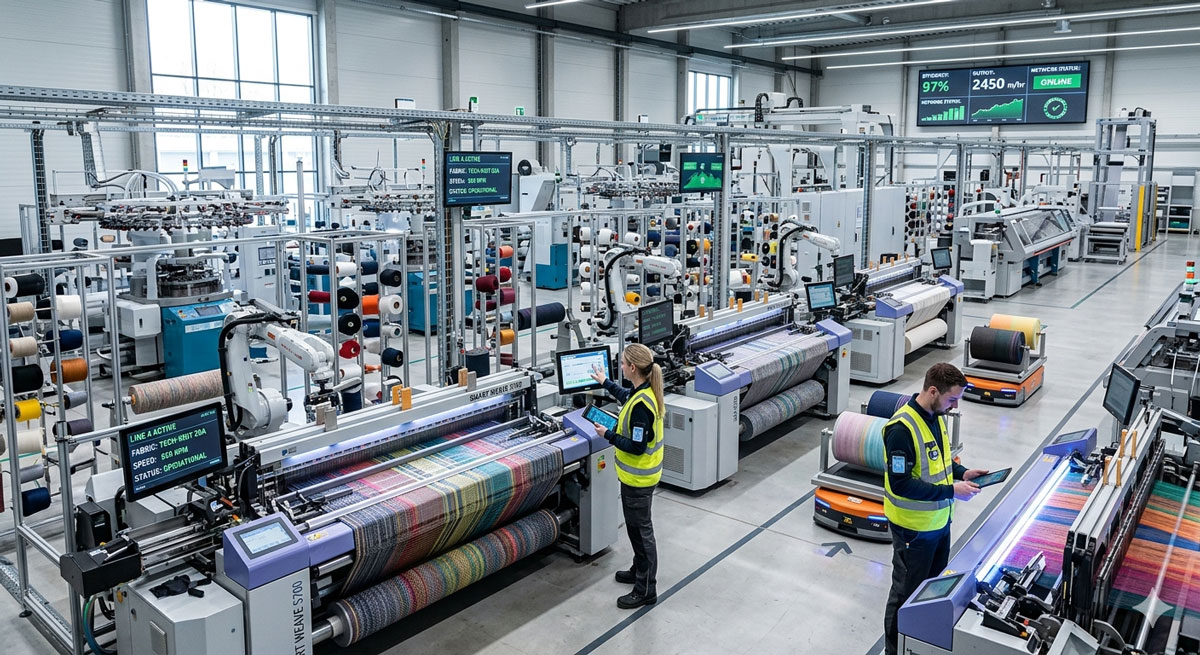
Automation and advanced machinery: Automation remains the foundation of smart manufacturing in textiles. Modern spinning, weaving, knitting, and garmenting machines are increasingly embedded with sensors, programmable logic controllers, and real-time monitoring capabilities. Automated material handling, robotic cutting systems, and semi-autonomous sewing units are gaining traction, particularly in export-oriented facilities where consistency and speed are critical.
While full automation remains limited in labor-intensive segments such as garment assembly, selective automation, focused on repetitive, precision-dependent tasks, has delivered measurable improvements in throughput and defect reduction.
IoT and connected factories: IoT plays a central role in enabling real-time visibility across textile operations. Sensors deployed on machines monitor parameters such as vibration, temperature, yarn tension, energy consumption, and machine uptime. This data is transmitted to centralised systems that provide operators and managers with actionable insights.
Connected factories allow for continuous monitoring of production efficiency, early detection of anomalies, and faster response to operational issues. In the Indian context, IoT adoption has been particularly strong in spinning mills and processing units, where machine performance and resource consumption significantly impact margins.
AI and advanced analytics: Artificial intelligence (AI) and machine learning are increasingly applied to optimise decision-making across the textile value chain. Computer vision systems are used for automated fabric inspection and defect detection, reducing dependence on manual quality checks and improving consistency.
Predictive analytics models help anticipate machine failures, enabling maintenance to be scheduled proactively rather than reactively. In production planning, AI-driven tools assist in optimising line balancing, minimising bottlenecks, and improving order fulfillment accuracy. These applications are gradually shifting manufacturing from experience-based management to data-driven operations.
Systems integration: Manufacturing execution systems (MES), enterprise resource planning (ERP), and supply chain management platforms form the digital backbone of smart manufacturing. Integration between shop-floor systems and enterprise-level software enables seamless data flow from production to procurement, inventory, and logistics.
Cloud-based platforms, in particular, have lowered entry barriers for small and medium-sized enterprises by reducing upfront infrastructure costs and enabling scalable deployment. Mobile dashboards and remote monitoring tools have further expanded access to operational data beyond factory premises.
Sustainable technologies: Sustainability has become a defining dimension of smart manufacturing in textiles. Digital technologies are being used to monitor and optimise energy, water, and chemical usage – especially in processing and dyeing operations, which are resource-intensive.
Advanced effluent treatment systems, smart water management solutions, and energy optimisation software contribute to lower environmental impact while improving regulatory compliance. Digital traceability tools, such as RFID and QR codes, support transparency in sourcing and production, aligning Indian manufacturers with global sustainability expectations.
Impact on the industry
The adoption of smart manufacturing technologies is reshaping the Indian textile industry across multiple dimensions.
Productivity and operational efficiency: One of the most immediate impacts of smart manufacturing is improved productivity. Real-time monitoring reduces unplanned downtime, while predictive maintenance minimises disruptions caused by equipment failure. Automated quality inspection and process control systems reduce rework and waste, leading to higher effective output from existing capacity.
Data-driven planning enables better synchronisation between different stages of production, reducing lead times and improving on-time delivery performance. These gains are particularly significant in export-oriented operations, where reliability and speed are critical competitive factors.
Quality and consistency: Smart manufacturing enhances product quality by reducing variability in processes. Automated inspection systems ensure consistent standards across batches, while data analytics help identify root causes of defects. Improved quality not only reduces rejection rates but also strengthens long-term relationships with international buyers who prioritise consistency and compliance.
Resource efficiency: Sustainability is no longer a peripheral concern for the textile industry. Smart manufacturing enables precise measurement and management of resource consumption, leading to significant reductions in energy use, water intake, and chemical waste.
Digital reporting and traceability systems also simplify compliance with environmental and social standards required by global brands and regulators. As sustainability becomes a key determinant of market access, smart manufacturing provides Indian textile firms with a pathway to align economic and environmental objectives.
Workforce transformation: The impact of smart manufacturing on the workforce is multifaceted. While concerns about job displacement persist, the more immediate effect has been a shift in skill requirements. Operators are increasingly required to interact with digital interfaces, interpret data, and manage automated systems.
This transition creates demand for upskilling and reskilling, particularly in areas such as machine diagnostics, data interpretation, and systems maintenance. In the long term, smart manufacturing has the potential to improve working conditions by reducing physically demanding tasks and enhancing occupational safety.
Challenges and opportunities
Despite its potential, the adoption of smart manufacturing in the Indian textile industry faces several challenges.
Key challenges: A major barrier is the high initial investment required for advanced machinery, sensors, and digital systems. For small and medium-sized enterprises, which constitute a large portion of the sector, access to capital remains a constraint.
Legacy machinery and fragmented production setups also complicate integration efforts. Many textile units operate mixed fleets of old and new equipment, making standardisation and data integration difficult. Additionally, gaps in digital skills and limited awareness of technology benefits can slow adoption.
Cybersecurity and data governance are emerging concerns as factories become more connected. Ensuring data integrity and protecting sensitive production information require new capabilities that many firms are still developing.
Opportunities for the sector: At the same time, smart manufacturing presents significant opportunities. Modular and scalable technology solutions allow firms to adopt digital tools incrementally, aligning investments with operational priorities. Government initiatives focused on manufacturing modernisation, infrastructure development, and skill training can further accelerate adoption.
From a market perspective, smart manufacturing enhances India’s positioning as a reliable and responsible sourcing destination. Firms that invest in digital capabilities are better equipped to meet evolving buyer expectations related to transparency, sustainability, and speed-to-market.
Long-term vision
Looking ahead, smart manufacturing is expected to become increasingly embedded in the Indian textile ecosystem. Emerging trends include greater use of digital twins for production simulation, wider adoption of AI-driven demand forecasting, and deeper integration between manufacturing systems and global supply chain platforms.
In the long term, the vision for smart manufacturing in India extends beyond individual factories. The development of digitally enabled textile clusters, shared infrastructure platforms, and data-driven policy frameworks could create system-level efficiencies and resilience.
As technology costs decline and digital skills become more widespread, smart manufacturing is likely to transition from a competitive differentiator to a baseline capability. The firms that succeed will be those that view digital transformation not as a one-time project, but as an ongoing strategic process aligned with productivity, sustainability, and workforce development goals.
Concluding note
Smart manufacturing represents a pivotal opportunity for the Indian textile industry to reconcile growth with efficiency, quality, and sustainability. While challenges remain, the direction of change is clear. By embracing data-driven manufacturing and aligning technological adoption with sector realities, the industry can strengthen its global relevance and build a more resilient future.
About the author: