


The rapid increase in market potential for industrial textiles and its application has led high profile manufacturers to develop specialised fabric for knitting and serve the end purpose efficiently in sectors such as agriculture, construction, geotextiles, automotive, protective apparel and electronics, affirms Abdulwahid Dadhiwale.
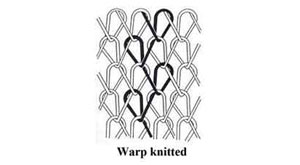
Knitting is one of the several ways to turn thread or yarn into cloth (compared to weaving, crochet). Unlike woven fabric, knitted fabric consists entirely of horizontally parallel courses of yarn. The courses are joined to each other by interlocking loops in which a short loop of one course of yarn is wrapped over the bight of another course. Knitting can be done either by hand, described below, or by knitting machine. In practice, hand knitting is usually begun (or "cast on") by forming a base series of twisted loops of yarn on a knitting needle. A second knitting needle is then used to reach through each loop (or stitch) in succession in order to snag a bight of yarn and pull a length back through the loop. This forms a new stitch. Work can proceed in the round (circular knitting) or by going back and forth in rows. Knitting can also be done by machines, which use a different mechanical system to produce nearly identical results.
The knitting process consists of interconnecting loops of yarn on powered automated machines. The machines are equipped with rows of small, hooked needles to draw formed yarn loops through previously formed loops. The fabric is designed to take force in two directions (0° and 90°). For this can be used roving of glass, high tenacity polyester, aramid or carbon as pillar threads and weft threads. These fabrics are used for reinforced composites. Considering though orientation of the force taking yarns (0°, 90°) this fabric is comparable to a woven fabric. However, there is the advantage that yarns are directly oriented and lie absolutely straight in the fabric. This means that there is no loss of tenacity as in the woven due to its crimp effect. Furthermore, the yarn-protective inlay system prevents all fibre damage.
Innovation
The 3D-glass textiles, manufactured on double needle bar high speed Raschel machines of LIBA find ever more fields of application within the area of composite materials, technical textiles.
Manufacturing properties
Made of 100 per cent e-glass, one uses the capillary function of the glass, i.e., when absorbing the resin, the commodity sets up itself automatically to the desired height.
Variety
Whether as isolation layer in the boat and container construction or as double-walled tanks, these so-called spacer fabrics perform particularly well. Caused by the fabric construction, after laminating, a more stable, lightweight and ductile composite develops.
Flexibility
Depending on the final product, the thickness of the fabric can be adjusted between 3-15 mm directly at the machine. By using a special design technique, a thickness of even 25 mm can be achieved.
Applications
- Composite reinforcements (Sandwich-constructions)
- Container
- Tanks
- Boats
- Aircraft
- Sport shoes
- Medical textiles and mattress
- Geotextile application
Geotextiles are permeable textile materials, which are designed for use in civil engineering applications such as erosion control, soil reinforcement, separation, filtration and drainage, etc. Geotextiles are forecasted to be the fastest growing sector within the market for technical textiles. At least 70 per cent of all geotextile fabrics fall into the category of nonwoven geotextiles and at least<